

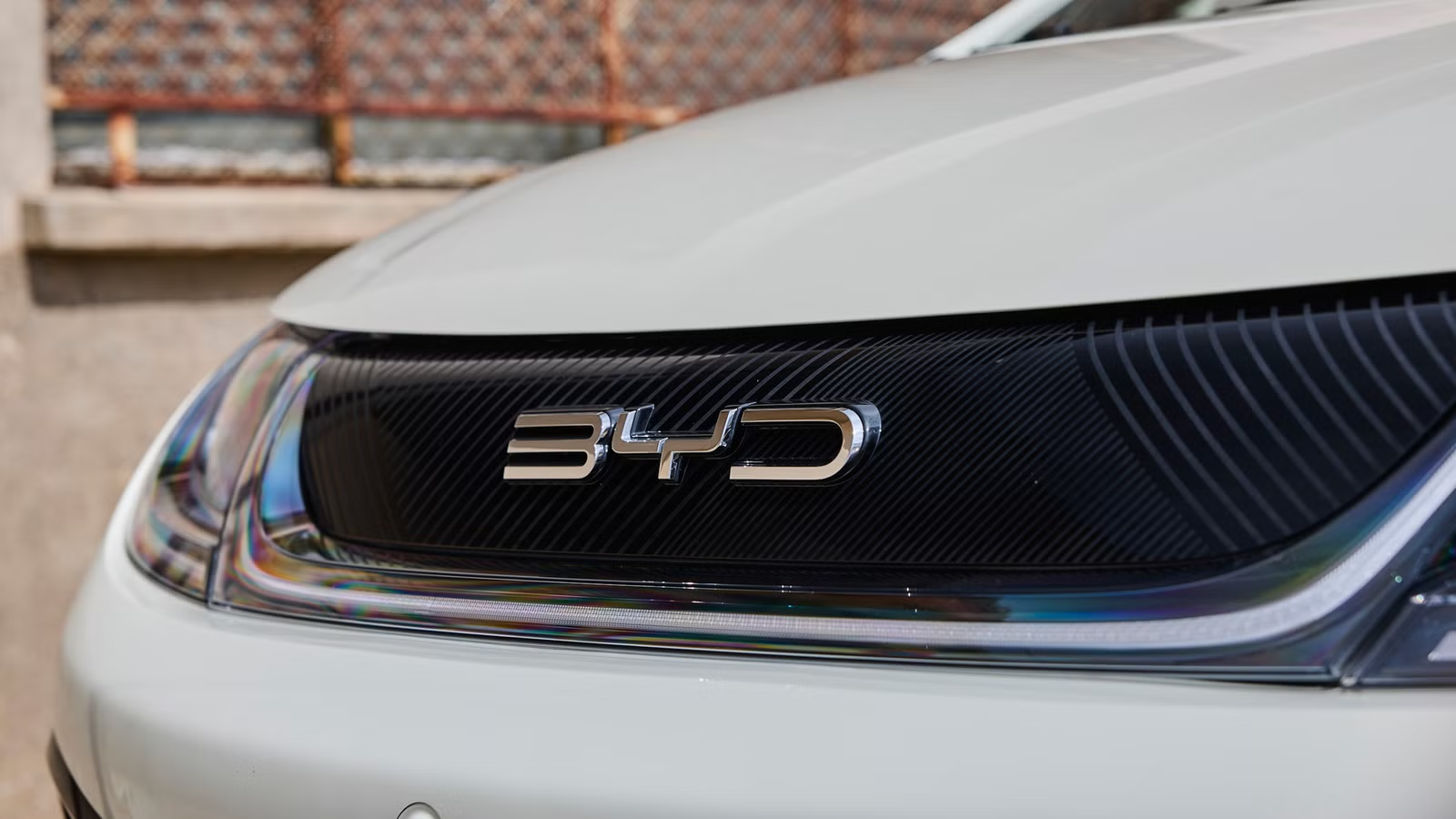
How much can we really know about the potential success of Chinese automotive brands, if they should figure out a way to sell cars in the US? It’s possible that President Trump would allow it if a Chinese manufacturer committed to building a US plant to assemble those cars with American workers. The only certainty is that China has produced more cars than it can sell in its existing markets and wants badly to penetrate the richest automotive market on the planet – the US.
Related
What You Really Want To Know About China’s Answer To Tesla
BYS is China’s best-selling EV brand – how does it really stack up against Tesla?
Gen Z Wants Chinese EVs
Audi E SUV ConceptAudi
Cox Automotive dug deep into this question and delivered scads of insights after surveying 802 American consumers and 132 franchised dealers, starting last October. Cox’s latest report, “Chinese Auto Brands: What US Consumers and Dealers Think – And What It Means if Entry Becomes Reality,” probably needs a shorter title, but it provides a glimpse into the psyche of American car shoppers, especially for EVs.
Key takeaways: 38% of consumer respondents would consider a car from a Chinese brand, and 69% of Gen Z EV-oriented shoppers are likely to consider a Chinese brand. BYD has the most brand awareness, as 35% of consumers are aware of this Chinese brand that sold more EVs last year than Tesla (2.3 million v. 1.6 million). To a lesser extent, the respondents recognize the Changan, Chery, and Geely brands, but how is it possible that 25 percent of survey participants know about Jetour? Chery Holding Group created the Jetour automotive brand in 2018 in China.
Profits Explain Dealer Disinterest?
Geely Yinhe L7 plug-in hybrid.Geely
On the retail front, 40% of consumers told Cox they are open to Chinese brands coming to the US, but only 15% of dealer respondents are supportive. Is it any surprise that dealers aren’t interested in selling low-priced, less-profitable Chinese cars? Perhaps dealer executives fear that Chinese cars will be low-quality and will cause headaches for service departments.
Or, it could be the exact opposite – selling cars built well enough to negate the need for a service department, where dealerships make most of their money. And it could be they view Chinese cars as an existential threat to the 18,000 franchised US car dealers in business today.
That concern must weigh heavily on retailers, in the same way that Japanese cars entering the US in the 1980s were a threat, and German luxury cars in the 1990s, and new and improved Korean cars in the 2000s, and so-on. There have been umpteen ways that car dealers (and, of course, domestic automakers) have adapted to shifting market dynamics, or left the game entirely. There were more than 22,000 franchised dealers in the US 20 years ago, according to Automotive News, while the Mercury, Oldsmobile, Plymouth, Pontiac, Saturn, and Scion brands all folded since 2000.
Price Is Driving Perceptions
Cox Automotive studied how US consumers and dealers perceive Chinese automotive brands.Cox Automotive
What also weighs heavily – but on consumers – is the cost of a new car in America, which has hovered an average of $50,000 for a few years. Three-quarters of US consumers say a new car is out of reach for them financially, and the average monthly payment is around $700. Some loans extend to more than 8 years, and the interest on those loans is crushing family bank accounts.
So is it any wonder that 49% of Cox consumer respondents perceive Chinese automotive brands as a “good value for money,” that 43% (see slide above) perceive them as “fuel efficient,” 41% see them as “technologically advanced,” or that 40% give them high marks for “innovation?” Mind you, none of these respondents have driven a Chinese car, so they can’t really answer the question about perception with any authority. But when a low price enters the conversation, it’s easy to understand how desperate car shoppers would respond this way.
Gauging Quality, Performance
BYD Seal Rear 3/4BYD Auto
Those US consumer thoughts on Chinese cars trail off a bit when asked whether they perceive those brands as reliable, fun to drive, safe, durable, environmentally friendly, good performers, or exhibiting high quality. But still, at least 32% of survey respondents rated Chinese cars as excellent or very good on those attributes, according to the survey. Again – without ever having driven a Chinese car.
When Americans hear that new cars from China could be half the price of current offerings, they explain quotes like these from survey respondents:
“I believe Chinese brand vehicles are reliable, modern, and worth considering so I am willing to try them out.”
Related
Apparently, Ford’s Solution To Beat China Is To Build Cars For Them
Are the joint venture tides rolling the other way?
‘Way Better Than American Cars’
Or, “Chinese vehicles are manufactured way better than American cars. They last longer and are built more durable with less breakdowns.” The survey goes further, using images of current Chinese and US cars – both unbranded and with visible branding – to gauge consumer response. The Cox study found that images of unbranded Chinese ICE vehicles from Geely and Chery stack up well against the ICE Chevy Equinox. And while the Geely Xingyuan EV is more appealing than the BYD Seagull – both from China – neither is as strong as the Tesla Model Y, the consumer study found.
Cox Automotive studied how US consumers and dealers perceive Chinese automotive brands.Cox Automotive
And here’s the chart (above) that explains US consumer interest in Chinese cars, whether all-electric or ICE. Cox shows the Geely Xingyuan EV costing $15,000 compared to a $40,000 Tesla Model Y. Are Americans willing to accept 84 horsepower and 255 miles of range? Maybe at that price. Likewise, the ICE Chery Tiggo 4 crossover costs $16,000 with 145 horsepower, compared to $28,600 for a base ICE Chevy Equinox 175 horsepower. If Chinese cars like these become available in the US market, it will be interesting to see where these prices actually land.
While the study finds older Boomers with more money are less interested in Chinese cars, the enthusiasm from Gen Z poll respondents suggests there could be pent-up demand for EVs in the US, but they need to be less expensive than even the $30,000 Chevy Bolt and Nissan Leaf. If young consumers love the quality and price of Chinese laptops, smartphones and $200 50-inch televisions from Costco, then a Chinese car has a chance in America.
Ssource: Cox Automotive
