

It started with a single horseless carriage and a meter ticking away on the streets of Stuttgart. In 1897, Gottlieb Daimler’s Victoria became the world’s first taxi, fitted with the world’s first taximeter to measure time and distance traveled. Its top speed was a modest 11 mph — barely faster than a brisk jog — but it was enough to spark an industry. The well-heeled novelty-seekers of Stuttgart could hardly have imagined what would follow. Two decades later, the more affordable Ford Model T democratized the taxi trade, turning it into a genuine transport alternative for people from all walks of life.
More than a century on, the taxi is woven into the fabric of cities across the globe — from the yellow cabs of New York to the tuk-tuks of Bangkok. The options have never been more varied: big ones, small ones, luxury ones, and stripped-back workhorses. Electric taxis, hybrids, and traditional internal combustion engines all share the road. Covering thousands of miles every month, a modern taxi demands one thing above all else: reliability. This list covers some of the most dependable taxis you can catch a ride in from around the world — including a few that will genuinely take your breath away.
For this list, we had a peek around the globe at some really popular and reliable taxis, focusing on some regular examples, but also some more exotic options. Although reliability combined with low running costs are obviously more important than horsepower in the world of taxis, we included the maximum power as a reference… power is always important, anyway. The places mentioned under each heading are not the only places these taxis are found.
Toyota Corolla 1.8
South Africa, Oman, Indonesia
The Toyota Corolla 1.8 may be as boring as watching paint dry, but it is highly reliable, offering low running costs, good fuel consumption, and very reasonable comfort levels.Wikimedia Commons
Engine
1.8-liter Inline-4
Power
140 hp
Torque
105–127 lb-ft
MPG
30 (estimated)
Is there a car more perfectly suited for the taxi job than a Toyota Corolla? Probably not. The Corolla combines a comfortable, refined ride with low running costs, strong fuel economy, and adequate performance. It is a breeze to drive in heavily congested city centers, and its reliability is legendary — the chances of it leaving a driver and passengers stranded by the roadside are, well, extremely slim. The only real excitement comes at the end of the month when the maintenance bill arrives and you realize you barely spent a cent. It is simply a very capable, if unspectacular, choice — not that passengers tend to complain.
London Taxi Company TX4
Formerly London, Europe, China, Parts of Australia
London’s famous Black Cab, a car designed from scratch to be only a taxi, is still a common sighting on English roads.Wikimedia Commons
Engine
2.5-liter, turbocharged, inline-4 diesel
Power
101 hp
Torque
177 lb-ft
MPG
25 (estimated)
The London Taxi Company’s TX4, which has been around since 2007, is the only taxi in this line-up that was designed from the ground up to serve a single purpose: ferrying passengers. And yes, it may resemble a hearse of sorts, but the interior is purpose-built around the business of moving people through the City of London over short distances. There is a generous amount of space for customers, and suicide rear doors make getting in and out more convenient. Power comes from a VM Motori 2.5-liter turbodiesel engine, with a choice of five-speed manual or five-speed automatic gearbox. The TX4 had a top speed of around 80 mph, and although it was replaced in London in 2017, it continues to serve in several other territories.
Ford Crown Victoria
Belarus, Armenia, Ukraine
The Ford Crown Victoria cabs are synonymous with New York, where they served for many decades. It is powered by a 4.6-liter V8, no less.Wikimedia Commons
Engine
4.6-liter V8
Power
239 hp
Torque
281 lb-ft
MPG
20 (estimated)
How far can a Ford Crown Victoria taxi go? Apparently more than one million miles on its original engine — that’s what one New York cab is said to have covered, running 24/7. Back in the early 2000s, Ford’s engineers fitted a 239-hp V8 to the Victoria, partly because it doubled as a popular police interceptor that demanded both reliability and pace. For taxi duty, Ford revised the gear ratios on the rear differential and four-speed automatic gearbox, stretching them out to help with fuel consumption in stop-and-go city traffic. The Crown Vic became as much a part of Manhattan’s identity as the Empire State Building or Times Square. Production ended in 2011, but the last examples reportedly only retired from taxi service in 2024 — a remarkable final chapter for an American icon.
Toyota Prius
Japan, Canada, Australia
The Toyota Prius hybrid has come a long way since the first model was launched in 1997. The latest hybrid not only has a combined 194 hp in the tank, it looks pretty fine too. It’s really the ideal base for a taxi.Wikimedia Commons: ANCreviews95
Drivetrain
2.0-liter Inline-4 and electric motor
Power
152–194 hp (combined)
Torque
139 lb-ft
MPG
57 (claimed)
Once upon a time, the Toyota Prius was powered by a peculiar hybrid drivetrain and styled in a way that made onlookers wince. The latest generation is a different story entirely: genuinely good-looking, practical, and packing 194 hp while returning more than 50 MPG. It is also an ideal taxi platform, and is used as such in several territories, including Singapore. Spacious and running on proverbial fumes, the Toyota delivers a very comfortable ride and has proven it can go the distance, with several units said to have exceeded 500,000 miles. The one caveat is the lithium-ion battery pack, which has a finite lifespan and will typically need replacement at around 200,000 miles. Beyond that, it is as close to bulletproof as a taxi gets.
Hindustan Ambassador
India
Engine
1.5-liter Inline-4, diesel
Power
40–70 hp
Torque
64–91 lb-ft
MPG
32 (estimated)
The Indian-made Hindustan Ambassador was first introduced in 1957, based on the British Morris Oxford and celebrated as “the king of Indian roads” — a title earned in part because it was a locally manufactured product. The original Morris was designed by Sir Alec Issigonis, who also gave the world the Mini. Thanks to its clever platform design, the Ambassador’s interior was surprisingly spacious for its era. Several engines were offered over the years, including a 1.5-liter diesel producing 40 hp — the first diesel car available in that market. The government restricted diesel variant sales to government departments and taxi operators, and so the legend of the diesel Ambassador taxi was born. Robust, tough, and blessed with that roomy cabin, the 1.5 DSL became something of an institution on Indian roads.
Ford Escape Hybrid
USA
The Ford Escape hybrid was the first hybrid to go into official taxi status in New York, with units often exceeding 400,000 miles.Wikimedia Commons
Drivetrain
2.5-liter Inline-4 and electric motor
Power
192 hp
Torque
155 lb-ft
MPG
32 (claimed)
The 2004 Ford Escape Hybrid became the first hybrid-powered taxi approved for commercial service in New York City. It is powered by a 2.5-liter Atkinson-cycle inline-four paired with an electric motor — a hybrid system essentially similar to what Toyota uses in the Prius, made possible because Ford licensed a number of Toyota’s patents. The hybrid transaxle was supplied by Aisin, a Japanese transmission manufacturer with ties to Toyota, and Sanyo reportedly provided the battery pack. The result was a highly reliable SUV taxi, with many examples reportedly clocking more than 500,000 miles in service.
Tesla Model Y
China and Japan
A number of electric Tesla models are used in the business of taxi driving, with the Model Y offering a practical compromise between space and EV range.Wikimedia Commons
Motor
Single electric motor
Power
280–295 hp
Torque
310 lb-ft
Range
300 miles (estimated)
The Tesla Model Y arrived in 2020 and wasted little time making history: by 2023 it had outsold the Toyota Corolla to claim the title of best-selling car in the world, with a reported 1.2 million units. Tesla followed that up by selling more than 1.7 million Model Ys in 2024, cementing its status as the best-selling EV of all time. The entry-level Model Y runs a single rear-mounted electric motor with around 300 miles of range and 280 hp on tap, enabling a 0–60 mph sprint of roughly six seconds — handy when a passenger is running late. The Model Y is already in active taxi service in New York, and it seems only a matter of time before it spreads to other markets.
Gravity Ford Mustang Mach-E
USA (NY)
EV taxi company Gravity runs a fleet of Ford Mustang Mach-E cars in New York.Gravity
Motor
Single electric motor
Power
266 hp
Torque
317 lb-ft
Range
250 miles (estimated)
New York City’s Taxi and Limousine Commission has licensed Gravity Technologies to run a new EV taxi program, deploying both the Tesla Model Y and the Ford Mustang Mach-E on city streets. The Mustang Mach-E Select model is powered by a single rear-wheel-drive electric motor producing 266 hp, making for brisk performance in urban traffic. Its range of around 250 miles trails the Tesla slightly, but Gravity has kept fares in line with standard NYC taxi rates. Rear-seat passengers get a custom 22-inch monitor offering music, media, and a photo booth — a nice touch. Gravity’s EVs can be hailed on the street or booked through an app, and they look set to be a fixture on New York’s streets for years to come.
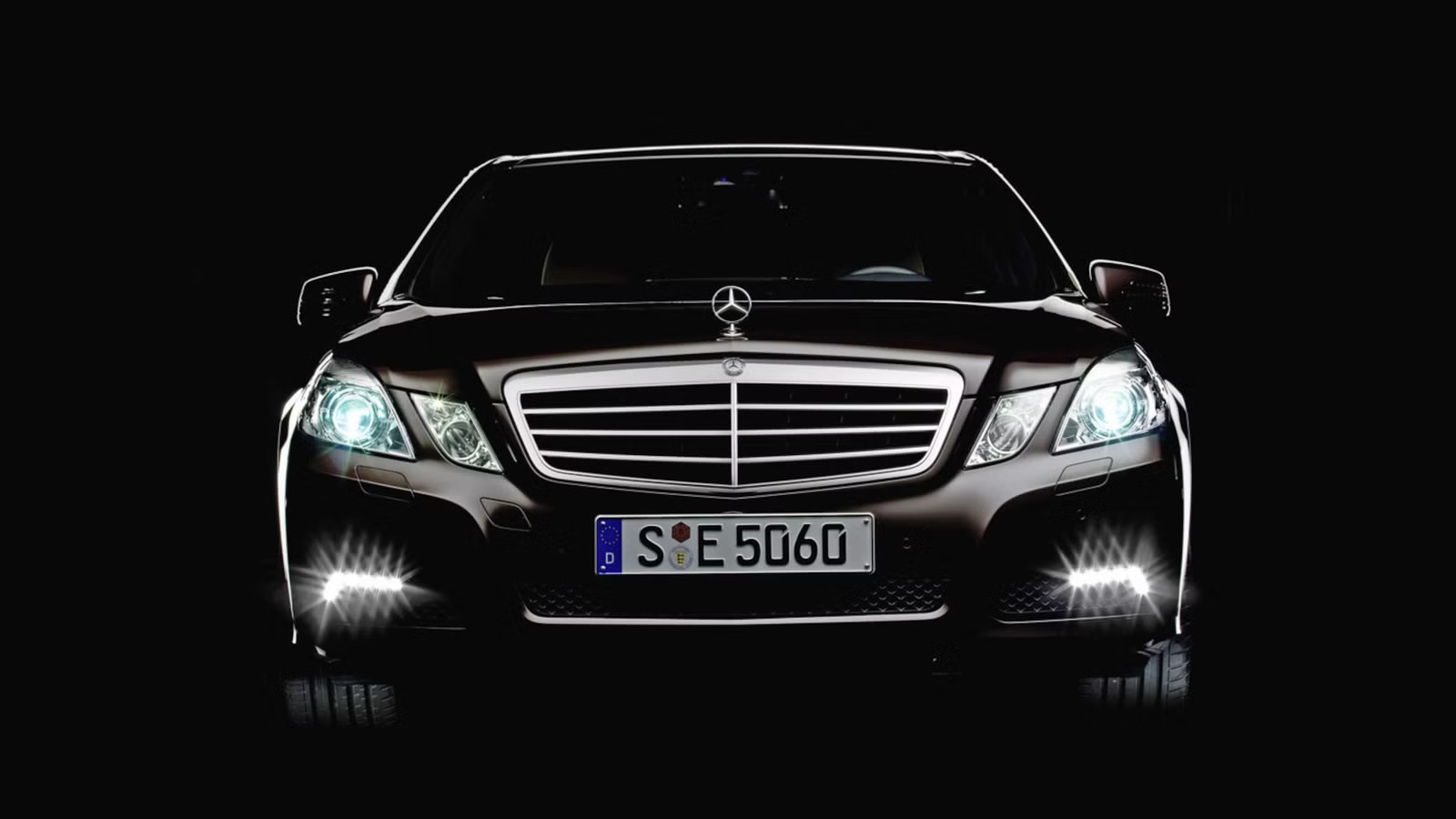
Mercedes-Benz E-Class
Germany, Austria, Cyprus
For many decades, the Mercedes-Benz E-Class was a popular taxi option in Germany. But e-hailing apps have, in more recent times, seen the demand for discounted E-Class taxis slow down to a trickle.Wikimedia Commons
Engine
2.0-liter turbocharged Inline-4, mild hybrid
Power
201–255 hp
Torque
236–273 lb-ft
MPG
41 (estimated)
For many decades, the Mercedes-Benz E-Class has been a staple of the taxi trade in and around major German cities, aided in part by Mercedes-Benz reportedly offering the big sedans at reduced rates to professional drivers and taxi operators. The E-Class offers generous space for passengers, who are cocooned in genuine luxury in the rear. The E200 has been a popular entry-level choice, with its turbocharged 2.0-liter four-cylinder producing 201 hp — enough to hold its own on the Autobahn while still returning around 40 MPG. Over the past decade or so, the rise of e-hailing services has dented E-Class taxi numbers in Germany, but the model remains a common and dependable sight on city streets.
Porsche 911 GT3 RS
Nürburgring, Germany
Meet the fastest taxi in the world, the Porsche 911 GT3 RS. For around $800 per Nürburgring Norschleife lap, it is also one of the most expensive.rent4ring.com
Engine
4.0-liter flat-6
Power
525 hp
Torque
343 lb-ft
MPG
8 (estimated)
Prius, Ambassador, EV? All a bit dull and boring, right? Well, here’s something to straighten the taxi equilibrium: the Porsche 911 GT3 RS. Based at the infamous Green Hell racing circuit in Germany — considered by many to be the most challenging and dangerous track in the world — you can rent a Porsche GT3 RS for around $800 per lap. Companies like Ring Taxi and Rent4Ring offer the GT3 as a rental, and clients can choose to either drive themselves with a professional instructor alongside, or simply hold on tight while a pro driver chases the Porsche’s 9,000 rpm redline. In short, the 911 GT3 RS combines blistering speed with remarkable reliability, running lap after trouble-free lap around The Ring. Who said taxis are boring when there’s a GT3 RS in the game!
Sources: Ring Taxi, Rent4Ring, London Taxi Company, Toyota, Ford, Mercedes-Benz, Tesla, Gravity Technology.
