

Toyota is one of the world’s largest automotive manufacturers, with a broader product lineup than many others could even imagine. It offers everything from comfortable commuters to back-to-basics sports cars, and even extreme off-roaders, with bare-bones utility pickups thrown in for good use.
But elsewhere in the world, Toyota offers or has offered dozens of models that you’ve likely never heard of, and are likely never to see unless you spend some time in some truly foreign places.
Toyota Alphard
Toyota has produced some awkward-looking vehicles over the years, but the equally awkwardly named Alphard may take the cake. The full-size luxury van is available in a seven- or eight-seat configuration with three engine choices and either front- or all-wheel drive. But the styling is what makes the Alphard most memorable. Visually, it embeds itself into your memory as if burned into your eyeballs with acid. Whilst it might not be the most stylish Toyota around, it does make for a comfortable ride that would put the limos available in the US to shame.
Toyota Avanza
Toyota boasts a strong presence in emerging third-world countries, particularly those that promote private means of transport. However, the Toyota Avanza is one model that caters to semi-public transport by offering a seating capacity for seven people, resulting in frequent use as a taxi cab in markets such as Indonesia and South Africa, where it’s particularly popular. Designed by the Toyota subsidiary of Daihatsu, the minivan is front-engined and rear-wheel driven, but don’t expect great driving dynamics. It’s tall and boasts soft suspension, designed to cater to high occupancy and poor road surfaces.
Toyota Aygo
The Aygo is a city car sold predominantly in Europe by Toyota. It’s the fruit of a three-way development plan with French brands Citroën and Peugeot and shares underpinnings with the Citroën C1 and Peugeot 108 city hatches. The Aygo’s name is a play on “I go”, and is designed to appeal to a younger generation of buyers than many of their other vehicles. As such, the second generation was designed with an almost cartoonish face, with inspiration for the design being taken directly from Japanese manga comics for their youthful appeal. The newest version of the Aygo, the Aygo X, continues this trend, but it’s also grown in size, as most nameplates usually do.
Toyota Crown Majesta
The Toyota Crown Majesta was a full-size luxury sedan that had been in production since 1991. The flagship had been sold exclusively in Asia, with its underpinnings being closely related to those found under the skin of the Lexus GS – albeit stretched for greater interior room and luxury. It shared much with both the GS and Lexus LS, including the 4.6-liter V8 engine shared by all three at some point, though the Crown Majesta is exclusively all-wheel drive and later switched to hybrid options before being discontinued in 2018 to make way for the Crown we know today.
Toyota Etios
The humble Etios is a budget Toyota hatchback and sedan aimed at select Asian markets like Indonesia, as well as other developing markets such as South Africa and Brazil. It’s a front-drive compact powered by a 1.5-liter four-cylinder engine with modest outputs and a frugal outlook on fuel economy. The Etios is a far cry from the lavish offerings we get here – compared to US-spec Toyotas, it’s downright poverty-spec – but in many countries, it provides an affordable means of transport with low running costs.
Toyota Harrier
Since 1997, Toyota has sold the Harrier mid-size crossover in Japan. When exported to the rest of the world, the Harrier was badged as the Lexus RX. At that stage, Lexus wasn’t sold in Japan. But when the third-generation Lexus RX was launched in Japan, the Harrier evolved into a standalone model based on its own platform, one that later turned into our second-gen Venza. That said, it retains many visual links with the Lexus RX. Powering the Harrier are a range of four-cylinder engines – naturally aspirated, turbocharged, and hybridized for various applications – all of which are mated to a CVT gearbox.
Toyota HiAce/Quantum
The Toyota HiAce, or Quantum in some markets, is a large van available in several configurations. It can be had as a panel van or a passenger van, with varying wheelbases, seating orientations, and roof heights, making it practical as both a people mover and a work van. The Quantum finds particularly high usage in commercial applications when it comes to ferrying people, with the van finding use as the main form of public transport like ‘taxis’ in South Africa and other markets.
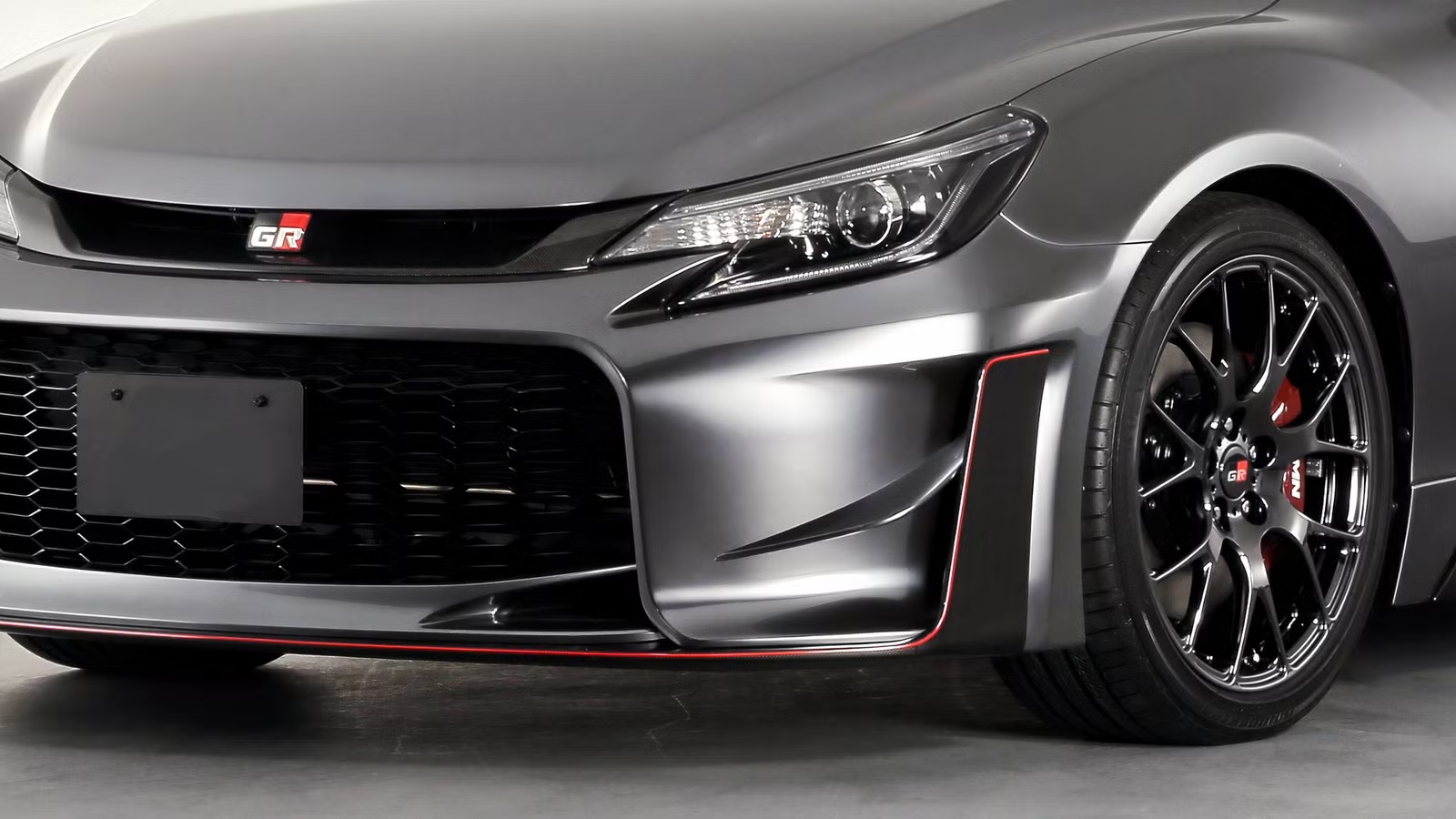
Toyota Mark X
Toyota’s Japanese product lineup is extensive, catering to a range of buying needs. The Mark X caters to the mid-size market and has done so since 2004. But it’s not entirely foreign, as it shares a large portion of its underpinnings, including engines, with the Lexus IS, RC, and GS sedans and coupe models. Under Toyota’s GRMN performance division, a manual gearbox is offered, though in standard guises, a range of V6 motors are paired with automatic gearboxes for a luxury-orientated mid-size sedan.
Toyota Rush
The Toyota Rush is a compact crossover and a product of badge engineering. It’s actually a Daihatsu Terios beneath the badge, but was released as a Toyota in Indonesia due to the brand’s strength in the Indonesian market. A 1.5-liter inline four-cylinder engine does duty under the hood, driving either the rear or all four wheels. Smaller than the Toyota RAV4 and C-HR, the Rush closely rivals vehicles like the Ford EcoSport.
Toyota Yaris XP150
You’re familiar with the Yaris nameplate – it was sold in the USA after all. So why is it appearing on this list? Well, in Thailand, South Africa, and a couple of other markets, there’s an altogether different Yaris available. It’s built larger than the locally available Yaris, with fairly striking design elements such as Corolla-inspired headlights and taillights. Available in hatch and sedan form, it’s actually more of a real Yaris than the Yaris we get – as these models, formerly sold as the Scion iA, are actually based upon Mazda underpinnings.
Sources: Toyota
