

BMW pretty much birthed the sports sedan market when it introduced its M3 and M5 models during the 1980s, the vehicles combining sports car-like performance with the practicality of a family sedan. The sector built in popularity during the 1990s and 2000s, and remains a lucrative part of the automotive market in 2026. From the early days of BMWs sporting models, manufacturers around the world recognized their potential and rushed to bring out their own models.
Mercedes-Benz, which focused on higher-end luxury cars prior to the 1980s, has remained a thorn in BMW’s side ever since it unleashed the C36 AMG to attack the M3 in 1993. With the E46 M3 raising the bar upon its launch in 2000, Mercedes’ reply now represents a used bargain.
BMW and Mercedes-Benz Cover Two Sides Of The Same Coin
It goes without saying that both the E46 M3 and the W203 C55 AMG are quick cars, with both sending well over 300 hp to the rear wheels. They also come with sports-tuned suspension to ensure they hold the road as well as possible, though they don’t necessarily use it the same way. They go about it in different ways, however. The C55 is equipped with a large, lazy 5.5-liter V8 that produces 362 hp. The BMW is powered by a highly-strung 3.2-liter inline-6 with 333 hp on tap.
While the M3 is set up to feel as agile and responsive as possible, the C55 AMG takes a smoother and more comfortable route.
While still designed to hold the road well and give confidence to its driver, it comes with softer suspension that is tuned to be more compliant on the road, which affords it a more comfortable ride. This does take away some responsiveness though, which tends to be the reason the M3 is held in higher regard as a pure performance car than the Merc.
The M3 Is Built To Be More Balanced
Aside from the suspension, BMWs M Division also worked hard to ensure the M3 had a perfect 50/50 weight distribution. The closer to 50/50 a car can be made, the more balanced it’ll be through the corners. The M3 utilizes a naturally aspirated straight-six engine, while the Merc gets a bigger and heavier V8. With both placed out front under the hoods of their respective hosts, they are part of the reason the M3 has a weight distribution of bang on 50/50, while the C55 AMG has to make do with a 56/44 ratio. Just because the M3 is superior dynamically, doesn’t necessarily mean it’s better for everyone than the more comfortable Merc.
The C55 AMG Is Significantly More Powerful
While the more comfortable ride of the C55 AMG is a compelling selling point for enthusiastic drivers who also want a taste of the high life, the C55 AMG also pleases those who want a potent engine. Its naturally aspirated 5.5-liter V8 brings a handy 362 hp to the party, as well as 376 lb-ft of torque. This puts it well clear of its M3 foe, which can ‘only’ muster up 333 hp and 262 lb-ft of torque.
The M3 does weigh around 125 pounds less though, which allows it to reach 60 mph in 4.8 seconds – a fraction quicker than the Merc at 4.9 seconds. The M3’s relative lack of weight, something lowered even more with the valuable CSL variant, adds further, well, weight, to the respective philosophies the two German automotive giants followed with their sports sedans. This is illustrated even more by the transmission options available with both models.
The M3 is only available with a pair of six-speed manual gearboxes, a traditional H-pattern unit, and a semi-automatic SMG. The C55 AMG, on the other hand, is only available with a five-speed automatic gearbox, which can be controlled manually via buttons behind the steering wheel.
Mercedes-Benz Didn’t Get Lazy With The C55 AMGs Underpinnings
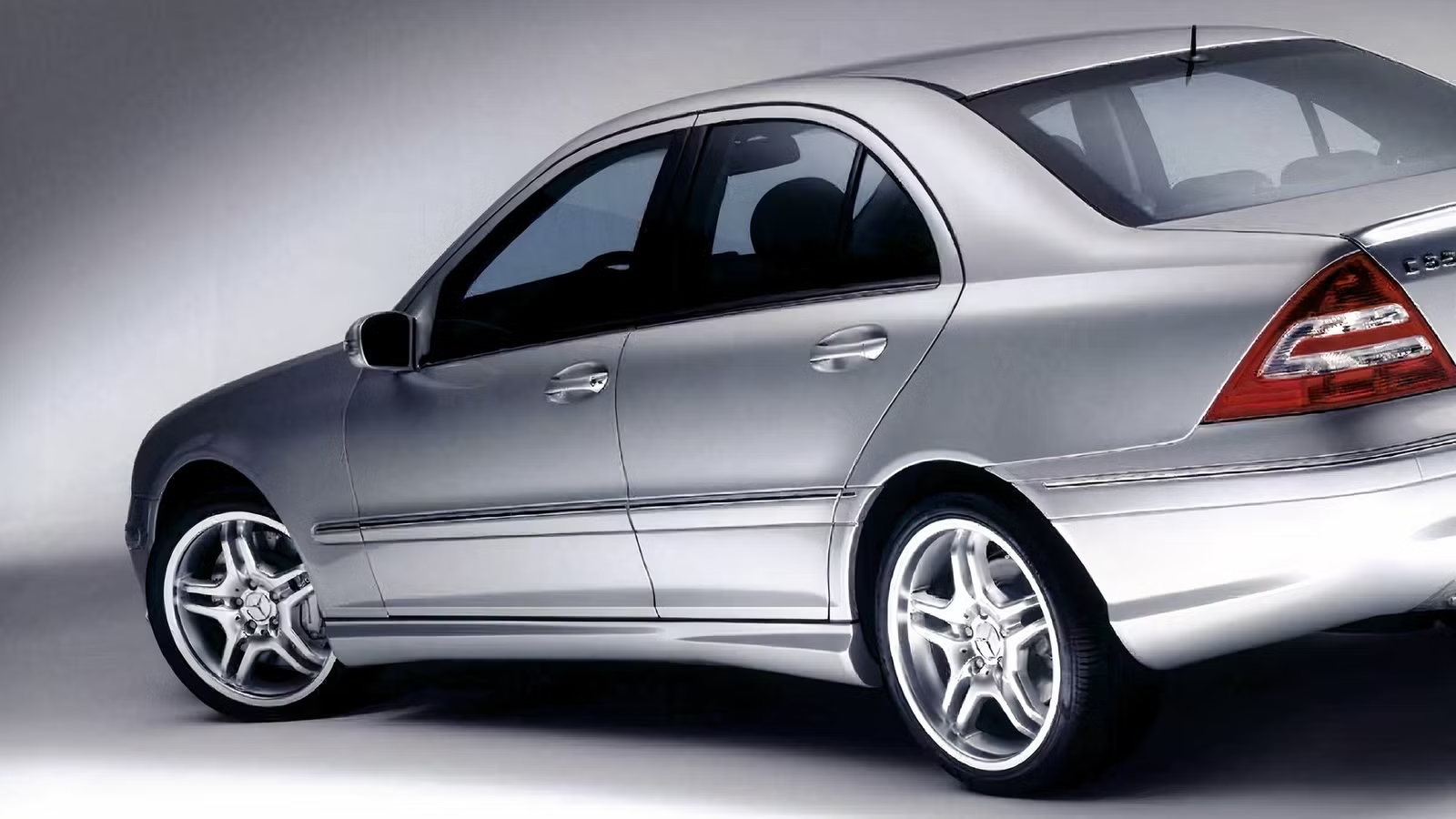
Silver 2005 Mercedes-Benz C 55 AMG side viewMercedes-Benz
Just because the C55 AMG isn’t as dynamic in the handling department as the M3, doesn’t mean it isn’t as sophisticated under the metal. It gets independent suspension on each corner, which is backed up by AMG-tuned gas-pressurized shock absorbers. It also comes with an AMG-tweaked electronic stability system, which works out in real time how much power and braking to send to each wheel.
The system helps to prevent understeer or oversteer through a corner, allowing even the most ham-fisted pilots to pretend they’re George Russell. As the cherry on the cake, the C55 AMG comes with an AMG-developed four-piston disc braking system, which comes with ventilated rotors to help keep the discs cool under heavy punishment.
You’ll Have Some Money Left In Your Back Pocket Should You Opt For The C55
Close
The Mercedes-Benz C55 AMG (W203) stands out as one of the best value-for-money modern classics on the market, typically fetching between $12,000 and $18,000 for well-kept examples. Produced in limited numbers from 2005 to 2007, it offers exceptional performance per dollar, but its market values remain significantly lower than its primary contemporary rival, the BMW E46 M3. Today, clean driver-condition E46 M3s command between $25,000 and $40,000, while pristine, low-mileage manual examples routinely surpass $50,000 to $70,000.
This substantial price gap stems largely from differing enthusiast appeal and heritage. The E46 M3 earned legendary status through its high-revving S54 inline-six engine, sharp track-focused chassis, and availability with a proper six-speed manual transmission, making it a darling of collectors and purists alike. By contrast, the C55 AMG was equipped exclusively with a 5-speed torque-converter automatic, leaning into its identity as a effortless, high-speed V8 cruiser rather than an apex hunter. However, the C55 holds a distinct edge in ownership reality: powered by the naturally aspirated 5.4-liter M113 V8, it boasts exceptional reliability compared to its high-strung BMW counterpart. While the E46 M3 wins on investment appreciation and handling dynamics, the C55 AMG delivers raw V8 thunder and practical everyday performance for roughly half the price.
Sources: Mercedes-Benz, BMW
