

If you’ve ever wished you could buy one electric vehicle that could evolve with your needs instead of replacing it every time your use case changes, a Canadian company thinks it has the answer.
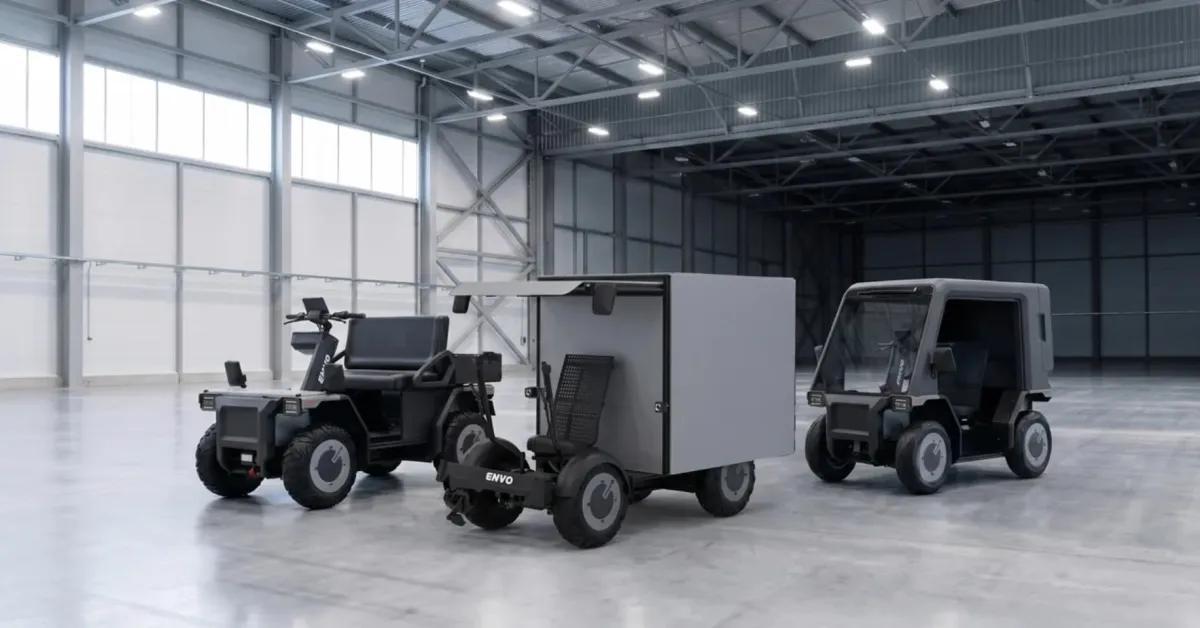
ENVO Drive Systems has unveiled its new Utility Personal Transporter (UPT), a modular electric vehicle platform that can be configured into as many as 18 different vehicle types, with even more combinations possible through optional accessories and upgrades.
Instead of building separate vehicles for every application, ENVO has designed a common chassis that buyers can customize into everything from a low-speed vehicle (LSV) and golf cart to a cargo hauler, utility ATV, or industrial transport vehicle.
Think of it almost like a skateboard chassis, but instead of for cars and trucks, it’s intended for every other type of smaller and more customizable electric vehicle.
The company says buyers can either start with one of several pre-configured models or build their own from scratch using an online 3D configurator. The system allows customers to choose different chassis layouts, drivetrains, battery packs, steering systems, wheels and tires, seating arrangements, cargo beds, bumpers, chargers, and other accessories.
ENVO likens the experience to building with LEGO bricks, while also comparing the concept to IKEA’s approach to modular furniture.
According to ENVO founder Ali Kazemkhani, the goal is to rethink how light electric vehicles are designed and sold.
“Most manufacturers sell one vehicle for one job. With UPT, we build one platform that users can tailor into the perfect vehicle for what they need today and adapt for what they may need tomorrow.”
The company says the platform has spent four years in development and is intended to solve one of the biggest challenges facing niche electric vehicles: low production volumes. By mass-producing a common platform and allowing customers to customize it afterward, ENVO believes it can offer purpose-built functionality without the high price tag that usually accompanies specialized vehicles.
Depending on the final configuration, the UPT is expected to include features such as modular battery packs, optional four-wheel drive, individual wheel traction control, crawl mode, over-the-air software updates, smartphone integration, accessory power outputs, solar charging readiness, IP67-rated environmental protection, and even preparation for future remote or robotic operation.
Pricing is expected to range from around US$8,000 to US$12,000, depending on the selected configuration.
ENVO envisions the platform serving a surprisingly broad range of applications, including farms, resorts, warehouses, airports, municipal fleets, construction sites, campuses, delivery operations, recreation, security, and even mobile businesses such as coffee carts.
Pre-orders are now open, with production slated to begin in late fall. The company expects the first customer deliveries to begin in early 2027.
Electrek’s Take
I always enjoy seeing companies challenge our assumptions about what an electric vehicle has to be, and the UPT certainly fits into that category.
The modular concept is genuinely interesting because it attacks a problem that many low-volume EV manufacturers face: every specialized vehicle is expensive to develop and produce. That’s why we end up with smaller, seemingly lower-performance golf cart-type vehicles often costing as much or more than a car. But if ENVO can successfully build a common platform while allowing customers to swap between different body styles and accessories, it could significantly lower costs while giving buyers much more flexibility over the life of the vehicle.
Of course, the proof will be in the execution. Modular products often sound fantastic on paper, but their success depends on how easy they actually are to reconfigure, how durable the components are after years of swapping parts, and whether buyers really take advantage of that flexibility.
Still, I have to admit that the idea of buying one electric platform that can haul tools during the week, shuttle friends around a campground on the weekend, and then evolve into something entirely different a few years later is a compelling one. At the very least, it’s one of the more creative approaches to light electric vehicles that I’ve seen in quite a while. And the engineer in me is tickled pink at the possibilities it could provide.
FTC: We use income earning auto affiliate links. More.
