

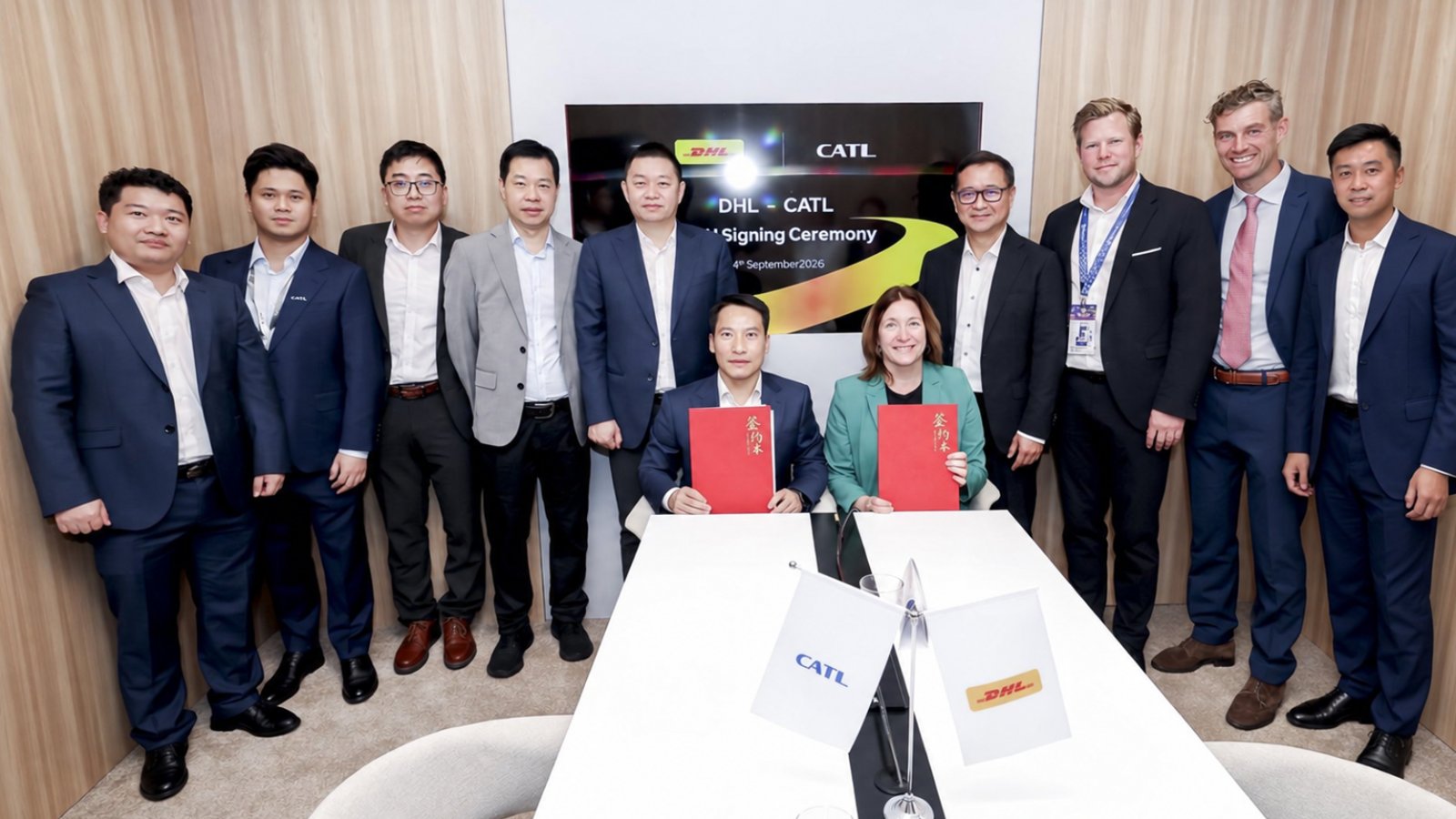
CATL and DHL Group representatives mark the signing of an MoU on green freight corridors in Europe in Hanover, Germany, on September 14, 2026. Credit: CATL
- The cooperation covers electric trucks, charging infrastructure and battery swapping pilots to help cut emissions from European road freight.
- The companies aim to develop a replicable model for freight electrification, including transport within CATL’s European supply chain.
CATL (HKEX: 3750) and DHL Group have signed a new memorandum of understanding (MoU) to explore green freight corridors in Europe, expanding their cooperation on logistics electrification.
The companies announced the signing on September 14 in Hanover, Germany. Building on their global MoU signed in September 2024, the new agreement focuses more closely on electrifying and decarbonizing European road freight, according to a statement on Friday.
Potential areas of cooperation include identifying suitable transport corridors for electrification, engaging electric vehicle manufacturers, deploying mobile and stationary charging infrastructure, and conducting battery swapping pilots, CATL said.
The companies aim to combine DHL’s real-world logistics needs with CATL’s battery, charging and swapping technologies to explore operating models that can be replicated across different routes, rather than focusing on a single technology or pilot.
The MoU establishes a framework for assessing cooperation opportunities. The statement did not disclose specific corridors, investment amounts or launch dates, with individual projects still to be determined.
As CATL’s strategic logistics partner, DHL aims to develop and scale sustainable freight solutions across Europe, including transport within CATL’s European supply chain.
Akin Li, executive president of CATL’s overseas business, said European freight electrification requires more than batteries or vehicles alone. It also requires combining real logistics demand with charging, energy storage, battery swapping and lifecycle services.
Potential participants in charging and energy infrastructure include QUIBO Energy, which is strategically backed by CATL and Xiaomi, and FleetBoost, a European provider of high-power charging and energy storage solutions.
QUIBO Energy was formerly known as SUNNIC. It and FleetBoost previously jointly developed the FleetBooster 20 and 40, which use CATL battery technology, and are now working together on scalable mobile energy and charging solutions.
Potential participants in battery swapping include Swaptopus, a joint venture established by CATL and Octopus Energy to develop an electric truck battery swapping network across Europe.
When CATL and Octopus Energy announced plans for the joint venture in June, they said the first demonstration stations were expected to begin operating in the UK in 2027, with plans to expand the UK network to more than 30 stations by 2035.
Other vehicle manufacturers, infrastructure providers, energy companies, logistics partners and investors may also participate in individual projects, depending on each corridor’s requirements, according to the latest statement.
The cooperation complements CATL’s expansion in commercial vehicle batteries. The company also launched its Tectrans II commercial vehicle battery solution in Hanover on September 14.
The heavy-duty truck version can support a range of up to 1,000 kilometers in its highest configuration and accommodates both charging and battery swapping, offering replenishment options for different transport applications, according to CATL.
DHL said it aims to achieve net-zero logistics-related carbon dioxide emissions by 2050, with cooperation among logistics providers, vehicle manufacturers and the energy sector essential to advancing decarbonization.
The heavy-duty truck version supports megawatt-level fast charging, reaching 80% in 25 minutes.
