

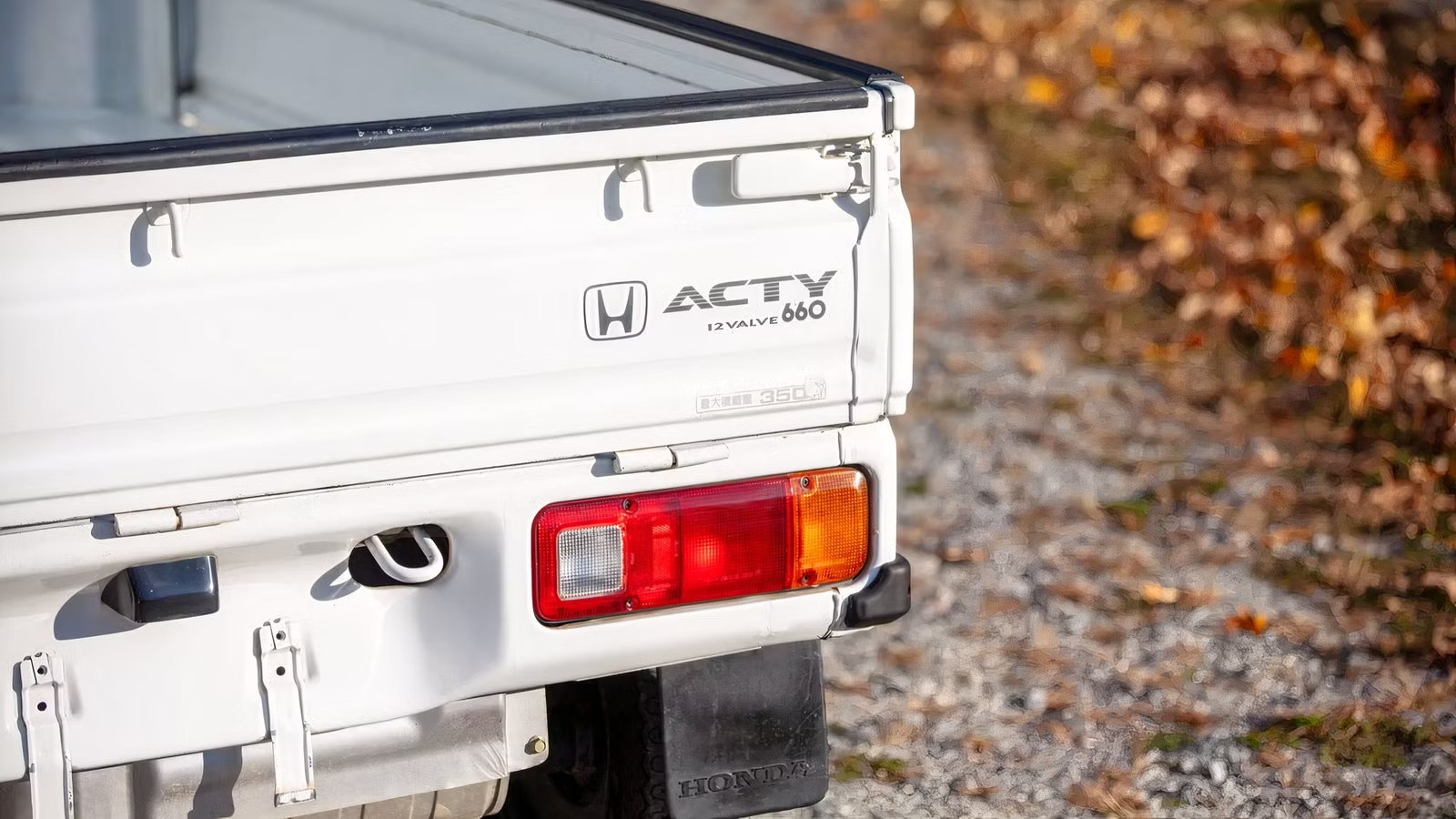
Kei trucks have quietly carved out a devoted following in the United States, and it’s easy to see why. These pint-sized Japanese workhorses offer something the domestic truck market simply can’t: extreme compactness, surprising practicality, and running costs that make a full-size pickup look extravagant by comparison. At the center of that growing interest sits one model in particular — the Honda Acty. Part miniature pickup, part cult classic, the Acty has become a go-to import for farmers, ranchers, and small-property owners who need a nimble work vehicle that fits where nothing else will. Here’s a closer look at its history, specs, and why it still makes sense to buy one today.
The Third-Generation Honda Acty: A Pocket-Sized Pickup Truck
Front shot of a 1999 Honda ActyBring A Trailer
Honda Acty (3rd Gen) Specs
Engine
656 cc inline-three
Horsepower
52 hp
Torque
45 lb-ft
Transmission
5-speed manual, 3-speed automatic, 4-speed automatic
The Honda Acty is a kei truck that has been around for nearly 50 years. Its third generation, introduced in 1999, is the most recent one to be eligible for import to the US. If you’re looking for a no-frills, practical, small work vehicle, the Acty may be a great choice for you.
Although the third-gen Acty was available in both van and truck form, the vehicles imported to the US mostly belong to the latter group. This truck is powered by a three-cylinder engine just 656 cc in size. This engine is part of Honda’s E0 family, found in several of the brand’s kei cars. E0 engines had a remarkably long production run, with some examples remaining in service as late as 2020. They have since been largely succeeded by Honda’s “P” series engine family.
The Acty’s output was initially 45 hp, but later rose to 52 hp and 45 lb-ft of torque. Transmission options included a three-speed automatic, four-speed automatic, and five-speed manual.
The Acty offers several advantages over a more traditional pickup truck. It can transport around 750 lbs of cargo while consuming far less fuel and requiring less maintenance than most trucks. Insurance costs are likely to be lower as well. This is largely due to its legal status: kei trucks are typically only permitted on private property, which means maintenance standards and insurance requirements are far less stringent than for vehicles operated on public roads.
The Honda Acty On The Market Today
With earlier examples of the third-gen Honda Acty now eligible for import, a growing number of these vehicles are available on the used market — a convenient option for buyers who’d rather skip the hassle of importing one themselves. Prices vary depending on mileage, maintenance history, and overall condition, so it’s worth shopping around and verifying the import paperwork before committing.
The second-gen model is slightly cheaper and easier to find, as it has been eligible for import for a few years longer. Prices do tend to climb for rarer or more specialized configurations — dump truck variants, for example, regularly sell for north of $10,000, as do well-modified examples built out for off-road use. Generally speaking, though, a solid standard Acty in ready-to-work condition can be had for a reasonable sum if you’re patient and do your homework.
Why Kei Trucks Still Make Sense In The US
1999 Suzuki Carry Blue Side ViewBring a Trailer
It might seem unusual to spend anywhere between $3,000 and $10,000 on a miniature pickup truck that potentially can’t even be used on public roads. Even when and where it can be used, with such modest carrying capabilities, surely US buyers would be better off with a tired old Ford or Chevy, rather than shelling out for one of these?
In many instances, yes. However, in certain applications — perhaps most notably in the agricultural industry — kei trucks make a great deal of sense. These tiny trucks are incredibly economical, and thanks to their diminutive stature, they can navigate narrow lanes and tight pathways that would be impassable for full-size, mid-size, or even compact trucks.
That combination of go-anywhere agility, frugal fuel consumption, and refreshingly simple drivetrains is what makes these tiny trucks a genuine proposition, even in the land of the full-size pickup.
The Acty’s Origins And Early Generations
Rear shot of a 1999 Honda ActyBring A Trailer
Although the third generation is the most popular in the US, the Acty has been around since long before 1999, tracing its origins back to the mid-1970s. The first generation was introduced in 1977; two years later, a van version joined the lineup as well. The first-gen Acty was powered by a 545-cc two-cylinder engine producing just 28 hp and 30 lb-ft of torque. Transmission options included a four- or five-speed manual as well as a three-speed “Hondamatic” — Honda’s first semi-automatic transmission — which was offered from 1982 onwards.
Unlike its successors, the first-generation Acty was sold in a handful of export markets, mainly the UK and Australia. It was never officially sold in the US, though it is now eligible for import on account of its age.
1990 Honda Acty Pickup 4WD 5-Spd Blue Rear Angled ViewBring A Trailer
After eleven years of production, the Acty entered its second generation in 1988. This version introduced the E0-series engines to the model, which would carry over into the third generation as well. Initially, power came from a 547-cc three-cylinder unit producing 34 hp and 33 lb-ft of torque. In 1990, the engine was upgraded to a 656-cc unit — closely related to the one used in the third-gen Acty — putting out 37 hp and 40 lb-ft of torque. Transmission options remained unchanged from the previous generation.
The second-gen Acty underwent a few design changes over the course of its lifespan. The 1990 facelift didn’t just bring an engine upgrade; it also revised the headlight design. The Acty truck, which originally wore round headlights, received the same rectangular units as the van version (dubbed the “Street”). The Street remained in production a little longer than its pickup counterpart, continuing to be sold until 2001. The Acty truck, meanwhile, was replaced by the third-gen version in May 1999.
Why Are Kei Trucks Enjoying A Wave Of Popularity In The US?
1990 Honda Acty Pickup 4WD 5-Spd Blue Front Angled ViewBring A Trailer
Kei trucks are a distinctly Japanese type of vehicle, but in recent years they have also become quite popular in the US. Most imported kei trucks can be found in rural areas, earning their keep in the agricultural sector. American farmers discovered that the practical, nimble kei truck was well suited to work on the land, ideal for navigating tight farm roads where larger home-grown trucks might struggle. They soon began importing these tiny pickups from Japan in sizable numbers. Due to the 25-year import rule, only trucks built more than 25 years ago are eligible for import — though this still leaves plenty of options for those who want a pocket-sized truck in their garage.
Kei trucks could not be more different from the kinds of vehicle most Americans picture when they hear the word “pickup truck.” This is a core part of their appeal: they offer something completely absent from mainstream American lineups. Their ultra-compact dimensions make them agile and able to squeeze into places larger vehicles simply can’t reach. They may only sport modest payload and towing capacities, but unpaved paths, narrow roads, and tight spaces are no match for the kei truck, making it easy to haul goods around a work site or farm. Their maneuverability, tight turning circle, and fuel efficiency all add to the appeal.
Of course, there are some downsides as well. Performance is not a strong suit of the kei truck, and most models top out somewhere between 50 and 80 mph. You are also unlikely to find any of the safety features we have come to expect in modern American vehicles. This affects the legality of kei trucks, which are largely confined to private property and banned from public roads in much of the US. In Texas, for example, kei trucks are completely banned except for agricultural use. Regulations are more lenient in some states: Alabama and Louisiana, for instance, allow kei trucks on public streets and back roads, though not on highways.
The Acty’s Arch Rival: The Suzuki Carry
1985 Suzuki CarryBring a Trailer
The Honda Acty is not the only kei truck that has enjoyed unexpected popularity in the US. Several other models in this category have been imported in sizable numbers, one of the most notable being the Suzuki Carry. Like the Acty, the Carry has a long history behind it: it was first introduced in the early 1960s and has gone through eleven generations so far, ten of which are eligible for import.
1985 Suzuki CarryBring a Trailer
Throughout most of its lifespan, the Carry has also been available in both pickup truck and van form. The only generation to exclusively offer the pickup body is the eleventh and current one, which US-based buyers won’t be able to import for some years yet.
The Suzuki Carry shares many of the Honda Acty’s qualities that make it an attractive option for American buyers seeking a capable work vehicle. Its design is simple and straightforward, with minimal technology, safety equipment, or complex mechanical systems to worry about. The model is small, reliable, and easy to maintain. Replacement parts are also especially plentiful for the Carry, which makes keeping one on the road more straightforward than you might expect. The Carry is additionally equipped with high/low dual-range gearing, giving it the ability to tackle rough terrain with confidence.
Sources: Honda, Suzuki
