

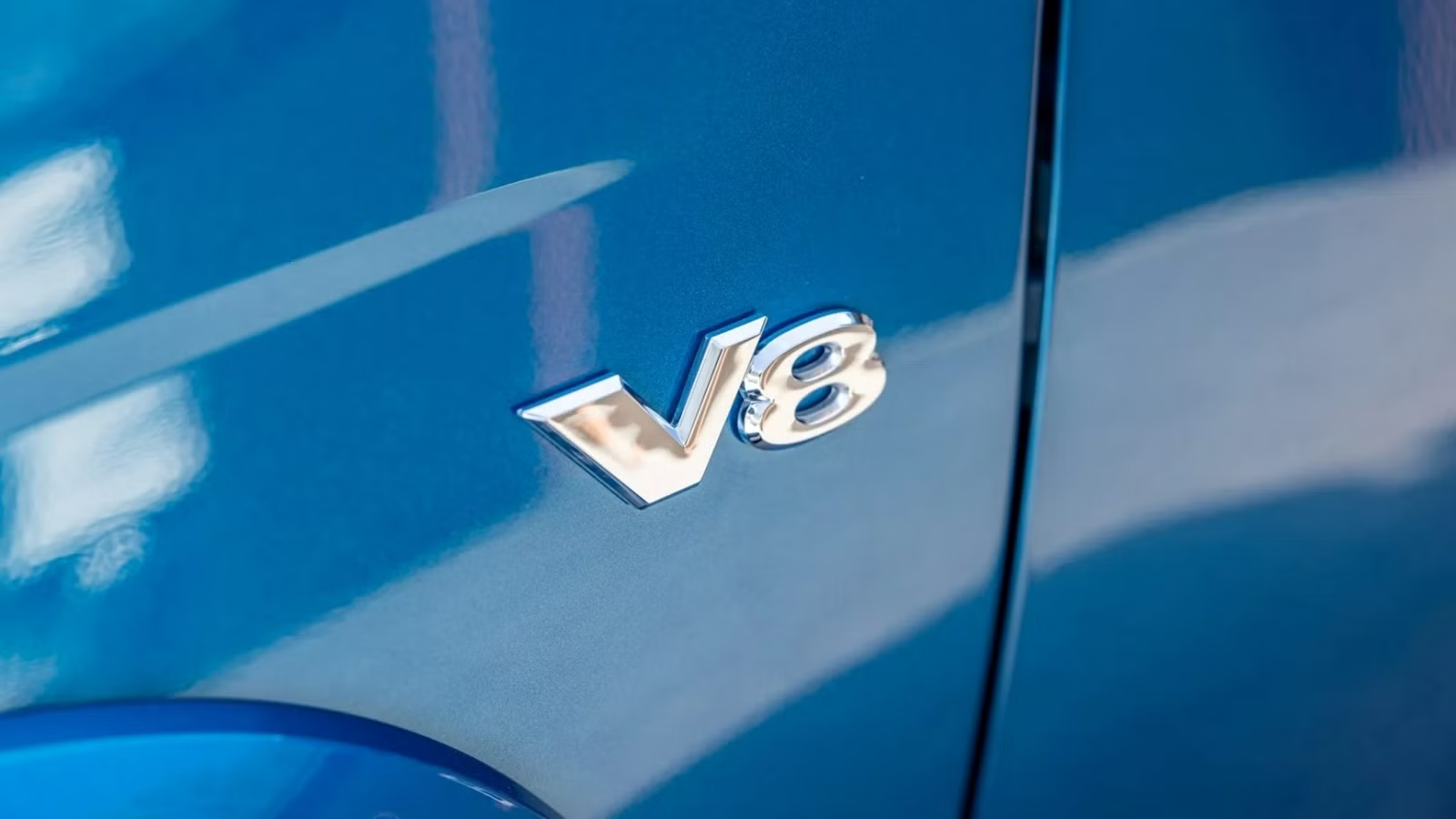
Spend any time in enthusiast circles, and you’ll hear the same lament: modern trucks have grown too big, too heavy, and too complicated. Against that backdrop, a forgotten oddity from Chevrolet’s back catalog is quietly attracting a second look — the V8-powered Colorado. Built for just three model years before the nameplate went on hiatus, this compact truck packed a Hummer-sourced 5.3-liter LS V8 under its hood, making it one of the rarest factory small-block swaps ever to roll off a production line. If you’ve never heard of it, you’re not alone — and that’s exactly what makes it worth knowing about.
The popularity of midsize trucks has soared over the last decade or so. The Chevrolet Colorado and the Ford Ranger nameplates returned to take advantage of the newfound popularity, as both monikers briefly retired during the 2010s.
Before the Colorado went away for a while, Chevy decided to give it a send-off that few knew about. Beginning three years before its initial retirement, the Colorado was available with a V8 shared with the Hummer H3. An eight-cylinder engine in a truck as small as the Colorado sounds asinine, or awesome, depending on how you look at it. Regardless, it happened, and here’s what the little eight-pot truck was all about.
When A Hummer And A Pickup Love Each Other Very Much…
2011 Chevrolet Colorado V8 painted in blue with black interiorBring A Trailer
Chevrolet Colorado V8 Key Points
- Introduced in 2009
- Featured a 5.3-liter V8
- Just under 5,000 examples produced over three years
- Related to the Hummer H3
The Chevrolet Colorado hit the market just over 20 years ago. Prior to its introduction, the Chevrolet S-10 filled this role in the brand’s lineup for decades. According to General Motors, Chevy decided to phase out the S-10 name in order to move their compact pickup truck into the modern era. The automaker had already completed a similar transition with its full-size Silverado pickups by renaming them from the old C/K Series models.
2011 Chevrolet Colorado V8 painted in blue with black interiorBring A Trailer
When the Colorado arrived for the 2005 model year, the truck had its work cut out for it. The model needed to make a name for itself in a market dominated by already-famous nameplates like the Ford Ranger and the Toyota Tacoma. Sales were strong off the bat, and the decision to switch from the old S-10 namesake to the new Colorado moniker seemed to be paying off. At the time, the Colorado shared a platform and several components with the Hummer H3, which itself launched for 2006.
The Colorado carried the usual sort of features buyers expected from a compact pickup truck at the time. There was a choice of small engines and a standard five-speed manual transmission, with an optional automatic. While the Colorado sold approximately 128,000 units during its first full model year, sales began to drop steeply — Chevy managed to shift just 24,642 of them in 2010. A modest sales recovery happened for the 2011 and 2012 model years, though deliveries never rebounded to the levels seen in the early years.
Where Does That V8 Come From?
2011 Chevrolet Colorado V8 painted in blue with black interiorBring A Trailer
Just a few years after the H3’s introduction, orders came down from GM’s top brass to ax the model, along with the entirety of the Hummer brand. The move was part of a broader consolidation following GM’s declaration of bankruptcy. The decision, however, left a surplus of 5.3-liter V8s that had been earmarked for the Hummer H3. The most straightforward solution was to fit some Chevrolet Colorado pickups with the engine. It was a win-win: GM worked through its excess inventory of powerplants, while Chevy could command a higher price for a V8-equipped Colorado.
The V8 Colorado’s Specs & Features
2011 Chevrolet Colorado V8 painted in blue with black interiorBring A Trailer
This engine belonged to GM’s famous LS small-block family and carries the internal designation “LH8” for 2009 and “LH9” for the 2010, 2011, and 2012 model years. The LH8 contains no special technology such as active fuel management (AFM) or variable valve timing. The LH9 added flex-fuel compatibility and variable valve timing to the mix.
Chevy only offered the V8 Colorado with an automatic gearbox. All examples came in the top-spec 3LT trim, and four-wheel drive was the sole available drivetrain layout.
The V8 Colorado’s detailed engine and performance specs are laid out in the table below, using the final 2012 model year as the reference point:
Engine Details
5.3L LH9 NA V8
Horsepower
300 hp
Torque
320 lb-ft
0-60 MPH Time
6.9 seconds
Quarter Mile Time @ MPH
15.2 seconds @ 90.6 mph
Max Towing Capacity
6,000 lbs
Curb Weight
4,310–4,476 lbs
*Specs courtesy of General Motors and MotorTrend testing
Features
2011 Chevrolet Colorado V8 painted in blue with black interiorBring A Trailer
Because the V8-equipped Colorados came exclusively in 3LT trim, virtually every available option was included as standard. The expected kit was all there — electric windows, air conditioning, and a powered driver’s seat. Additional features included a tachometer, sliding rear window, and an upgraded stereo. Cab configurations were limited to either an extended cab or crew cab, with no single-cab option available. A Bluetooth system and a pair of 12-volt power outlets were also standard.
Want One? Here’s How Much You’ll Have To Shell Out
2011 Chevrolet Colorado V8 painted in blue with black interiorBring A Trailer
Owning one of the only V8-powered compact pickup trucks produced in that era is an attractive prospect, especially if you don’t want to spring for a Dodge Dakota. Partly because the Colorado V8s came exclusively in that top-spec 3LT trim, they can still fetch a respectable sum on the used market — though the average asking price isn’t as stratospheric as you might expect. Used market pricing for V8-powered Colorados from 2009 to 2012 is detailed in the table below:
2009
2010
2011
2012
Current Average Used Price
$8,244
$9,400
$10,014
$10,367
As is the case with certain limited-production models, it’s worth flagging something before you dive headlong into buying one. Because only a few thousand examples of the V8-equipped Colorado were produced, pricing can vary widely. While the figures above reflect Kelley Blue Book’s average pricing, a number of examples have sold for well over $20,000 through auction sites and private sales, particularly those with low mileage.
Suffice it to say, the V8-powered Colorado, while relatively obscure, still attracts considerable attention whenever one comes up for sale. The best strategy is to be patient and wait for a solid example to surface. Do your research — this isn’t the sort of truck you should buy on impulse the same day you develop a craving for one. Unless, of course, luck is on your side. Either way, the opportunity to own a V8-equipped Chevrolet Colorado is an exciting prospect.
The Cost Of Ownership
2011 Chevrolet ColoradoChevrolet
As is always the case, buying the truck is only part of the picture. Keeping it looking sharp and actually on the road is a whole other cost — one that many buyers conveniently gloss over when justifying a purchase like this. Fortunately, Colorado V8 ownership isn’t fraught with punishing maintenance or repair bills, which makes these trucks all the more enticing.
- Fuel consumption isn’t great; expect to average around 16 mpg with an even city-to-highway split.
- RepairPal suggests annual repair and maintenance bills of $634, although that figure covers all grades, so treat it as a rough guide. Even so, it falls below the average for other trucks in the Colorado’s segment.
- CarEdge also places the Colorado marginally below the average repair and maintenance cost for trucks in the same segment.
- Both the LH8 and LH9 V8 engines used in these trucks omit AFM (Active Fuel Management), sidestepping one of the more costly recurring issues found in other GM V8s of the era.
As ever, buyers need to be cautious. Many of these trucks were used hard when new — that means high mileage and demanding conditions, so watch for chassis damage, rust, and worn suspension and braking components. A pre-purchase inspection is well worth the investment: a bad example could become a money pit, while a great one at the right price is a find worth celebrating.
What Has the Chevy Colorado Become?
2026 Chevrolet Colorado Trail Boss driving front 3/4 angle in redChevrolet
2026 Chevrolet Colorado Specs Overview
Engine
2.7L Turbo Four-cylinder
Horsepower
310 hp @ 5,600 rpm
Torque
430 lb-ft @ 3,000 rpm
Transmission
8-speed Automatic
Drivetrain
RWD or 4WD w/ 2-speed Transfer Case
Chevy’s Colorado was once a V8 sleeper of a midsize truck, but that era lasted only a few model years. For most of its life, its standard powertrain has almost always been a four-cylinder. Other engines were available along the way — including the rather unique 3.7-liter inline-five. That said, anyone who takes issue with General Motors’ 2.7-liter turbocharged inline-four should take a look at the model’s history. This TurboMax engine is the only available powertrain for the Colorado and GMC Canyon today. Every Colorado pairs it with an eight-speed automatic transmission, with trim level and options dictating whether power goes to the rear wheels or all four.
There are six trims to choose from for the 2026 model year. Prices start at $32,400 for the WT base model and climb to $50,700 for the ZR2 off-road variant, before destination, options, taxes, and other fees. All share the same engine, but the higher trims justify their premiums with equipment like the ZR2’s standard three-inch lift, 33-inch all-terrain tires, and Multimatic DSSV dampers.
The LS Tuning Gateway
GM LS V8 engineGeneral Motors
Beyond its factory specs, the real appeal of the V8 Colorado lies in its tuning potential. The Gen IV small-block architecture is arguably the most widely supported engine platform in automotive history. For enthusiasts, this truck represents a factory LS swap where the hard work — wiring, mounting, and cooling — is already sorted. While the stock 300 horsepower was respectable for its era, a camshaft upgrade and a free-flowing exhaust can push output well past the 400-horsepower mark without breaking the bank. That makes it a far more cost-effective performance project than trying to work around the complex, encrypted ECUs found in current-generation pickups.
The Street Truck Renaissance
2025 Ford F-150 Lobo heroJared Rosenholtz/CarBuzz/Valnet
The truck community is also experiencing a notable cultural shift. After a decade in which overlanding builds and lifted off-roaders like the ZR2 dominated the conversation, the street truck aesthetic is staging a genuine comeback, with models like the Maverick and F-150 Lobo leading the charge. The ZQ8-equipped Colorado, with its factory-lowered stance and tighter steering rack, stands as a natural counterpoint to the oversized, heavy trucks that define today’s market. Pair the truck’s relatively light curb weight with modern performance coilovers and staggered alloys, and you have a nimble, hot-hatch-style pickup that’s hard to replicate at any price. In an era of 6,000-pound EVs, this lightweight V8 platform is a refreshing reminder of what straightforward, driver-focused performance used to feel like.
Sources: General Motors, Chevrolet, TheDrive.com, MotorTrend
