

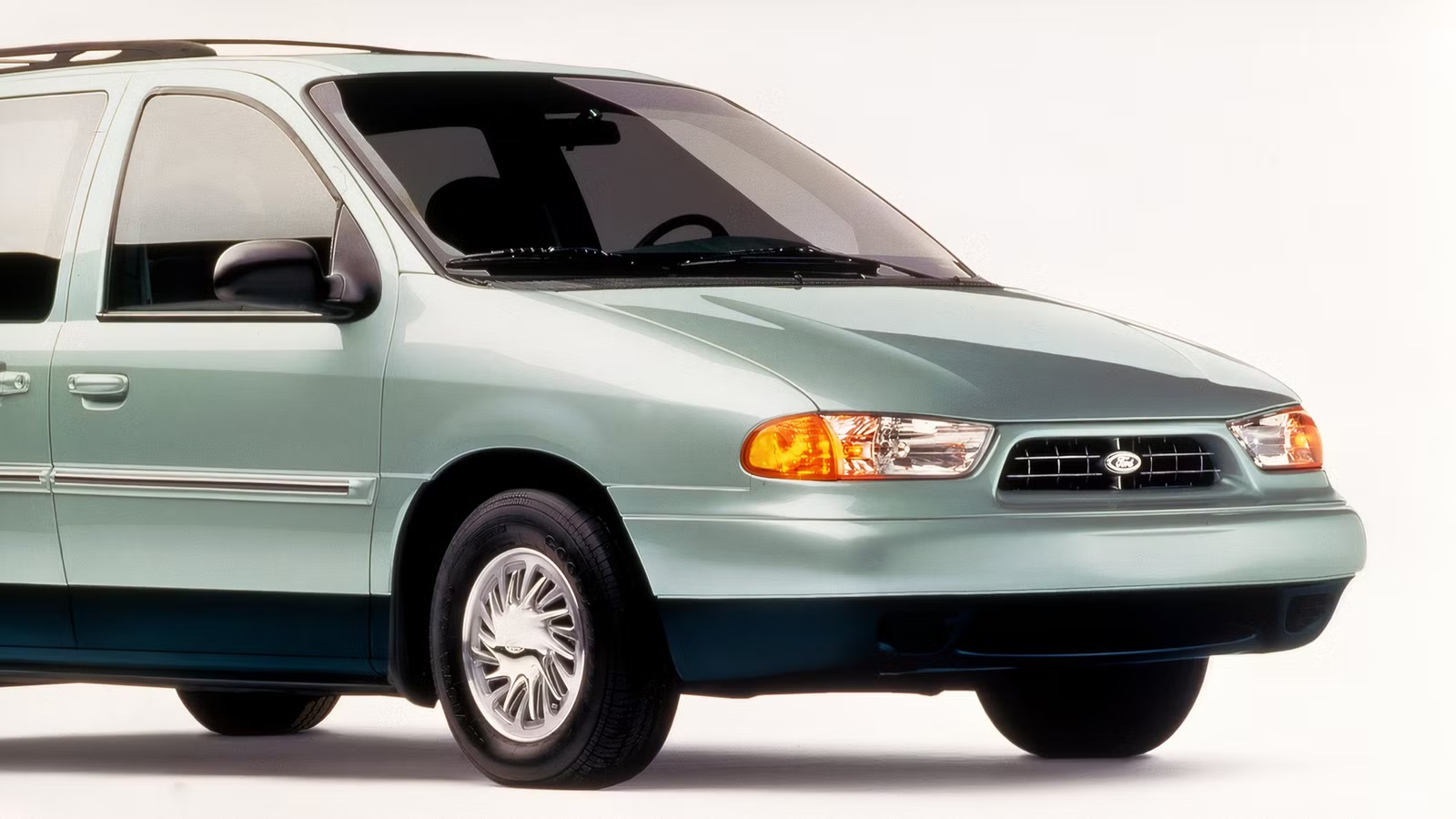
In the go-go 1990s, soccer moms were hot and the minivan segment that courted them was hotter. Although some automakers attempted to think outside the box, the most successful family haulers were the ones that imitated the Dodge Caravan, Chrysler Town & Country, and Plymouth Voyager. Ford got that memo in 1995 when it introduced the Windstar, which was based on the Taurus sedan platform and featured more carlike driving dynamics than the heavier-duty Aerostar that preceded it.
There was just one problem. The cutting-edge 1995 Windstar almost instantly got outclassed once Chrysler redesigned its minivan triplets for 1996, giving them more space, additional family-friendly features, and – crucially – dual sliding doors. Caught with its Huggies down, Ford began an emergency refresh of its aerodynamically styled vanlet for the 1998 model year, but its solutions were a lot weirder than they needed to be. Even more oddly, the facelifted minivan lasted only one model year before being replaced with a new design entirely.
Meet The King Door: Ford’s $100 million Answer To A Problem It Could Have Solved More Simply
1995–1998 Ford WindstarFord
Introduced very early in 1997, the 1998 Ford Windstar was rushed into production with a revised exterior design that added some of Ford’s upcoming “New Edge” styling trends – found on the 1999 Mustang, 2000 Focus, and 1999 Mercury Cougar – to the otherwise ovoid minivan. The headlights were narrower and angrier, and the front fascia was lightly reshaped to look more aggressive than its bubbly predecessor. The biggest (and weirdest) change to the Windstar, however, was a totally new driver-side body structure.
1995–1998 Ford WindstarFord
In contrast to the third-generation Chrysler vans, which offered an optional sliding door on both the left and right sides of the body, Ford lengthened the driver’s door by six inches instead. Ford took credit for the idea, but in truth, the concept of asymmetrical passenger doors was made famous by the AMC Pacer hatchback, whose passenger-side door was longer.
Called the “Family Entry System,” the Windstar’s longer left-side door theoretically made it easier for a whole family of rear-seat passengers to climb aboard, some via the right-side slider and some by crawling behind the driver’s seat to get in back, two-door-coupe–style.
Although the extended-length opening – also nicknamed the King Door – was standard on all 1998 Windstars, Ford also offered a tilting, sliding driver’s seat as an optional enhancement to the Family Entry System. A lever on the seatback would flip and slide the seat forward, again like a coupe, making it easier for rear passengers to wriggle through the narrow opening.
Ford also pitched the sliding seat as an easier way to load groceries and cargo without having to pop the tailgate. And, lest busy moms and dads get frustrated by constant seat adjustments, the driver’s perch returned to its original position when folded back into place.
The question wasn’t whether families could squeeze through the King Door – it’s whether any of them actually wanted to. The answer would cost Ford $100 million to find out.
Why Ford Spent $100 million On A Door That Lasted One Year
1998 Ford Windstar BrochureFord
Try climbing into the back of a Ford Mustang, then do the same task with a Honda Accord, and you’ll understand why the Family Entry System didn’t have much staying power. Loading children into the middle and rear seats was far simpler through the passenger-side rear sliding door, and we doubt too many buyers took advantage of the additional cargo loading “convenience,” either.
On the plus side, the King Door didn’t detract from the Windstar’s impressive safety rating for the time, as the 1998 model achieved a best-available “Good” rating from the Insurance Institute for Highway Safety (IIHS) and a five-star frontal crash record from the National Highway Traffic Safety Administration (NHTSA). The 1996–2000 Chrysler minivans were only rated as “Marginal” from the IIHS, and although they weren’t officially tested by NHTSA, an independent evaluation of a 2000 Dodge Grand Caravan done to the government agency’s standards revealed higher injury measures than those of the Windstar.
Still, Ford obviously knew its stopgap measure wasn’t sufficient, despite costing a reported $100 million to develop, since so much of the van’s structure had to be redesigned. Within 18 months of the facelifted, first-generation Windstar going on sale, the second-generation model hit the market. Introduced in July 1998 as a 1999 model, the new Windstar was more fully baked than its immediate predecessor, complete with an optional driver-side sliding door that matched its Dodge, Plymouth, and Chrysler competition for ease of use.
Why Chrysler Outlasted Every American Minivan Rival
1995–1998 Ford WindstarFord
Despite its newer, more cohesive design and a family-friendly list of safety and convenience features – many of which were proposed by the real-world moms at Ford who helped develop the 1999 Windstar – it didn’t sell as well as a single member of the Chrysler trifecta, much less their combined sales. Its 2004 Freestar replacement wasn’t competitive either, and in 2008, Ford gave up on minivans in favor of the boxy, three-row Flex crossover.
It wasn’t just the Blue Oval that abandoned minivan sales. GM’s first carlike family hauler attempts were the 1990 Chevrolet Lumina APV and its Pontiac Trans Sport and Oldsmobile Silhouette siblings, but they were too avant-garde for most customers. GM replaced the “Dustbuster” vans with the 1997 Chevy Venture, Pontiac Trans Sport/Montana, and Oldsmobile Silhouette.
The General made a third attempt at minivan success with the 2005–2008 Chevrolet Uplander, Pontiac Montana SV6, Buick Terraza, and Saturn Relay, except they were somehow uglier and less cool than the minivans they replaced. None sold particularly well, and as with Ford, GM exited the minivan segment in favor of a family of three-row crossovers for the 2008 model year.
Why the 1998 Windstar Is One of the Rarest – and Most Troubled – Fords You Can Buy Today
1995–1998 Ford WindstarFord
The first-generation Windstar was reasonably successful in its debut 1995 model year, but just 24 months later, its primary competition – the triplets from both Chrysler and GM – had all leaped past it in terms of practicality. We aren’t quite sure why Ford felt like spending $100 million on a refresh that would end up getting outclassed by its own replacement one year later, but at the turn of the century (and a few years before the dot-com bust) car companies had money to burn.
Oddball collectors who want to acquire the one-year-only facelifted Windstar will have to look far and wide for a decent example. In addition to their suspect practicality, many first-gen Ford minivans succumbed to head gasket and transmission failures since the 3.8-liter V6 and four-speed overdrive transmission were designed for the much lighter Ford Taurus and Mercury Sable. Still others suffered from rust issues, and many fell into the rabbit hole of successively less careful owners as they depreciated.
Even in the post-RADwood era, minivan enthusiasts (what a concept!) have gravitated more toward the otherworldly General Motors APV vans or the bestselling Chryslers in which they grew up. The 1995–1998 Ford Windstar remains a rarity, both in classifieds and car meets. If you do come across one, you can rest assured that, despite its relatively conventional appearance, the 1998 Windstar is one of the rarest Fords on the road today – and you’ll get to bore anyone to death when they ask why.
Base Trim Engine
3.8L V6
Base Trim Transmission
4-speed automatic
Base Trim Drivetrain
Front-Wheel Drive
Base Trim Horsepower
200 HP @4900 RPM
Base Trim Torque
240 lb.-ft. @ 3600 RPM
Base Trim Battery Type
Lead acid battery
Model
Windstar
Source: Ford, IIHS, NHTSA
