

Volvo Cars executives this week shared their automotive outlook with investors, and the broader picture was a bleak assessment of how geopolitics, trade, and tariffs are fundamentally changing what is now a fully global auto industry. But the best solution for tough times is the same as it’s always been: new product.
The Swedish automaker promises a bevy of new vehicles, including region-specific vehicles for Western markets and China, all coming by 2030, representing Volvo Cars’ largest product offensive ever.
2026 Volvo XC90 Black EditionVolvo
Volvo Platforms For The West, Shared Platforms For China
While we wait for more details about these new vehicles, it appears they will all come with a cord, either as fully battery-electric models or as next-generation plug-in hybrids with bigger electric motors for longer EV range. Volvo is planning 13 in total, an ambitious number to launch in less than four years.
Among the “new and regionally tailored cars” are seven earmarked for Western markets. These will spring from Volvo’s SPA2 and SPA3 platforms, which means cost savings in technology and manufacturing and improved profitability, said Volvo Cars CEO and President Håkan Samuelsson, who also calls these cars “100% Volvo,”developed in Sweden.
Meanwhile, Volvo and its owner, China’s Geely Holding Group, will collaborate on six new vehicles intended only for China by using shared platforms and “a software stack for China as well as common parts and a common supply chain.” While many automakers fear Chinese encroachment in their markets, Samuelsson sees Volvo’s relationship with Geely as a distinct advantage in an auto industry now in severe turmoil.
Wasn’t Globalization A Good Idea?
Samuelsson recalled how, years ago, auto executives embraced globalization as a strategy to “build one car in one factory and sell it everywhere.” But times have changed. “In the text book, it could be a good idea,” he told investors. “It worked some years ago. It is not going to work in the future.” Now, trade disputes, lethal military conflicts, and general economic uncertainty are forcing automakers to establish different strategies for different regions, with more interaction with customers, he said.
Geely vehicle platformGeely
“If we thought we had tough competition in the car industry, just wait – it will be even tougher,” Samuelsson said, noting the Chinese market, though enormous, cannot absorb all the cars produced domestically, due to severe overcapacity.
“When you can’t sell them domestically, what do you think they will do? They will, of course, export them. Americans have closed the door. The rest of us have to take it, and South America has very low tariffs, so they’re first on the list. Hyper-competition will come.”
–Håkan Samuelsson, Volvo Cars CEO and President
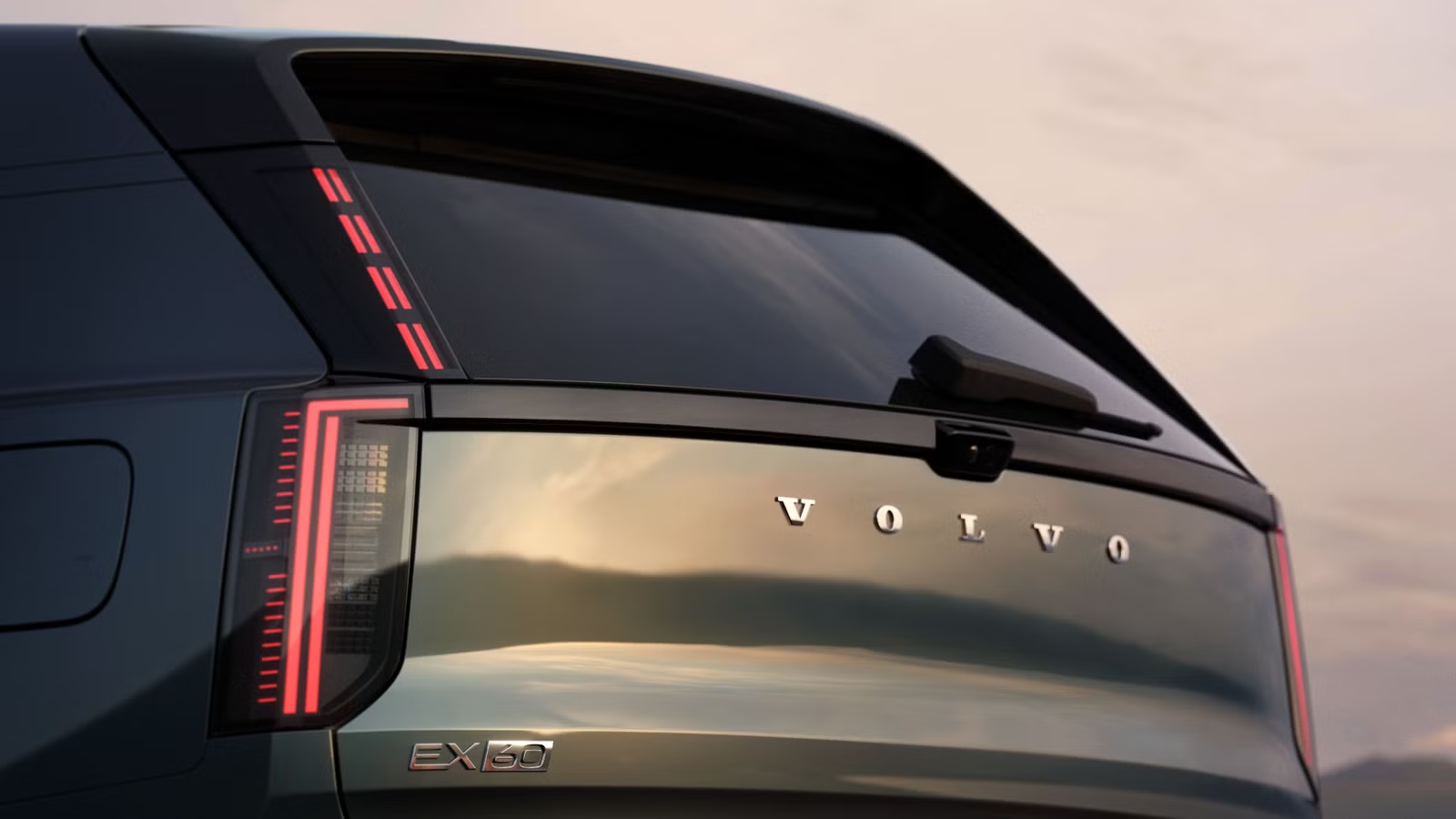
2027 Volvo EX60Tom Murphy / CarBuzz / Valnet
Volvo Has An EV Hit On Its Hands
Despite the big-picture concerns, Volvo appears to be defying the odds in demonstrating real growth in the battery-electric vehicle market outside of China. In Europe, Volvo holds 2.3% of the overall car market, while Germany’s biggest luxury players – BMW, Mercedes-Benz, and Audi – each hover around 5.5%.
Within the BEV market itself, Volvo claims about 4% of that segment, but that figure doesn’t include the all-new 2027 EX60 electric crossover. Factor in the retail orders for the new EX60, and Volvo’s EV share in Europe goes well past 5%, in line with the German luxury brands, said Erik Severinson, Volvo’s chief commercial officer.
“On the BEV market in Europe right now with what we’re selling with the EX60, Volvo has roughly the same market share as the premium Germans have, which we never, ever have been close to in the past.”
–Erik Severinson, Volvo Chief Commercial Officer
Volvo Strategy Update September 2026 and 2027 Volvo EX60 BEVVolvo
Fuel Prices Driving Up Euro EV Sales
Severinson also provided data (above) showing how rapidly the EV market has grown in China and particularly in Germany, especially as fuel prices there have skyrocketed in recent months in response to the war in the Middle East. In Germany, Severinson said EV sales now account for 25% of all vehicles sold in Europe’s largest market.
“Actually in the last weeks, almost 50% of all new cars sold in Germany are fully electric,” Severinson said. “So Germany is going electric and Germany is massively important for the European car market.” Germany exports a lot of used cars to other markets in Europe. “So when Germany turns, a lot of other markets will follow as well.”
2026 Volvo EX90 front 3/4 angle in red while parkedVolvo
CarBuzz Insight – Why This Matters:
Of course, US consumers are also feeling pain at the pump, but they aren’t responding by flocking to EVs, like they are in Germany. “Fully electric cars have actually gone down in the last few months,” Severinson said of the US. Still, Volvo is convinced that across the auto industry and all powertrain configurations, “electrification is the path to grow, and the only thing that is growing is cars with a cord.”
In the US, that explains why Volvo’s plant in South Carolina will be churning out a next-generation plug-in hybrid, likely as part of the 13 new vehicles globally in coming years.
