

Since the Lamborghini Miura arrived in 1966, the term “supercar” has been, more or less, clearly defined. Supercars are models that are built purely in the name of driving excellence, with few holds barred in that endeavor. Since the mid-1960s, loads of supercars have been produced to further cement them as some of the best-of-the-best, including the Lamborghini Murcielago, the modern Ford GT, and the Maserati MC20.
However, while the supercar has been clearly defined over the years, some brands have attempted, and succeeded, in producing supercars based on models that don’t exactly fit the mold in their base iterations. Think of the C8 Chevrolet Corvette Z06 or even the new ZR1X. The standard Corvette is merely a sports car. Still, the Z06 grade adds a flat-crank, naturally aspirated engine producing 670 horsepower and a whole host of performance upgrades that elevate it to supercar status.
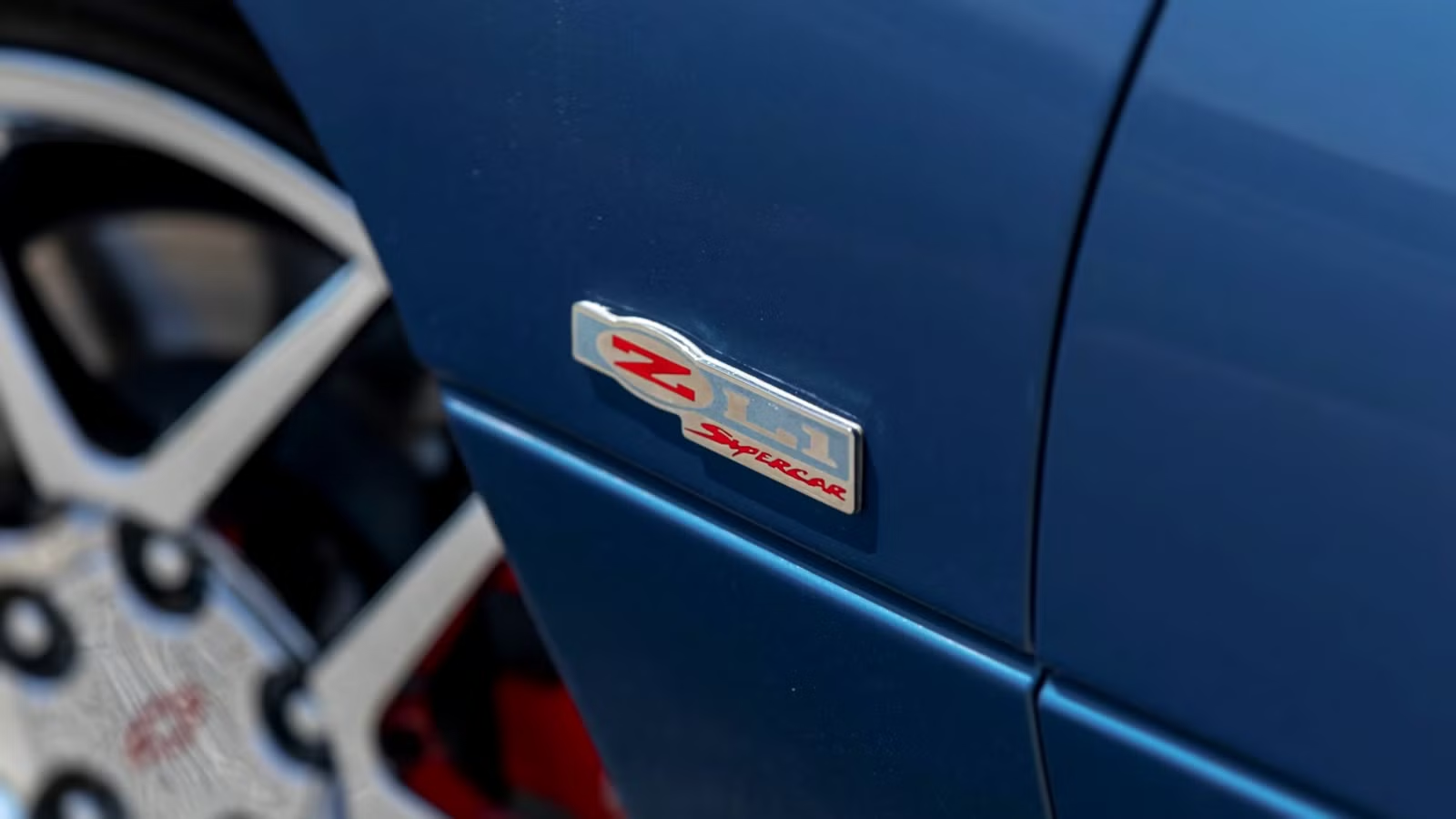
A fascinating example of this from 23 years came when the Georgia-based tuner GMMG took the fourth-gen Camaro and made extensive modifications to it. The finished product was called the Camaro ZL-1 Phase III. The company considered it to be a true supercar.
Related
What’s The Difference Between A Sports Car, A Supercar, And A Hypercar?
Is it even possible to define these concepts?
The Camaro Was Sporty, But Never Super… Until This Version
2002 Chevrolet Camaro ZL1 Phase 3 finished in blue with black interiorMecum
Chevrolet Camaro ZL-1 Phase III Key Points
- Introduced in 2002
- Roughly 31 examples built
- Produced by tuning company GMMG
- Meant to commemorate the introduction of the 1969 COPO Camaro
- Featured a 427 cubic-inch (CID) V8
Roughly 33 years before GMMG decided to build its ZL-1 Phase III Camaro, Chevrolet released the COPO Camaro, which, at the time, was the most hardcore version of the car produced. The COPO (Central Office Production Order) Camaro was a unique model at its inception. In essence, the cars were able to be special-ordered with options, engines, and other drivetrain features not otherwise available in the factory-built models you’d find on a showroom floor. The hardcore, drag-strip-ready ZL-1 version was produced as part of the program.
1969 Chevrolet Camaro ZL1Mecum
GMMG’s planned car was actually meant to pay homage to the original COPO ZL-1 Camaro. The original version’s production lasted for just one model year, 1969. In 2002, the Georgia-based GMMG company hatched a plan to produce 69 examples of a new ZL-1 Camaro to convince Chevy to produce its own factory version. Of those 69, only 31 would be the most powerful version, the Phase III.
GMMG Was No Novice When It Came To Tuning Chevys
2002 Chevrolet Camaro ZL1 Phase 3 finished in blue with black interiorMecum
GMMG set about its monumental task of building its own version of the ZL-1 Camaro in theearly 2000s, following a failed attempt to get Chevrolet to build a ZL-1 to commemorate the original model’s 30th anniversary in 1999. The company was no stranger to tuning Chevys, as it had been responsible for building special-edition Camaros like the Intimidator SS, which hit the market in 2001. There were to be three versions, or “phases”, ranging from Phase I, Phase II, and the aforementioned Phase III model, which would be the most powerful and track-ready. Heading up the project was a man named Matt Murphy.
2002 Chevrolet Camaro ZL1 Phase 3 finished in blue with black interiorMecum
If you’ve already guessed, the reason for the GMMG ZL-1’s 69-unit cap — of which only 31 would be Phase III variants — was a nod towards the original ZL-1’s production year and number produced. The engine was to be a 427 CID V8, which was the same displacement as the original ZL-1. Of course, the GMMG version of the powerplant was much more modern than the old school mill. It looks as if you can sum up GMMG’s decision to produce its own ZL-1 Camaro as a “stick it to ’em” decision.
Related
The High-Performance ’69 Chevrolet Pony Car You Didn’t Know About
Although a lesser-known model, this high-octane Chevrolet deserves a thorough going-over.
The Ins And Outs Of The GMMG’s Supercar
2002 Chevrolet Camaro ZL1 Phase 3 finished in blue with black interiorMecum
As we mentioned previously, there were to be three iterations of GMMG’s ZL-1 Camaro, but only the Phase III model was granted the use of the term “supercar”. Underneath its hood, there was an all-aluminum 427 CID big-block V8, specially tuned by GMMG themselves. The basic engine was lifted from Chevrolet’s Corvette C5-R racecar, although heavily modified in order to be street-legal. Changes aside, the engine still packed a race-bred punch.
2002 Chevrolet Camaro ZL1 Phase 3 finished in blue with black interiorMecum
Making up the engine’s performance prowess was a slew of upgrades not typically found in road cars. For example, it boasted a set of JE lightweight pistons lashed to a 4340 steel forged crankshaft and a set of 4340 forged connecting rods. For those unsure, 4340 refers to the alloy type used in the production process, which in this case was high-strength, low-alloy steel containing nickel, chromium, and molybdenum.
The cylinder heads received porting and polishing for better flow, and a high-performance camshaft was installed, as well. As for the rest of the ZL-1 Phase III, it received a performance-tuned suspension loosely based on the existing Camaro SS, and its brakes were similarly beefed up. A six-speed manual transmission produced by Tremec was standard.
We outline the 2002 GMMG Chevrolet Camaro ZL-1 Phase III’s available engine and performance specs, of which there are few, in the table below:
Engine Details
427 CID (7.0L) NA V8
Horsepower
600 hp
Torque
575 lb-ft
*Specs courtesy of Silodrome.com
Current Pricing
2002 Chevrolet Camaro ZL1 Phase 3 finished in blue with black interiorMecum
As you can imagine, a 600-horsepower (more than a brand-new C8 Corvette Stingray), limited-edition Camaro that calls itself a supercar costs more than, say, a 10-year-old Civic. However, you’re getting much more oomph for your money than you would with the sensible Honda, and that’s a promise. As of this writing, the 2002 GMMG Camaro ZL-1 Phase III is still rather obscure, meaning its pricing isn’t as high as you may expect. The car is, however, still well into the six-digits. If you check out some sold auction listings on sites such as Mecum or Barrett-Jackson, there are a couple of examples that have sold for around $115,000–$150,000.
Related
Chevy’s 10-Year-Old Track-Focused Camaro Is Still Worth A Bundle In 2025
Is this a future classic?
Impressive? Yes. Supercar—Impressive? Well…
2002 Chevrolet Camaro ZL1 Phase 3 finished in blue with black interiorMecum
Before arguments break out in the comments, let’s dive into whether this Camaro can actually be considered a supercar. First, let’s look at its power output. 600 horsepower in 2002 was more than enough to catapult a car into supercar status. After all, the Lamborghini Gallardo only made 493 horsepower with two more cylinders than the GMMG Phase III ZL-1, and the Gallardo is firmly within the confines of being considered a supercar.
Secondly, we’ll have to look at handling. The issue with this, though, is that handling ability can typically only be measured by track times or pure feel. Since this author has never driven one of the 31 built, we can’t use the car’s feel to sort that out. To make matters more difficult, there are no official lap times for the car, so we err on the side of caution and say that no, it does not handle as well as a conventional supercar.
Lastly, let’s look at appearance. The styling isn’t too different from other fourth-gen Camaro models. It looks more like a muscle car, which cannot be said about supercars at all. Nobody has ever looked at a modern, high-tech supercar and mistook it for a Chevrolet Chevelle, for example.
2002 Chevrolet Camaro ZL1 Phase 3 finished in blue with black interiorMecum
Bearing all that in mind, we can say that, no, the 2002 GMMG Chevrolet Camaro ZL-1 Phase III isn’t a supercar, despite what its trunk badge says, but it sure makes enough power from that 427 CID big-block to run alongside them.
Sources: Silodrome.com, American Muscle Car Museum, TheMattAvery.com
