

As it turns out, there’s something generational about one of the simplest roadside automotive tasks, changing a flat tire. At some point, a lifelong motorist will almost certainly encounter a pesky flat, which may often be due to an errant nail or an oversized pothole. But research suggests that people place more faith in some generations than others when it comes to changing that wheel and tire.
According to new international research, 67% of Americans feel that Gen X is the generation they would most trust for the task, with Gen Z receiving a staggering 0%. But there’s much more to the story than meets the eye and these numbers may have also their roots within both technological development and shifting lifestyle factors.
America Hands The Lug Wrench To Gen X
1992 Dodge Viper photo showing the cargo area and spare tireRM Sotheby’s
2026 Jeep Wrangler Sport
Engine
3.6-liter Pentastar V6
Transmission
Six-speed manual or automatic
Drivetrain
Four-wheel drive
Power
285 hp
Torque
260 lb-ft
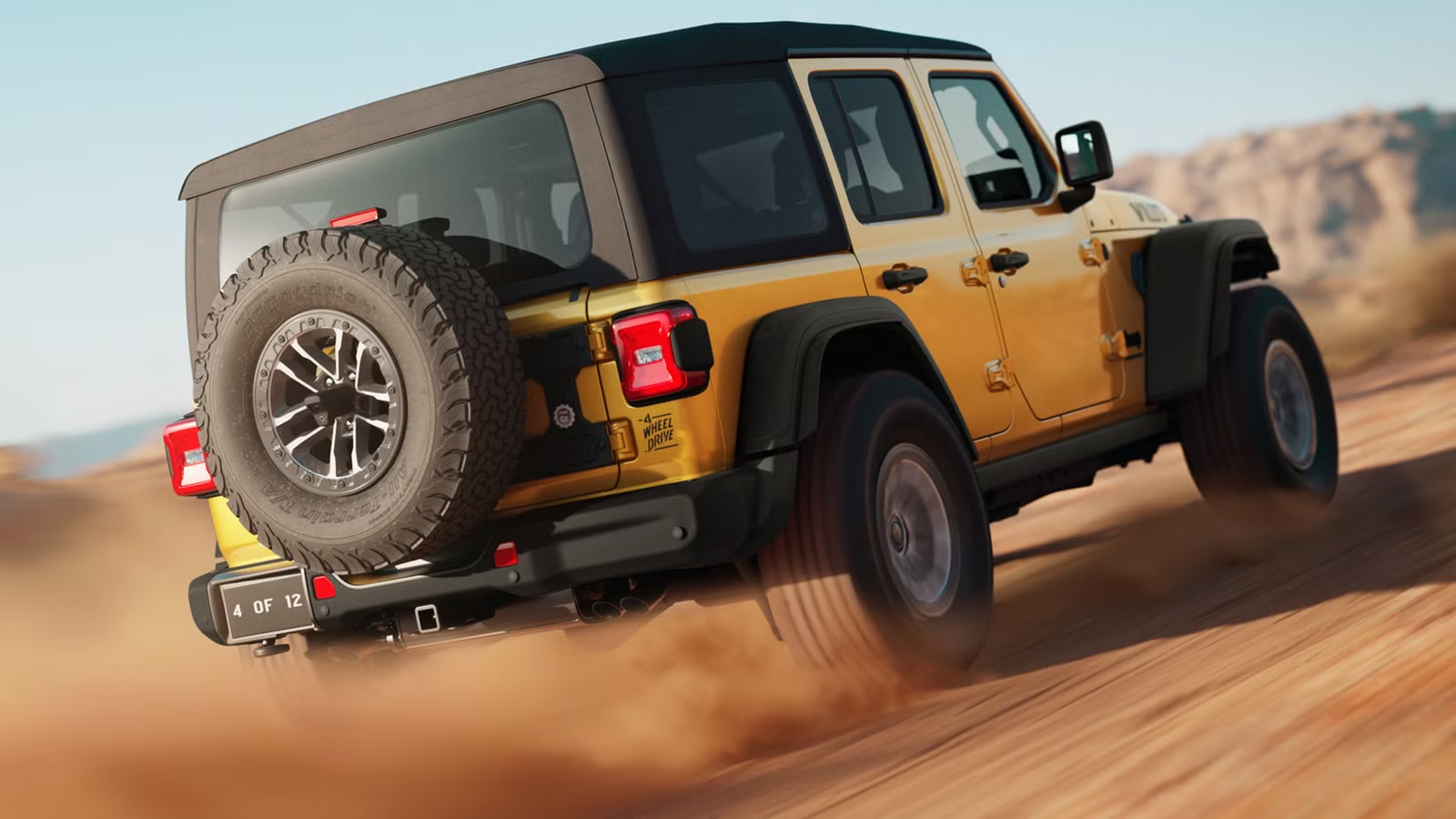
Jeep’s 2026 Wrangler Sport is deliberately old school in many respects. For example, its spare wheel and tire couldn’t be more obvious, as it sits right on the back of the vehicle to make it as easy as possible for people to effect the swap. But many Americans feel that a Gen Z driver would simply struggle to do that work.
Most of the respondents in the survey would instead select a Gen X person, with 67% of US respondents feeling that way, and 57% of global voters opting for the same group of people. Gen X led this category in 14 of the 15 countries in the survey, apart from South Africa, where Millennials came in first place.
Gen Z didn’t fare very well at all and collected only 2% globally, with that zero rating in the UK, Portugal, and Australia, as well as the US.
Still, it’s important to remember that this was not about a specific person or whether somebody younger could actually do the required work. Instead, the question asked respondents to choose the generation they trusted most. And it’s important to remember that Gen Z motorists simply don’t have the same level of experience as their Gen X counterparts.
Don’t forget that those Gen X drivers have been able to build up a reputation for this type of task for many decades, through having to deal with punctures, to say nothing of dead batteries, overheating, and other minor emergencies.
Gen X Learned Before The Car Became A Black Box
ToolsAaronBersée/CarBuzz/Valnet
In addition to the obvious age gap, it’s also important to consider technological development. Gen X people are broadly between 46 and 61 years old today and cut their teeth from a driving perspective in the 1980s and 1990s. Back then, cars were a great deal simpler than they are now and nothing like the more standardized computer-controlled vehicles of today.
Most Gen X drivers learned on vehicles that came out before standardized onboard diagnostics became universal. These only arrived in 1996 to affect new gas and alternative fuel passenger cars and light trucks. Drivers of cars from before that OBD-II system era may well have a lot more practical car knowledge.
For example, someone from that period may have had to assess certain vehicle faults through other means, like sight, sound, or fluid levels. They’d have to figure out whether belts, hoses, plugs, or fuses were at the root of any problem. Also, they might have had to tinker with a physical toolkit rather than have standardized diagnostic data pointing them toward a fault.
So, someone who is 55 years old now may have had to deal with decades of breakdowns and repairs. Gen Z drivers simply don’t have the same mileage under their belts or that level of experience to fall back on, meaning that Gen X counterparts may have had longer to prove themselves. Their experience came from an age when ownership was far more practical and often involved actual contact with the machinery.
Changing A Tire Is Becoming A Different Skill
Jeep Wrangler Rubicon Trail Hunt Edition from the rearJeep
While Jeep may make changing the tire as easy as possible with its new Wrangler, many manufacturers go in the opposite direction and remove the spare wheel entirely. Some OEMs now add mobility kits, sealant, and compressors, or even run-flat tires instead, often to save weight and packaging space. Some mobility kits can indeed handle small tread punctures, but they’re never going to be a universal substitute. After all, if the tire has sidewall damage or has sustained a full blowout, then the driver can leave those mobility kits where they are and call for roadside assistance or a tow.
When you look at the challenge from this perspective, it doesn’t really matter if the driver in question is from Gen Z or not. After all, even if they may know how to change a wheel, the subject is moot if there’s no replacement wheel on board. Federal safety guidance still advises drivers to inspect their tires before taking off to make sure that they have the correct pressure and adequate tread. But such inspections should also extend now to whether the vehicle actually has a spare, a compressor, sealant, run flats, locking wheel hardware, or simply no usable roadside solution at all.
Perhaps the outcome of the survey was not particularly fair. Respondents were judging Gen Z according to whether they could perform an iconic roadside ritual, just as the industry was making that ritual less consistent across the board.
Related
The Surprising Reason Behind The Puny Spare Tire In Your Trunk
It’s not really saving all that much rubber, right? So why are spare tires so much smaller than standard tires?
The 0% Result Says More About Trust Than Ability
When you dig further into the survey, you find that 29% of Gen Z respondents in the US said that they felt confident carrying out a mechanical task. And when you consider that 0% of surveyed Americans would actually choose them to do this, the gap seems to be more about public reputation rather than self-confidence.
More broadly, only 14% of Gen Z drivers who had attempted a car repair specifically, said they made the problem worse. So, the figures don’t support any cartoonish version of a generation that can’t touch a car without breaking it. Instead, the survey really is one of perception, with that 0% figure measuring a level of trust and not mechanical competence. The biggest takeaway may be that nobody expects Gen Z to tackle the tire-changing task, rather than thinking that they won’t be able to do it.
Gen Z May Be Learning Their Auto Skills In A New Way
2011-2013 Jeep Grand Cherokee Under-trunk Spare WheelJeep
Gen X may have built its automotive maintenance reputation through years of direct exposure and bloodied knuckles. But Gen Z may have a significant advantage here in that they can compress part of that learning curve through the medium of a phone screen. Here, another survey statistic shows that 71% of Gen Z drivers in the US used social media for car maintenance advice, and American Millennials were even more likely to do so, at 76%.
Related
Ford Turning Bronco Spare Wheel Covers Into Outdoor Speakers
The Honda Ridgeline’s bed speaker appears to have been a source of inspiration for Ford.
Today, 95% of US adults aged 18 to 29 use YouTube. This makes it a lot easier to learn how to replace a battery or even discover where the jacking points are on a certain vehicle rather than having to find out the hard way. Older generations are also turning to the internet and increasingly to AI tools for automotive guidance, so even the generation that wins the initial trust contest is finding new ways to get their answers. Even though – hypothetically speaking – nobody may trust Gen Z with the lug wrench initially, those youngsters may be the first ones to search for the correct procedure before they actually pick that wrench up.
This survey’s 0% figure is quite astonishing, but it’s important to read it in context. It doesn’t represent a verdict on universal incompetence, but rather on perceived credibility, and it’s simply not fair to say that Gen X can fix the car while Gen Z cannot. It’s more important to remember that Gen X has had decades of accumulated experience from a time when there was far more routine contact between a driver and their machinery.
Gen Z has had fewer years to build up any reputation in this area and, at the same time, modern cars increasingly hide, simplify, or eliminate many tasks. But as flat tires remain commonplace, any measure of trustworthiness still comes down to the person at the roadside. Regardless of their age, they’ll still need to know the car and the limits of the situation, and, crucially, know what to do next.
Sources: Jeep, Autotrader, Pew Research.
