

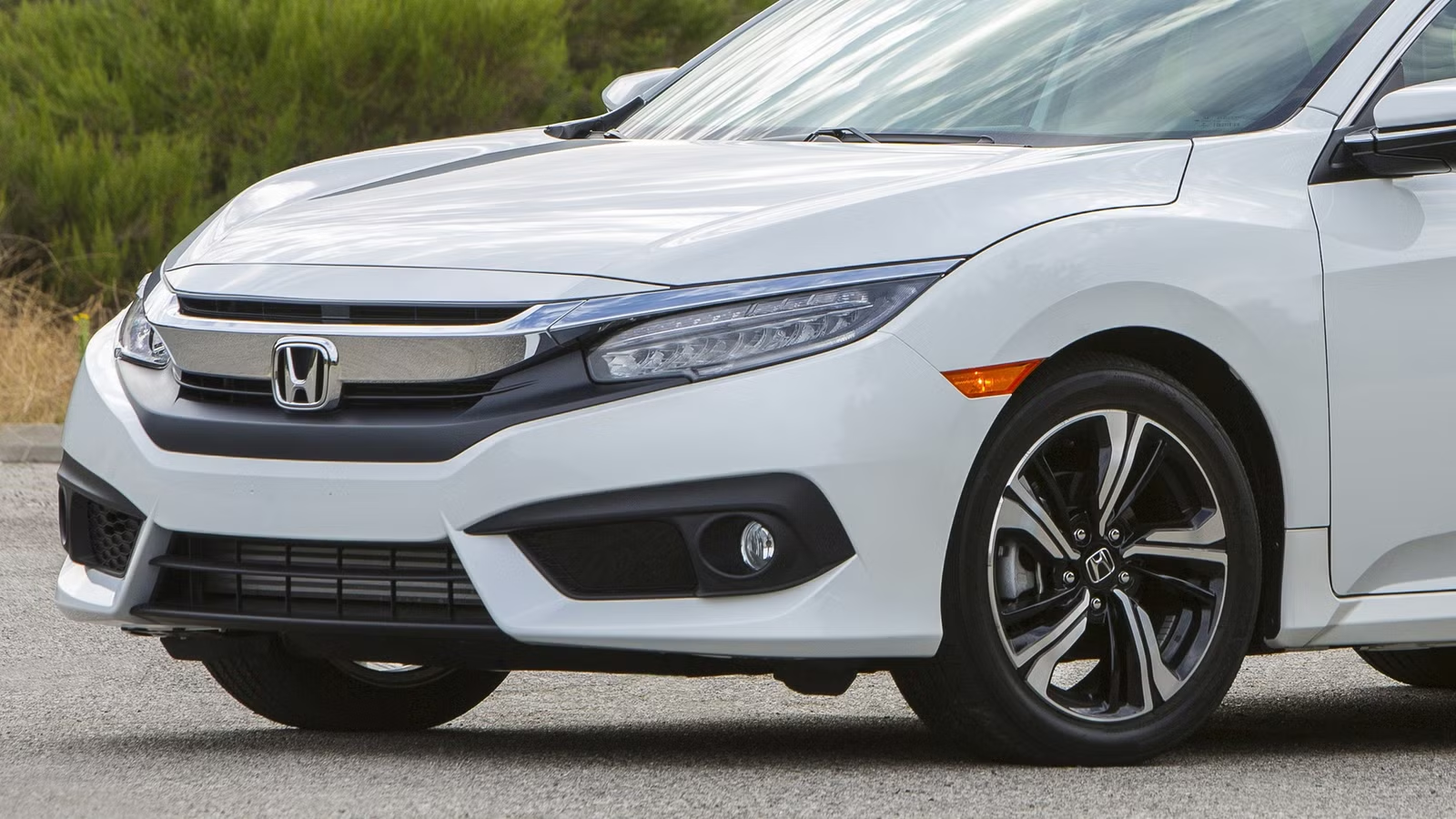
Identifying the Honda Civic years to avoid is essential to safeguarding your peace of mind. While this iconic vehicle nameplate has earned a legendary global reputation for bulletproof engineering, certain production cycles suffered from some serious mechanical failures. To establish the absolute best Honda Civic year options, we look past the emotions running riot in forums and rely on the data provided by the bodies that matter.
The information in this article was correct at the time of writing. We did not go further than the year 2000 when gathering the information, and the write-up excludes the Type R and Coupe models. Authoritative sources are listed at the end.
The Absolute Best Civic Years
The 2021 Honda Civic
Front quarter view of a 2021 Honda CivicHonda
- J.D. Power Quality & Reliability: 86/100
- NHTSA Recalls: 4
- NHTSA Complaints: 133
The 2021 model serves as the grand finale of the tenth generation, making it a stellar option for modern used car buyers. Because it represents the ultimate year of its platform, every assembly method and component was optimized before the factory was re-tooled for the subsequent generation. NHTSA data confirms that recall volumes dropped off a cliff for this specific year compared to the turbulent mid-decade models. In addition to the exceptional ride comfort and a cabin space that rivals midsize alternatives, owners also benefit from stabilized depreciation curves. This means that your financial equity is likely to be protected over the coming ownership years.
Maintenance data suggests minimal out-of-pocket expenses during the initial years of operation, with severe powertrain faults labeled as anomalies. If you want a late-model compact car that feels fresh and features verified, bug-free components, this specific production year is an incredibly intelligent decision.
The 2014 Honda Civic
2014 Honda Civic SiHonda
- J.D. Power Quality & Reliability: 86/100
- NHTSA Recalls: 2
- NHTSA Complaints: 290
The 2014 model stands as one of the absolute best years for Honda Civic buyers who want long-term dependability that’ll be easy on their budget. This specific vehicle represents the pinnacle of the ninth-generation design cycle, and – as with most end-of-cycle models – it’s a phase where the Japanese brand successfully ironed out early electronic and mechanical glitches. Powered by a naturally aspirated 1.8-liter i-VTEC four-cylinder engine, this model bypasses the oil dilution concerns associated with later turbocharged variants.
According to J.D. Power, the 2014 iteration secured an exceptional quality and reliability score of 86 out of 100, marking it as a benchmark for the entire compact car segment. CarEdge also indicates that annual maintenance expenses for this production year are significantly lower than the segment average.
The 2015 Honda Civic
2015 Honda Civic Sedan Blue Front Angled ViewHonda
- J.D. Power Quality & Reliability: 83/100
- NHTSA Recalls: 1
- NHTSA Complaints: 377
Following closely in the footsteps of its immediate predecessor, the 2015 model is widely recognized as arguably the most reliable Honda Civic year for secondary market consumers. This car maintained the rock-solid powertrain combination of the 1.8L engine and a reliable continuously variable transmission (CVT), which, together, minimized mechanical complexity. Data from the National Highway Traffic Safety Administration (NHTSA) confirms a remarkably low volume of structural or powertrain consumer complaints for this specific calendar year. Additionally, the cabin materials and safety systems received minor updates that elevated the overall driving experience without introducing fragile tech components.
The 2020 Honda Civic
- J.D. Power Quality & Reliability: Not Rated
- NHTSA Recalls: 5
- NHTSA Complaints: 213
Moving into the more modern tech landscape, the 2020 model year serves as a bright light within the tenth-generation production arc. By the time this vehicle hit the assembly line, Honda had addressed the air conditioning component leaks and infotainment system display freezes that tarnished earlier iterations. The 2020 version boasts impressive safety features via the standard integration of the comprehensive Honda Sensing driver-assist suite across all trim levels. Buyers can choose between the base 2.0L engine or the more energetic 1.5L turbocharged engine, both of which demonstrate excellent longevity when properly maintained.
Related
Honda Civic Sedan Generations: Everything You Need To Know In One Place
The Civic Sedan represents the state of the compact sedan art, with lots of equipment, a sporty drive, and plenty of space, at a competitive price.
Honda Civic Years To Avoid Now
The 2001 Honda Civic
2001 – 2003 Honda Civic coupe front shotHonda
When ranking what year Honda Civic to avoid, the 2001 model is universally recognized as one of the absolute worst vehicles Honda has ever produced. It ranks top on this blacklist due to an unavoidable automatic transmission design flaw. The internal clutch packs and torque converters were undersized, leading to rapid disintegration under normal driving conditions. This isn’t a problem that might happen; it is a statistical near-certainty.
According to NHTSA data and major consumer complaint platforms, 2001 generated thousands of reports of transmissions slipping, shuddering, and completely locking up at highway speeds, creating severe safety hazards. Because the cost to rebuild or replace this flawed transmission can exceed $2,500, fixing it is almost the same price as a used example in today’s market.
“I recently bought a 2001 Honda Civic. It was driving fine until it suddenly started making grinding or weird noises. I couldn’t shift, and now the gears are locked up. It happened suddenly after no problems.”
The 2006 Honda Civic
A front three-quarter shot of a 2006-2008 Honda Civic Sedan driving Honda
The 2006 model takes the second spot on the blacklist for a defect that is arguably just as destructive as the 2001 model. This car kicked off the eighth generation with a notorious engine block casting defect. The aluminum block was vulnerable to thermal stress, frequently developing hairline fractures that allowed engine coolant to pour out without warning. This rapid loss of coolant causes the engine to overheat and destroy its own internal rotating assembly, requiring a complete engine replacement.
While Honda issued Technical Service Bulletin 10-048 and replaced many of these blocks under an extended warranty, that warranty has completely expired. If you purchase one without documented proof of a block replacement, you are playing Russian roulette with your wallet.
“The engine overheats due to a crack in the engine block, causing the coolant to leak. An overheated engine smokes and has the potential for fire. I did my research and spoke to a handful of certified mechanics. The solution, as I understand, is to replace the engine.”
The 2016 Honda Civic
2016 Honda Civic Exterior Front Three-Quarter Low Angle Honda
The 2016 model ranks as the least avoidable of the three worst years listed, but it still earns its spot on the blacklist. As the first year of the tenth-generation redesign, it bypassed the engine and transmission destruction of the older models, but introduced frustrating and expensive accessory failures. The biggest issue involves poorly manufactured air conditioning condensers that develop pinhole leaks. The leaking refrigerant also drains the system’s lubricating oil, causing the expensive AC compressor to seize entirely. This cascade transforms a simple leak into an expensive repair bill. Additionally, this production year suffered from a high volume of NHTSA complaints regarding sticky steering racks and a very glitchy infotainment system.
“Steering becomes ‘sticky’ when operating at high speeds, especially in the summer months. This makes intended small adjustments into large, jerky movements, creating a huge safety risk. This issue has been recalled for newer Honda Civics, but not older models, and has been an issue for years now. The issue has been brought up to Honda Dealerships, but no solution has been provided. No warning messages appear.”
11th-gen Honda Civic!
2022 Honda Civic Exterior Driving On HighwayHonda
The current eleventh-generation Civic took an unprecedented leap forward, prompting many industry analysts to label it the absolute best iteration in the badge’s history. For consumers shopping for modern options, these vehicles offer an incredibly compelling combination of luxury-grade ride refinement, excellent safety ratings, and good powertrain efficiency. The chassis utilizes advanced high-strength steel that improves torsional rigidity, resulting in quiet cabin acoustics and well-mannered driving characteristics. The standout achievement is the newly introduced hybrid powertrain configuration, which blends a 2.0L engine with dual electric motors. This system generates 200 horsepower and 232 lb-feet of torque. Simultaneously, it achieves an EPA rating of 49 MPG combined.
“If you want affordable, practical fun in the perfect daily-drivable package and insist on nothing but a manual gearbox, then the 2022 Honda Civic Si has to be on your shortlist.”
– Roger Biermann, Managing Editor, CarBuzz
Is The Honda Civic A Good Buy?
Honda
The Best Model Years
Model Year
Optimal Powertrain
Key Advantage
2014
1.8L 4-cylinder
Perfect for budget shoppers wanting mechanical simplicity
2015
1.8L 4-cylinder
Low annual maintenance costs
2020
1.5L Turbo 4-cylinder
Honda Sensing safety tech and modern styling
2021
1.5L Turbo 4-cylinder
Highly optimized and largely bug-free
The Honda Civic remains an exceptionally smart investment for buyers who prioritize long-term value and utility, provided you successfully navigate around the documented engineering minefields. Avoid the automatic transmission failures, cracked engine blocks, and expiring first-year redesign flaws highlighted in this guide. Instead, focus your search on the bulletproof ninth-generation’s final years. Or, if you have the means, simply opt for the 11th-generation Civic – it’s slightly pricier, but comes with a lot less drama.
Sources: Honda, NHTSA, J.D. Power, CarEdge
