

The biggest car news and reviews, no BS
Our free daily newsletter sends the stories that really matter directly to you, every weekday.
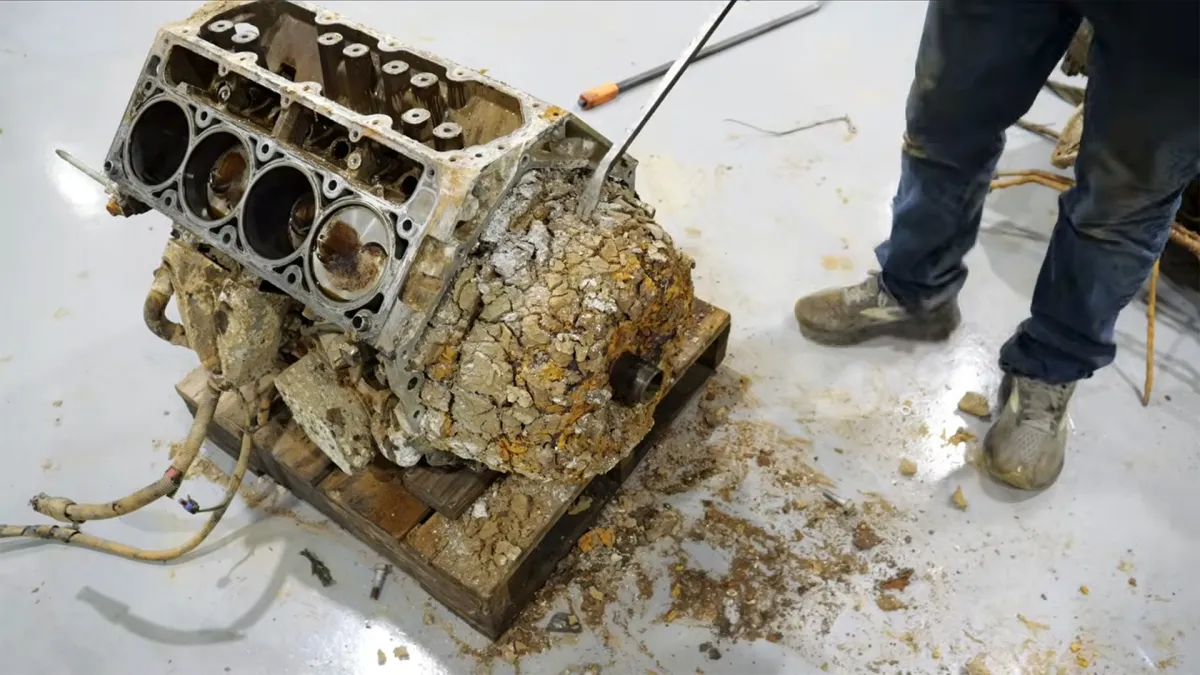
When you fish a car out of a lake or pond after it sat there for who knows how long, the results are always disgusting. I mean, what do you expect to find? A showroom beauty that just smells… fishy? Anywho, this 6.2-liter V8 out of a Chevy Camaro SS that was submerged in the Ohio River for years is a prime example. Not only are there rust and barnacles on the outside, but the inside is gross with mud, oil, and other types of slimy slime.
There’s an hour-long teardown video on the I Do Cars YouTube channel for those with time to kill. If you’re taking your union break, then stick with me for a minute or two. I’ll show and tell as briefly as I can while still showing just how bad this engine is.
I Do Cars via YouTube
A quick walkaround reveals a little bit about the sad state of this L99 V8, but not all of it. It’s difficult for Eric, the host, to even get a socket on most of the bolt heads as they’re caked with whatever-the-heck. There isn’t much silver left on this engine; really, it’s more orange and brown than anything.
Job number one was removing the drain plug. Once that was done, enough stagnant river water poured out to fill a Purina Tidy Cats litter container. Oil eventually followed, along with some nasty chunks of debris. Oi.
I Do Cars via YouTube
The intake manifold could have been far worse, but taking off the valve covers revealed some atrocities. The rockers were practically frozen with rust, and after further investigation, Eric discovered it was missing a pushrod. How does that happen? He suggests that someone might have removed it beforehand to hopefully solve a ticking problem, and y’know, I wouldn’t put anything past a fifth-gen Camaro owner. (I kid.)
Most of the cylinders were filled with mud, though surprisingly, the sleeves weren’t horrendously damaged. One was even clean, though that could have been because it sucked in some water before shutting down. There was still some rust that made the sleeves less than desirable. And since you can swap them out for a new set, I don’t know why anyone would want to try salvaging what was already there.
I Do Cars via YouTube
The pistons certainly didn’t fare any better, as Eric had to remove three rusty ones before getting the engine to turn. He did eventually force the crankshaft to rotate, which forced out tons of crumbly gunk. It took a lot of work to get there, though, and practically every step was filthy.
Maybe the most visually disturbing parts of the teardown were the camshaft removal (which Eric refers to as the “slime stick”), the bellhousing extraction, and the torque converter dislodging. I wouldn’t want any part of those jobs. But then again, this fella surely knew what he was getting into when he acquired the lump.
I Do Cars via YouTube
Having torn it down completely, Eric expressed how pleasantly surprised he was with the engine’s resistance to its surroundings. “This whole thing came apart. I did not expect any of that,” he said. “I broke one exhaust manifold bolt, but they do that when they’re not in rivers, or lakes, or ponds, or streams. I just can’t believe I got the whole thing apart.”
So, if anything, I guess we should give props to the team at General Motors. Here’s yet another reason to love the LS family of engines.
This LS Spent 4 YEARS In A River! Will It Come Apart AND What Survived? REEKS of Insurance Fraud!
Got a tip or question for the author? Contact them directly: caleb@thedrive.com
From running point on new car launch coverage to editing long-form features and reviews, Caleb does some of everything at The Drive. And he really, really loves trucks.
