

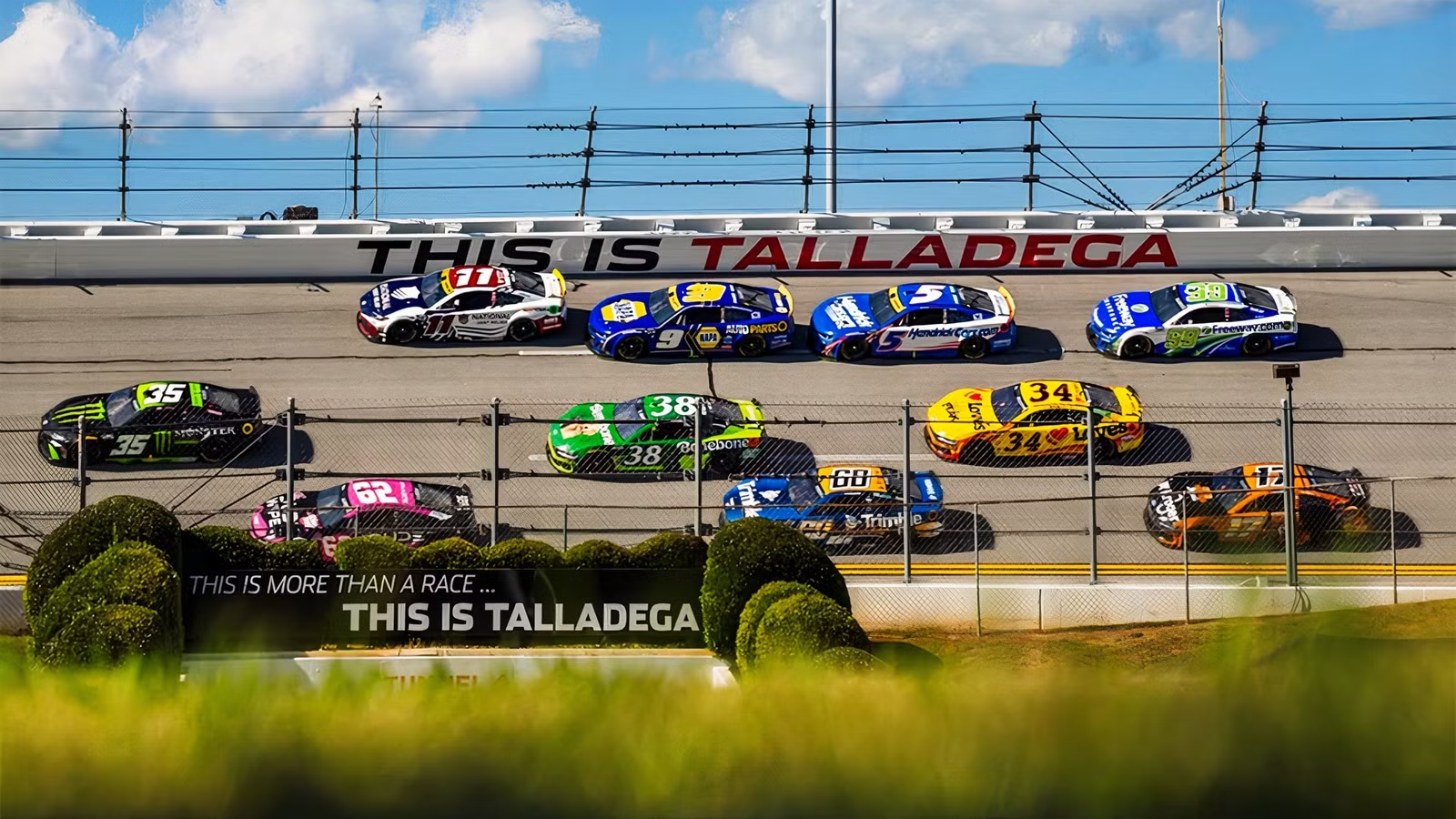
The roar of a naturally aspirated V8 engine echoing off the banking at Talladega isn’t just noise; it is the auditory signature of terminal velocity. For decades, aerodynamicists and fearless drivers have engaged in an arms race against atmospheric drag and centrifugal force. Asking how fast do NASCAR cars go requires separating restricted modern realities from unrestricted historical peaks. But whether your favorite driver is racing in a Mustang or Camaro (or a new Toyota Camry lookalike), there is a restriction everyone has to live by.
All information was correct at the time of writing as sourced from the authorities represented by the sport of NASCAR.
Fastest NASCAR Top Speed Ever!
nascar motorsport speed racingNASCAR / Facebook
Fastest NASCAR-Recognized Drivers
Driver
Bill Elliot
Rusty Wallace
Buddy Baker
Car
Ford Thunderbird
Dodge Intrepid
Dodge Charger Daytona
Speed
212.809 mph
228 mph
200.447 mph
Year
1987
2004
1970
Location
Talladega Superspeedway
Talladega Superspeedway
Talladega Superspeedway
To understand the true NASCAR top speed, we must look back to an era where unrestricted horsepower and aerodynamically slick cars ruled the track. In the 1980s and early 2000s, structural regulations allowed teams to push the absolute limits of mechanical grip and sheer power output. But there was an undeniable truth to these eras: stock cars are entirely capable of rivaling open-wheel aerodynamic speeds when untethered by governing bodies. Bill Elliott’s legendary 1987 qualifying lap remains the official record for a race weekend. His Ford Thunderbird sliced through the Alabama air at a sustained pace that terrified both drivers and officials.
“The fans went nuts. They loved it. They loved that stuff back then. The faster the better. We had worked so hard to get to that point that it was very satisfying from our end. We put a lot of effort into our speedway programs and already had really good power, so we were able to kind of marry it all together.”
– Bill Elliot, via Motorsport Tribune
However, Rusty Wallace’s 2004 test run represents the sheer, terrifying potential of modern aerodynamics combined with a de-restricted engine. NASCAR authorized Wallace to run a Dodge Intrepid without a restrictor plate, purely for data-gathering purposes. He pushed the machine to a staggering 228 mph down the backstretch. This guns-blazing demonstration proved that modern chassis designs are dramatically more slippery than the boxy steel frames of the 1980s.
Finally, Buddy Baker holds the historical milestone of shattering the 200-mph barrier on a closed course in 1970, driving the iconic winged Dodge Charger Daytona. This achievement forever altered the sport’s engineering trajectory, proving that extreme aerodynamic modifications were necessary to conquer the new superspeedways.
Origins Of The NASCAR Race Car
A Shady Start With 1920 Bootleggers
nascar motorsport speed racingNASCAR / Facebook
The genesis of America’s most prominent motorsport stems directly from criminal enterprise rather than structured athletic competition. During the Prohibition era, illicit alcohol distributors required vehicles capable of outmaneuvering federal agents on treacherous Appalachian mountain roads. This necessity birthed the first generation of high-performance mechanics who stripped excess weight, modified suspensions, and bored out Ford flathead V8 engines to maximize straight-line acceleration.
The structural rigidity and mechanical ingenuity developed in these clandestine garages formed the foundation for what would later become sanctioned racing. If a vehicle broke down during a high-speed pursuit, the consequences were jail time, or worse. That’s when reliability became just as important as raw pace. Beyond the pursuits, these bootleggers soon realized that their modified sedans possessed immense entertainment value. And this newfound entertainment led to weekend dirt track showdowns where drivers competed for bragging rights and prize money. The chaotic, unregulated races quickly swept across the rural southeastern United States, and later the country.
Daytona In 1948: A New Dawn
nascar motorsport speed racingNASCAR / Facebook
As the bootlegging era waned, the scattered dirt track events required formalization. In 1948, Bill France Sr. consolidated the broken regional rulesets into a single governing body, officially establishing NASCAR (National Association for Stock Car Auto Racing). The transition from chaotic races at Daytona to structured events on dedicated ovals legitimized the sport, and it attracted major corporate sponsorships and direct support from Detroit automakers.
This corporate involvement transformed the speed of NASCAR cars. Factory engineers began providing wind tunnel data, optimized chassis, and specialized racing components to their preferred teams. The aim shifted from merely finishing a race to dominating the field through superior aerodynamic efficiency and horsepower. The 1950s and 1960s saw a massive escalation in factory backing, culminating in the fierce “Aero Wars” where manufacturers designed dramatically sloped nose cones and massive rear wings to gain that last bit of advantage on the emerging high-banked superspeedways.
Record Challengers On The Oval
nascar motorsport speed racingNASCAR / Facebook
While Talladega dominates the stats ledgers, other tracks frequently pushed the boundaries of aerodynamic stability. Michigan International Speedway and Daytona International Speedway served as the primary battlegrounds for velocity supremacy. Throughout the 1970s and 1980s, determining the maximum NASCAR top speed mph became an obsessive pursuit for teams aiming to leverage their Sunday victories into Monday showroom sales.
Cale Yarborough cemented his legacy during the 1984 Daytona 500 qualifying, hitting 201.848 mph in a Chevrolet Monte Carlo. Yarborough’s run was a good example of how to use aerodynamic draft, proving that the slipstream effect was just as important as horsepower. Similarly, Richard Petty and David Pearson frequently pushed their specialized Plymouth Superbirds and Mercury Cyclones to the absolute edge of disaster on these banked ovals.
The continuous challenge for some or other record, especially speed, quickly moved away from solely pressing the throttle; it also required the often small adjustments to camber, tire pressure, and spoiler angles. Engineers shaved inches off the bodywork to reduce drag, and this meant operating within a gray area of the rulebook. This relentless pursuit of maximum velocity characterized NASCAR’s golden age of mechanical freedom.
When NASCAR Forced A Slow Down
All good things must come to an end. And if it’s not ending, then it must be slowed down. That’s what happened with NASCAR in the late ‘80s. The relentless chase for higher top speeds came to a sudden, disastrous halt during the Winston 500 at Talladega in 1987. Bobby Allison’s Buick LeSabre suffered a tire failure at over 200 mph, spinning backwards and generating immense aerodynamic lift. The 3,500-lb car went airborne, tearing down a massive section of the catchfence and nearly launching into the grandstands. It was a terrifying visual that forced the sport to reconsider its development trajectory. It was a rude awakening for the governing body upon realizing that the cars had outpaced the tracks’ safety infrastructure.
In response, NASCAR enforced an immediate mandate: the restrictor plate. This simple, square aluminum plate with four machined holes was mounted between the carburetor and the intake manifold. By choking the volume of air and fuel entering the engine, the vehicles were instantly restricted by nearly 300 hp. The top speeds at Daytona and Talladega plummeted from 212 mph down to a strictly managed 190 mph.
However, this new restriction came with a new challenge. While the plates indeed kept the cars grounded, they inadvertently created a dangerous new dynamic known as pack racing. Because no single car possessed the horsepower to break away from the aerodynamic draft, fields of 40 cars ran within inches of each other at 190 mph. This forced slowdown altered the strategic landscape, shifting the focus from individual on-track brilliance to drafting alliances with competitors and split-second survival instincts.
Why Don’t NASCAR Cars Look Fast?
nascar motorsport speed racingNASCAR / Facebook
If you’ve ever wondered why modern races seem visually slower than the unrestricted spectacles of the past, the answer lies within the heavily regulated architecture of the Gen 7 (Next Gen) car, introduced in 2022. NASCAR has systematically shifted its focus away from maximum velocity toward extreme parity, cost control, and driver safety.
Today, vehicles no longer utilize carburetors or restrictor plates. Instead, engine output is choked using tapered spacers and electronic fuel injection mapping. Depending on the track layout, engines will be allowed to run 510 hp, 670 hp, or 750 hp. The Gen 7 chassis also features a stepped front splitter, a massive rear diffuser, and a symmetrical composite body that generates incredible downforce. This high-downforce, high-drag aerodynamic package glues the car to the asphalt, allowing drivers to carry massive momentum through the corners.
Quick facts on the Gen 7 cars:
- 5.86L naturally aspirated V8
- 510/670/750 hp – track dependent
- ~530 lb-ft
- 5-speed sequential transaxle transmission
Can Top Speed Records Be Beat?
nascar motorsport speed racingNASCAR / Facebook
There’s a sobering reality to that question, because Bill Elliott’s official 212.809 mph qualifying record will stand forever. The nature and makeup of modern motorsport completely prohibit a return to the unchecked aerodynamic arms races of 1987.
Looking toward the 2030s, the potential integration of hybrid powertrains or complete electrification could theoretically inject massive torque into the sport. However, NASCAR will inevitably use software limits and aerodynamic drag to artificially suppress top speeds well below the 200-mph threshold. Just like it’s doing now. It might not be what fans want, but the liability associated with an airborne, 3,400-lb hybrid vehicle flying into a modern grandstand ensures that the governing body will maintain absolute control. This might seem frustrating on the surface, but making sure drivers and spectators are safe is the sport’s number one priority, because even with all the safety advances made over the last few decades, serious accidents still happen.
And that reiterates the reality: raw, terrifying terminal velocities are locked in the history books. Permanently.
Sources: NASCAR, Hendrick Motorsports, Motorsport Tribune, Speedway Media
