

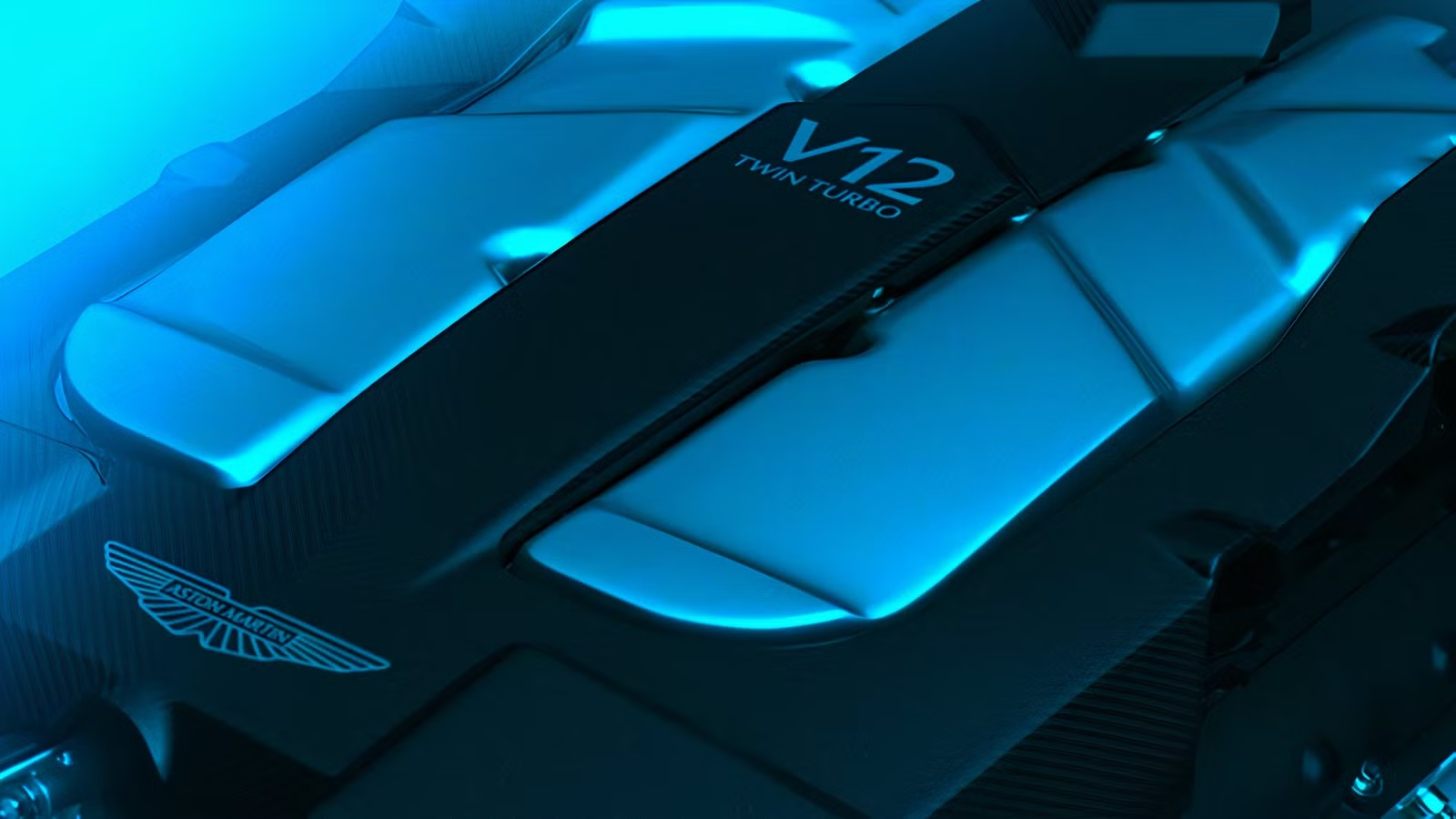
When the least expensive coupe in your lineup is knocking on $200,000, you know there’s room to maneuver in satisfying the appetite of well-financed car collectors who won’t flinch at $4 million for the F1-inspired Aston Martin Valkyrie hypercar. While the sky may be the limit for a brand like Aston Martin, there are actual limits that cannot be overcome at any price, such as regulatory hurdles that can render certain vehicles illegal or unavailable for sale in certain regions that want to replace internal-combustion engines with silent, zero-emission EVs.
There Are Fewer V12 Options Every Year
2026 Aston Martin Vantage SIan Wright/CarBuzz/Valnet
Yes, even the upper crust must sometimes abide by rules and regulations that often change with the political winds, and sometimes those political winds change so dramatically that old-school internal combustion holds on a little longer. Aston Martin, for instance, like many automakers, has pushed back plans for a battery-electric luxury car, but you should still expect to see one in the 2030s, according to an Auto Express interview with Aston CEO Adrian Hallmark.
While EVs might be on the backburner for now, Hallmark points to one powertrain sector that isn’t even close to the stove. “We don’t need plug-in hybrids” to be compliant with emerging Euro 7 regulations, he says, because driving data has confirmed what we’ve known for a while – that people who purchase PHEVs often fail to plug them in, resulting in more tailpipe emissions while adding cost, complexity, and weight for no good reason.
Related
Why Almost Every Major Automaker Is Starting To Quietly Kill The V6 Engine
And not all of them are downsizing, either.
At some point, V12s will likely be shelved, and Mercedes-Benz has already pulled its 6.0-liter twin-turbo V12 from the Mercedes-Maybach S 680, although BMW is still building 6.75-liter twin-turbo V12s for Rolls-Royce models for the foreseeable future, while the ultra-luxury brand has scrapped its previous plan to go fully electric by 2030.
Different Automakers, Different Strategies
Aston Martin appears to be more in line with the Rolls-Royce approach than the pre-emptive Maybach discontinuation. Yes, Hallmark says Aston Martin wants to simplify its powertrain offerings, but for now, the V12 engine could live on until Europe takes more drastic regulatory action.
2025 Aston Martin Vanquish heroJared Rosenholtz/CarBuzz/Valnet
“We’ve done some work to make the V12 compliant to European and US [regulations],” Hallmark tells Auto Express. “If we keep our V12 sales under 1,000 per year, then we’re exempt from legislation until 2035 at least.” That bodes well for Aston Martin V12s in today’s Vanquish and Valiant. The downside is limited production, meaning not everyone who wants a brand new V12 Aston can necessarily get one. That is, as long as demand doesn’t exceed 1,000 per year.
Hallmark also says Aston Martin is developing a clean-sheet modular architecture for a “revolutionary” new generation of sports cars and SUVs with stop/start 48-volt mild hybrid technology that still requires no-compromise internal-combustion power.
Related
Brabus Just Built The Most Badass Aston Martin Of All Time
Bespoke carbon fiber body. Twin-turbo V12 with 986 horsepower. Say hello to the Bodo.
CarBuzz Insight – Why This Matters:
As long as enthusiast collectors are eager to spend deep into six-figure territory for an Aston Martin, the folks in Gaydon, UK, will have money to develop more of them, while they explore ways to share more componentry across the lineup, allowing front-engine SUVs, mid-engine supercars, and even electric luxury cars to roll down the same line at some point in the future. It might sound bonkers, but that’s the out-of-the-box thinking that every automaker must entertain to secure its future. Nearly 20% of Aston Martins are sold with V12s, so any attempt to keep them relevant would be good for the bottom line.
Source: Auto Express
