

Today’s full-size pickup trucks are rolling living rooms — heated and ventilated seats, rear-seat entertainment, enough legroom to stretch out on a cross-country haul. It’s easy to forget that this wasn’t always the case. For most of the 20th century, truck cabs were strictly utilitarian: cramped, noisy, and about as comfortable as a park bench. Climate control was a luxury, seat adjustment was minimal, and anyone riding in back — if there even was a back — was essentially an afterthought. Old C-10s and Toyota pickups were appealing in their simplicity and rugged durability, but they were a far cry from the SUV-like trucks of the modern era.
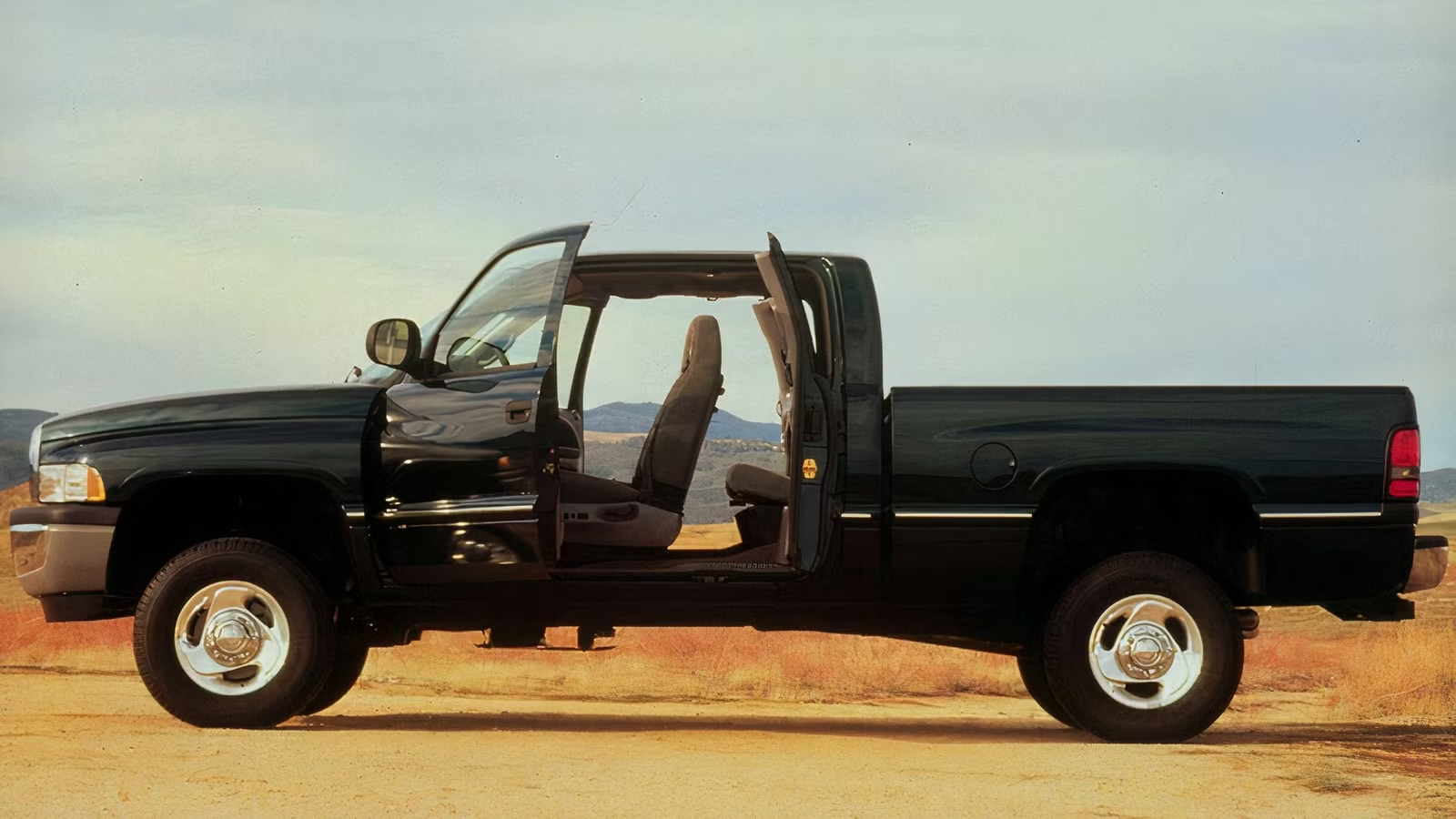
Someone was bound to crack the code eventually, but it was Ram that got there first — bringing a four-door, two-row crew cab to a standard-duty mass-production pickup with the 1998 Dodge Ram 1500. Further innovations, courtesy of both Ram and its competitors, would follow over the coming years, eventually producing the cushy full-size trucks we know and love today, but there’s a strong argument to be made that it all starts with the 1994 Dodge Ram 1500.
The Second-Gen Dodge Ram Kicked Off A Revolution In Truck Design
1998 Dodge Ram 1500 quad-cabDodge/Stellantis
In terms of performance specs, the 1998 Dodge Ram 1500 with the 5.2-liter V8 engine was in the same general ballpark as its competitors. A 1998 Ford F-150 with a 5.4-liter V8 would produce 235 hp, while a 1998 C/K with a 5.7-liter V8 would do 255 hp.
1998 Dodge Ram 1500 Quad Cab Performance Specs
Engine
5.2-Liter NA 8-Cylinder
Power
230 hp
Torque
300 lb-ft
Transmission
5-Speed Manual
Drivetrain
Rear or All-Wheel Drive
What really set the entire second generation of the Dodge Ram apart was the roomy interior. The second-gen Dodge Ram kicked off with the 1994 model, introduced in 1993, boasting a regular cab with reclining seats and behind-the-seat storage options. Those generous interior dimensions came directly from Dodge’s design team reaching out to actual truck buyers to learn what the American workforce truly needed in a pickup.
Take A Big Truck, And Make It Bigger
1998 Dodge Ram 1500 quad-cabDodge/Stellantis
By the late 1990s, Dodge was selling around 350,000 to 400,000 Rams a year, so the brand was clearly doing something right. The introduction of the clamshell-door quad cab for 1998 was an example of simply doubling down on what was already working: drivers wanted extra space, so Ram gave them even more of it, with four doors for easier access.
1998 Dodge Ram 1500 Quad Cab Interior Dimensions
Headroom Front/Rear
40.2/39.4 Inches
Legroom Front/Rear
41/31.6 Inches
Hiproom Front/Rear
65.6/65.6 Inches
Shoulder Room Front/Rear
66/67.7 Inches
If you were around to see these quad cabs first hit the road, they were a pretty big deal at the time. The rear-hinged back doors allowed passengers into the second row without requiring the front seats to fold down. Second rows in pickup trucks weren’t completely unheard of at the time, but full backseats were usually reserved for 2500s and super-duties. Gen X kids will no doubt remember being crammed into upright backseats with their knees up to their ears back in the day. In those days, the backseat of a truck was barely big enough to fit a toolbox, let alone two or three passengers of any size.
By the early ’00s, a full-size pickup truck without a four-door, two-row cab option was almost unheard of. The Chevy Silverado, introduced in 1998 for the 1999 model year, added a four-door option in 2000, and the Ford F-150 first became available with a full-size four-door SuperCrew cab in 2001. When the Toyota Tundra launched in 1999 for the 2000 model year, the four-door clamshell Access Cab was a no-brainer. The Ram 1500 set the bar, and Dodge’s competitors had no option but to clear it.
From Bare Bones To Luxury-Lite
1998 Dodge Ram 1500 quad-cabDodge/Stellantis
The 1925 Ford Model T Roadster is the vehicle most frequently credited as the first pickup, being sold with a pickup body to appeal to farmers who had been modifying Model Ts with custom-built cargo boxes. Gottlieb Daimler built a combustion-powered truck in 1896, but it wasn’t mass-produced, and electric trucks date back more than a century, though they were always produced in low numbers in the early days. Meanwhile, Ford sold 135,000 Model T pickups, so whether or not you want to credit it as the very first, it was certainly the model that put pickups on the map, proving there was a market for the work truck.
Similarly, the 1998 Ram 1500 was not actually the very first pickup truck to hit the market with a crew cab. Rather, it was the first standard-duty, mass-production, daily-driver pickup truck with what we consider to be a crew cab. International Harvester sold a three-door crew cab back in 1957, the Travelette, with a second row and seating for six, and the brand would later add a fourth door. But International Harvester produced only 72 of the three-door models in 1957, and the four-doors, produced in 1961, are similarly rare.
If You Want To Split Hairs, The 1998 Ram Wasn’t Even Dodge’s First Four-Door Pickup
Dodge was selling four-door pickups as early as 1961, although the brand employed a third-party contractor to build its four-doors after the truck had already rolled off the assembly line — so, again, not mass-production. In 1973, Dodge introduced the Club Cab, a regular cab stretched by 18 inches with a small back seat, but only two doors.
If you look at the history of the automotive industry, you often find that the “first” in any category was not technically the very first, but rather the first to mass-market. Farmers and ranchers were converting their Model Ts into pickups long before Ford decided to do it for them, and crew cabs have existed since at least the mid-20th century — just never as a standard option in a mass-production model. In other words: the 1998 Dodge Ram deserves the credit for bringing the modern crew cab into the mainstream, whether or not it was technically the first truck to ever feature four doors and two rows.
In The Market For A 27-Year-Old Pickup?
1998 Dodge Ram 1500 quad-cabDodge/Stellantis
The 1998 Dodge Ram is so old that the truck doesn’t even go by that name anymore — it’s been called the Ram pickup, or simply the Ram 1500, since the 2011 model year. So, technically speaking, they don’t even make this pickup anymore. And we’re here to tell you that you should seriously consider buying one.
We know that sounds bonkers, but Dodge Rams from this era are considered to be implausibly reliable. We once covered a Ram 3500 with more than two million miles on the odometer, and the Ram Forumz board is full of late-1990s Ram 1500 owners reporting a quarter million miles and up with no major mechanical issues. If you’re in the market for a now-and-then work truck, a 1998 Dodge Ram might be the last pickup you ever need for hauling the occasional sofa or carrying a load of gravel. Here’s what you can expect to pay for one, according to Kelley Blue Book.
Trim
Original MSRP
Fair Purchase Price
Club Cab
$3,376 – $3,800
$3,015 – $3,185
Quad Cab
$3,765 – $5,278
$3,150 – $4,605
Regular Cab
$4,743 – $5,419
$3,961 – $4,884
If you don’t mind something with a lot of miles on the odometer, you can practically buy a 1998 Dodge Ram for pocket change. Even a low-mileage model might sell for less than you’d spend on a brand-new economy car. We wouldn’t recommend a high-mileage 1998 Dodge Ram as a daily driver, but if you only need it to haul a few bales of hay now and then, there’s no reason you can’t keep it running for years to come.
Sources: Dodge, Smithsonian, Kelley Blue Book.
