

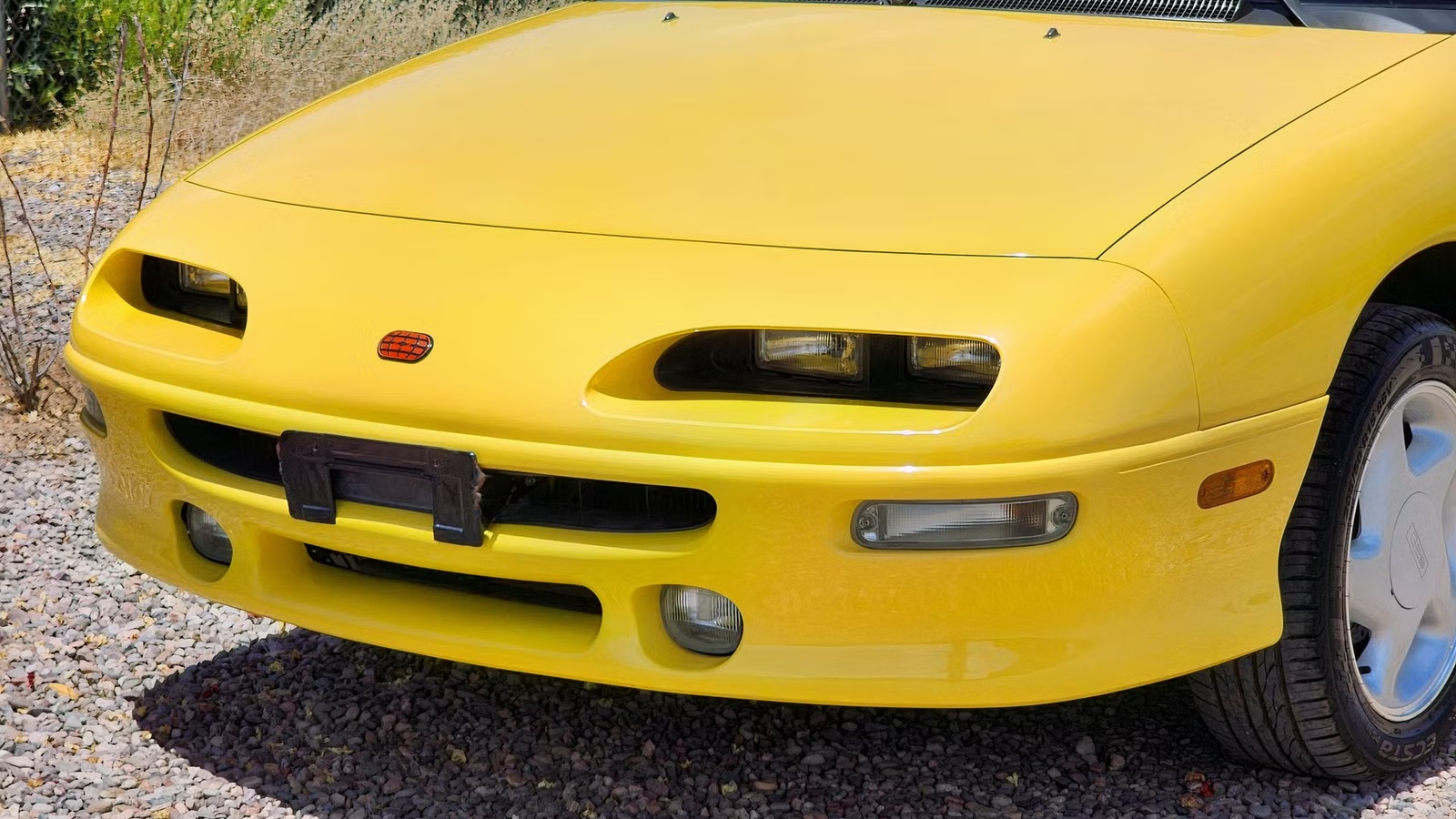
The automotive world was changing fast in the late 1980s and early 1990s, especially in the US. Consumers were beginning to abandon the old-school, personal luxury coupes in droves, seeking more exciting models made by foreign automakers. Namely, Japanese sports coupes were gaining traction in the American market quickly, leaving domestic brands to try and play catch-up. Think of models like the Ford Probe and the Dodge Stealth, both of which were USDM models meant to combat the Japanese sports coupe onslaught.
While the two domestic models listed above are well-remembered today, there were others that seemed to slip under the radar of history. The Geo Storm GSi is one of these left-behind models. The brand, Geo, was a subsidiary of General Motors for just eight years, from 1989 to 1997. The Storm coupe was an Isuzu-based model that was given a new badge and stripped of some luxuries. The GSi model was the hottest iteration, and its main objective was to be as good as a Japanese sports coupe without the higher price tag.
“Storming” Onto The Scene
1992 Geo Storm GSi finished in yellow with gray interiorCars & Bids
At its core, the Geo Storm GSi was an Isuzu Piazza/Impulse. During its model run spanning 1990 through 1993, it was offered alongside the Impulse, albeit at a lower price point. The Storm GSi was tasked with targeting a lower rung of the market, while also offering a decent amount of performance to boot. Unfortunately, the turbocharged engine found in the Isuzu Impulse RS was omitted from the Storm GSi’s offering list, as it had to make do with a 1.6-liter, naturally-aspirated mill upon its debut.
1992 Geo Storm GSi finished in yellow with gray interiorCars & Bids
When it first hit the market, the Storm GSi was stickered at just about $11,650. By 1992, its price had risen to approximately $13,300. This was, in some cases, much lower than some of its competitors. For comparison, the 1992 Mazda MX-3 GS carried a base MSRP of around $13,800, and the ’92 Mitsubishi Eclipse GS 2.0 stickered for approximately $13,889. However, the Geo was roughly $350 more expensive than the Nissan NX2000, a model that was introduced to the US market in 1992 as a replacement for the Pulsar NX.
1992 Geo Storm GSi finished in yellow with gray interiorCars & Bids
Along with its cheap price, the Storm GSi was praised for its handling and overall performance. During its debut model year, AutoWeek tested a GSi and stated that it was “a good performer” and was surprisingly agile for a sports model with such a low price. Road and Track also tested a Storm GSi, specifically around a skid pad, wherein it earned the highest lateral “g” rating of a reported 0.85g. The publication went on to say the model “…sticks like pine tar to the autocross course…”
The model was facelifted in 1992, when it gained a revised front and rear fascia.
Related
This Crazy ’80s Nissan Was A Coupe, Wagon, T-Top, And Pickup All In One
The ’80s was a time of invention, experimentation, and breaking new ground. Is that what Nissan was thinking with this shapeshifter coupe?
What Made The Storm GSi’s Thunder
1992 Geo Storm GSi finished in yellow with gray interiorCars & Bids
At first, the Geo Storm GSi came equipped with a small, 1.6-liter inline-four engine called the “4XE1”. The mill belongs to Isuzu’s “X” engine family, which carried other mills widely used by other, world market GM models. It featured a cast-iron engine block and an aluminum cylinder head, along with a near-square bore/stroke ratio, making it rather smooth in its operation. The Storm GSi took advantage of two overhead cams and four valves per cylinder. In some performance circles, the 4XE1 is informally referred to as the “Buzzbomb” due to its noisy, rev-happy nature.
Come 1992, the Storm GSi was given a new, larger mill. The new engine was a 1.8-liter unit carrying the engine code “4XF1.” For the most part, it was nearly identical to the replaced 4XE1, except for a longer piston stroke. Using the longer stroke, the new motor could deliver more torque alongside a wider power band, meaning it could throw out peak performance through a longer rev range. In situations where engine performance matters, like around a track, a wider power band is important.
1992 Geo Storm GSi finished in yellow with gray interiorCars & Bids
Backing up either the 1.6 or 1.8-liter engine is a standard five-speed manual transmission developed by Isuzu. It’s a close-ratio unit meant for quick circuit racing, rather than highway cruising. An optional four-speed automatic was offered, too. Front-wheel drive was the sole drivetrain option. Its fully-independent suspension setup is rather similar to the standard Storm, save for upgrades like a thicker sway bar on the rear axle and stiffer springs. However, it’s been reported that the Storm GSi is prone to understeer, even with the suspension upgrades.
Geo Storm GSi Specs
1.6L NA Inline-Four
1.8L NA Inline-Four
Horsepower
130 hp
140 hp
Torque
102 lb-ft
120 lb-ft
Cylinder Bore
3.15 in
Piston Stroke
3.11 in
3.54 in
Compression Ratio
9.8:1
9.7:1
Engine Redline
7,700 rpm
7,000 rpm
0-60 MPH Time
8.2 seconds
7.1 seconds
Top Speed
125–130 mph (est.)
Production Timeframe
1990–1991
1992–1993
*Specs courtesy of Storm specs database
Reliability Concerns
1992 Geo Storm GSi finished in yellow with gray interiorCars & Bids
Overall, the Storm GSi is known to be fairly reliable, even 30-odd years later. There are reports of overheating, and blown head gaskets are possible. However, the largest issue regarding overall reliability of the model is parts scarcity. Because of its Isuzu-built engines and manual transmission, should a component fail, finding an OEM replacement is, reportedly, virtually impossible. Some aftermarket support is out there, but not much.
Related
1990s Sports Cars That Deserve To Make A Comeback
Two doors, and fun to drive – yes, the 1990s had some classic sports cars. These names deserve to be revived again.
How It Compares To Its Rivals
While the American market was awash with different Japanese sports coupes in the early 1990s, the Nissan NX2000 and the Mazda MX-3 GS stand out as two of the Geo Storm GSi’s most direct competitors. So, let’s see how they stack up.
1992 Nissan NX2000
1991 Nissan NX2000 Red Front Angled ViewBring a Trailer
First up, we’ll take a look at the Nissan NX2000. Arguably, this little Nissan model is just as forgotten as the Storm GSi; it’s just that its brand name is much more widely known. When it first hit the market in 1992, Nissan positioned it as a cheap and cheerful sports car for the younger crowd. It boasts a 2.0-liter Nissan SR20DE inline-four-cylinder engine, either a five-speed manual or a four-speed automatic transmission, and a sport-tuned, fully-independent suspension.
Here’s a basic spec breakdown:
1992 Nissan NX2000
1992 Geo Storm GSi
Engine Details
2.0L NA inline-four
1.8L NA inline-four
Horsepower
140 hp
140 hp
Torque
132 lb-ft
120 lb-ft
0-60 MPH Time
7.5 seconds
7.1 seconds
Top Speed
126 mph
~130 mph (est.)
*Specs courtesy of Storm test results & Car and Driver
Based on the table above, both models are neck-and-neck in terms of on-paper performance. However, the Storm is known to be more agile on the track.
1992 Mazda MX-3 GS
1992 Mazda MX-3 ABS 1.8 Front AngleVauxford via Wikipedia
Here’s yet another seldom-remembered model, the Mazda MX-3 GS. Like the Nissan mentioned above, the MX-3 GS saw its debut model year in 1992. However, unlike the Nissan and Geo, the Mazda utilizes a tiny V6 engine measuring just 1.8 liters. The mill used a unique system in its intake manifold called Variable Resonance Induction System, or “VRIS”, which manipulated a series of butterfly valves under load to optimize torque delivery across the rev range. It also offered a choice between either a manual or automatic transmission, alongside a sport-tuned, adjustable suspension.
The specs:
1992 Mazda MX-3 GS
1992 Geo Storm GSi
Engine Details
1.8L NA V6
1.8L NA inline-four
Horsepower
130 hp
140 hp
Torque
118 lb-ft
120 lb-ft
0-60 MPH Time
7.4 seconds
7.1 seconds
Top Speed
127 mph
~130 mph (est.)
*Specs courtesy of StormOwners.com & Car and Driver
Yet again, the two models are extremely similar in their power outputs and 0-60 mph sprint times. However, it’s reported that the Mazda MX-3 GS is easier to drive, and handles smoother than the Geo.
Related
These Are 12 Of The Coolest Everyday Japanese Cars Of The 1990s
After the malaise of the previous decade, the 1990s were a new golden era for everyday performance, and Japanese automakers got in on the fun.
Pick One Up… If You Can Find One
1992 Geo Storm GSi finished in yellow with gray interiorCars & Bids
The Geo Storm GSi is one of those quirky, 90s-era sports coupes that can turn heads wherever you go. It’s also reasonably reliable, surprisingly nimble according to some authorities, and its divisive looks can easily draw a crowd at any car show or parking lot. While Geo managed to sell a fair number of Storms during its time—roughly 300,000—there aren’t many left on the roads. But, there aren’t many left on the roads.
Consequently, finding a GSi model for sale is a rarity. Only one has been sold on the popular auction website Cars & Bids, and it’s the same story with Bring A Trailer auctions. However, the C&B model sold for just $6,100 with 40,000 miles and a five-speed manual. So, that goes to show that if you can find one, it’ll be a cheap and fun way to pay homage to the 90s sports coupe scene.
Sources: StormOwners.com, StormOwners.com, Car and Driver, Cars & Bids.
