

UPDATE: 2026/06/22 12:52 EST BY SEAN MCMANUS
Even Other Unibody Trucks Have Split Body Panels
Added context to how other unibody trucks still split the body panels around their beds for easier replacement.
Imagine you owned a pickup truck and someone ran into the rear bedside as part of a relatively modest wreck. You’d take your truck to the body shop and ask them to fix everything in the normal course of business, but you’d quite rightly be amazed if the repair quote came to $14,000. But that’s exactly what happened to one Rivian R1T owner recently, who discovered some of the realities of owning an expensive truck.
The quoted number felt wildly out of proportion to the visible damage and shone a spotlight on the split-bodywork approach that manufacturers would usually take with these vehicles. Many OEMs expect pickup trucks to lead a hard life, with owners treating them as workhorses and taking them to places cars may not often venture. And although traditional truck design has long reflected that reality, Rivian went in a different direction with some interesting consequences for owners.
A Dinner Plate Dent Becomes A Five-Figure Warning
2022 – 2026 Rivian R1T Truck rear close-up view of the bumper while driving off roadRivian
2022 Rivian R1T Launch Edition Specifications
Motor
Four electric motors with large battery pack
Transmission
One-speed automatic direct drive
Drivetrain
AWD
Power
835 hp
Torque
908 lb.-ft.
While the Rivian R1T may be a truck at the end of the day, it’s also a fresh-sheet premium EV with stunning performance and a body that can often feel more sculpted than sectional. And many buyers who may not even purchase an R1T with truck capability front and center may come to find that it is indeed a truck when they get into a wreck.
In the normal course of business, the kind of damage indicated in the story above would be something that a truck owner would classify as painful but manageable. The damage wasn’t caused by a catastrophic crash of any kind, and the visible damage seemed to be concentrated on the rear bedside area alone. But as Rivian took a very distinctive approach to its truck design, the repair shop couldn’t limit its work to just the outer section.
Instead, it had to engage a much bigger and more invasive process. And this means that those complications can add up to be costlier than average if the base vehicle itself is a high-end machine. As repair processes never find their way into glossy marketing materials, most prospective buyers would be blissfully unaware of potential complications if they were to run into crash problems in the future.
Much of this has to do with positioning as Rivian launched the R1T as an electric adventure truck first and foremost. It had four motors with a huge straight-line pace, as well as air suspension and other trickery, and its design language suggested that it was different from any legacy pickup elsewhere. It could get to 60 mph in 3.0 seconds, and truth be told, most buyers weren’t necessarily focused on its payload or such down-to-earth details when they cut their initial check. However, the fact remains that if an expensive truck-shaped vehicle like this suffers truck-like body damage, then, with Rivian’s specific design approach, the bill would likely make headlines.
Trucks Typically Have Split Bodywork Because They’re Supposed To Be Fixable
2024 Rivian R1T Truck water fordingRivian
Manufacturers have historically used the split bodywork approach when building their trucks because these vehicles are meant to be workhorses. The pickup bed isn’t just a visual extension of the cabin, but its own functional zone that manufacturers expect to be damaged in the ordinary course of business. The bed may be scraped by cargo, dinged in the loading areas, or occasionally crushed by simple day-to-day mistakes. And over time, traditional truck design has evolved to treat this bodywork area as likely to require repair, which is why serviceability matters so much.
Ford presents a good example, and one of its standalone service parts for the F-150 is a “truck bed panel body side,” for $770, where the entire outer side of the bed is one replaceable component. Here, Ford is assuming that real-world use will occasionally damage that area without destroying the whole vehicle, and it’s making the bed structure a sacrificial or serviceable part of the truck’s working body.
In other words, split bodywork should help to localize damage and limit significant teardowns. The theory is that this type of bodywork reduces the extent to which a low-speed hit can spread the cost into surrounding systems, affecting labor time in the shop and bringing more complexity elsewhere. And on a vehicle that someone buys purely for utilitarian purposes, that logic seems relatively sound.
Rivian Broke With The Old Logic
2024 Rivian R1T Truck with the bed openRivian
Conventional working trucks are one thing, but the Rivian R1T is probably another. Here, Rivian took a distinct design approach, engineering this as a premium EV first and a truck second, and not as a legacy half-tonner that just happens to have batteries. The end result was extraordinary, as the R1T’s early quad-motor setup could produce 835 hp and 908 lb.-ft of torque, coming to the market at $85,000 as the Launch Edition.
Rivian’s premium clean-sheet thinking spilled over into the body design, and visually the R1T looks far less sectional than a traditional pickup. It’s certainly one of the best-looking trucks from the EV era so far, and it doesn’t speak the language of compromise like so many early pick-ups.
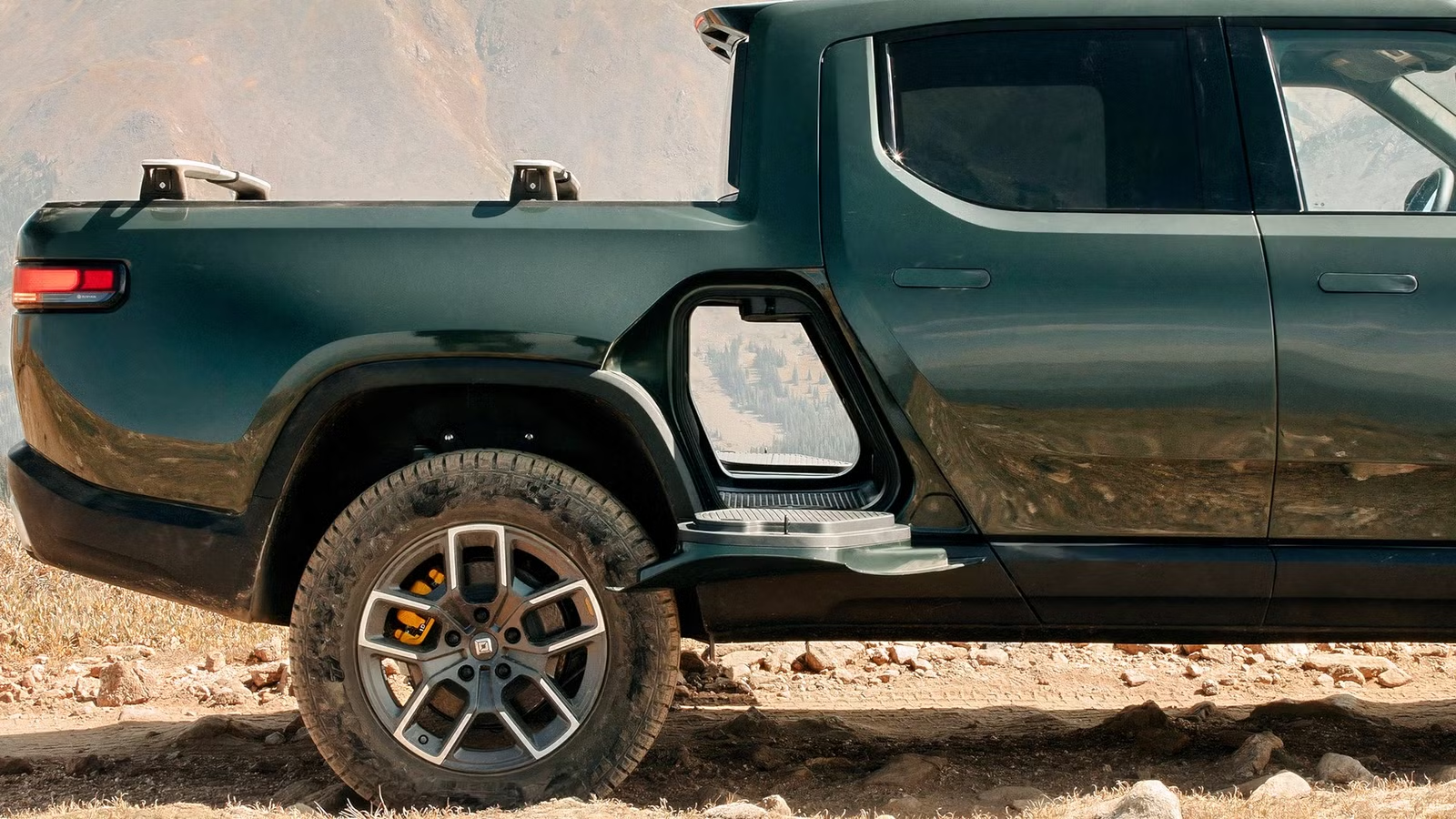
But that cleaner integration appears to come with a hidden cost if you want to use your R1T as a proper truck, because Rivian took such an integrated approach to its overall design that it subsequently became harder to cleanly isolate damage. The R1T has a single-piece outer body panel that runs continuously from the front A-pillar to the tailgate. And this means that even routine work might involve cutting the structural C-pillar or replacing the entire side aperture.
In the aftermarket, Rivian appears to understand the challenges caused by those fender benders and has set up a repair ecosystem to tackle collision repairs. It’s established a network of Rivian-Certified Collision Centers with trained technicians on board who perform work to strict Rivian specifications. Those certified locations also manage diagnostics and calibrations, and the company is clearly trying to handle its affairs sensibly from a quality control and safety perspective.
Related
Rivian Wants To Bring An Innovative Truck Feature To SUVs
And it could make charging a far more pleasant experience.
But the overall picture tells you that this is no old-school pickup, and its ownership proposition is different. A local body shop may be able to straighten out moderate truck damage on familiar vehicles using tried-and-tested repair logic. But as that R1T bedside panel issue shows, this is far more than just a repair of one panel. Instead, it underlines the broader consequence of fixing a more tightly packaged premium product.
Truck Damage Is Supposed To Be Normal, Not Exceptional
2024 Rivian R1T Truck side-profile with the front doors openRivian
Buyers of a niche super sedan or a six-figure sports coupe might shrug and accept costly body repairs, but those are very different machines next to a pickup truck. After all, those pickups carry a distinct set of ownership assumptions, and even if they’re expensive, they’re supposed to tow, haul, spend time on trails, or pick up your stuff from a hardware store. They’re far more likely than a typical passenger car to sustain the kind of low- to medium-speed body damage that split bodywork could (usually) manage.
Related
Rivian’s Hidden Emergency Door Handles Are So Concerning That Owners Are Tying Parachute Cords To Them
This is a stupid problem with a simple homemade solution.
This highlights the stark difference between Rivian’s truck design philosophy and the reality of normal truck use, even if Rivian did give the R1T some serious capability. With a payload of around 1,760 lb. and up to 11,000 lb. of towing capacity in some forms, the company certainly wasn’t shying away from the overall definition of a truck. But the harder you use a truck like this, the more valuable that old-fashioned repair-minded thinking becomes.
At the end of the day, the R1T isn’t a bad truck at all, and it’s one of the most impressive electric pickups you can get. It can still be brilliant, even with a design compromise that can become a headline maker after the honeymoon period. But while the R1T’s integrated bedside flatters the truck when new, it might punish the owner when normal truck life intervenes.
More Costs To Take Into Account: Expected Maintenance
Press image of 2022 Rivian R1T – front 3.4 angle close-up of the grille in a line with other trucksRivian
Not only will body damage to an R1T cost a pretty penny to fix, owners should be aware of potential repair and maintenance costs. Just because it’s an electric vehicle, doesn’t mean it’s free of maintenance entirely. The major repairs or maintenance items to be aware of include tires, brakes, and suspension components. According to Recharged, an R1T’s five-year scheduled maintenance should cost about $1,500. That includes maintenance at the intervals of 1–2 years, year 3, then year 5.
After the first year or two of ownership, buyers should pay for a tire rotation, multipoint inspection, cabin filter, wiper blades, and other small items. Once an owner reaches year three, they should consider a brake fluid flush, HVAC service for those in particularly harsh climates, another tire rotation, and multipoint inspection. Year five is where it could get more expensive, since the truck may need new tires at this point — tires for the truck’s 20 to 22-inch wheels could cost around $1,000 for a basic all-weather set these days, or well over $1,000 for an all-terrain upgrade.
Why Depreciation Sharpens The Risk
2024 Rivian R1T Truck front view on the roadRivian
Used R1Ts are now beginning to tempt people who might never have paid early-adopter money for one, and this can make a truck that has fallen sharply in value look like a bargain on paper. But that’s where the bodywork, design, and potential future repair bills come into the picture and may trouble excited owners down the road.
The challenge may start to come into sharper focus when you consider that the Rivian R1T has depreciated a lot in its four-year history. It’s lost as much as ~42% of its initial value against an average of 32.9% for the pick-up segment as a whole. And that translates to an average value of around $49,234 in the CarBuzz Marketplace for the R1T. This suggests that a used R1T could be affordable to buy sooner than many people expected, but still, that future body damage risk hangs over it like a black cloud.
Rivian certainly challenged the old split-bodywork approach by building a cleaner, smarter, and more distinctive electric pickup. But if the vehicle sustains a modest bumper hit, the old split-bodywork approach would seem like a better bet. And it makes you wonder if Rivian should have adopted that legacy truck convention. Perhaps it should have expected its owners to use their trucks hard and sustain damage while also expecting repairs to stay local, predictable, and survivable.
But Rivian took its own design approach, moving away from split bodywork, with the cost of ignoring that logic is now becoming clearer. And those who may be considering a used R1T might want to take Rivian’s bodywork design approach into account rather than get carried away with those acceleration figures.
Even Other Unibody Trucks Have Split Body Panels
2026 Ford Maverick Lariat side angle in red while parked in a studioFord
There have been a handful of unibody trucks in recent years: the Rivian R1T is the biggest, often competing with other half-ton electric trucks like the GMC Sierra EV, but smaller models like the Hyundai Santa Cruz, Ford Maverick, and even the midsize Honda Ridgeline all use unibody construction. That said, building a truck like they would a car doesn’t always mean sacrificing truck-like practicality. They still have beds, therefore they’re prone to damage in most of the same ways one could expect a full-size pickup to suffer.
Pictured above is the Ford Maverick. Even though it’s built like a car, the bed’s side panel is split from the rest of the body with a small gap just above the bed line, behind the rear window, separating it from the roof panel. Ford OEM Parts Online offers a replacement that fits the 2026 Maverick for $553.
The Hyundai Santa Cruz isn’t on sale anymore, but also offers split body panels for the rear bumper, side bed panels, roof, and so on. All this is to say that Rivian took the difficult route that might look sleek, but it costs owners thousands of dollars more than it should to replace.
Sources: Rivian, Ford, Hyundai, Recharged
