

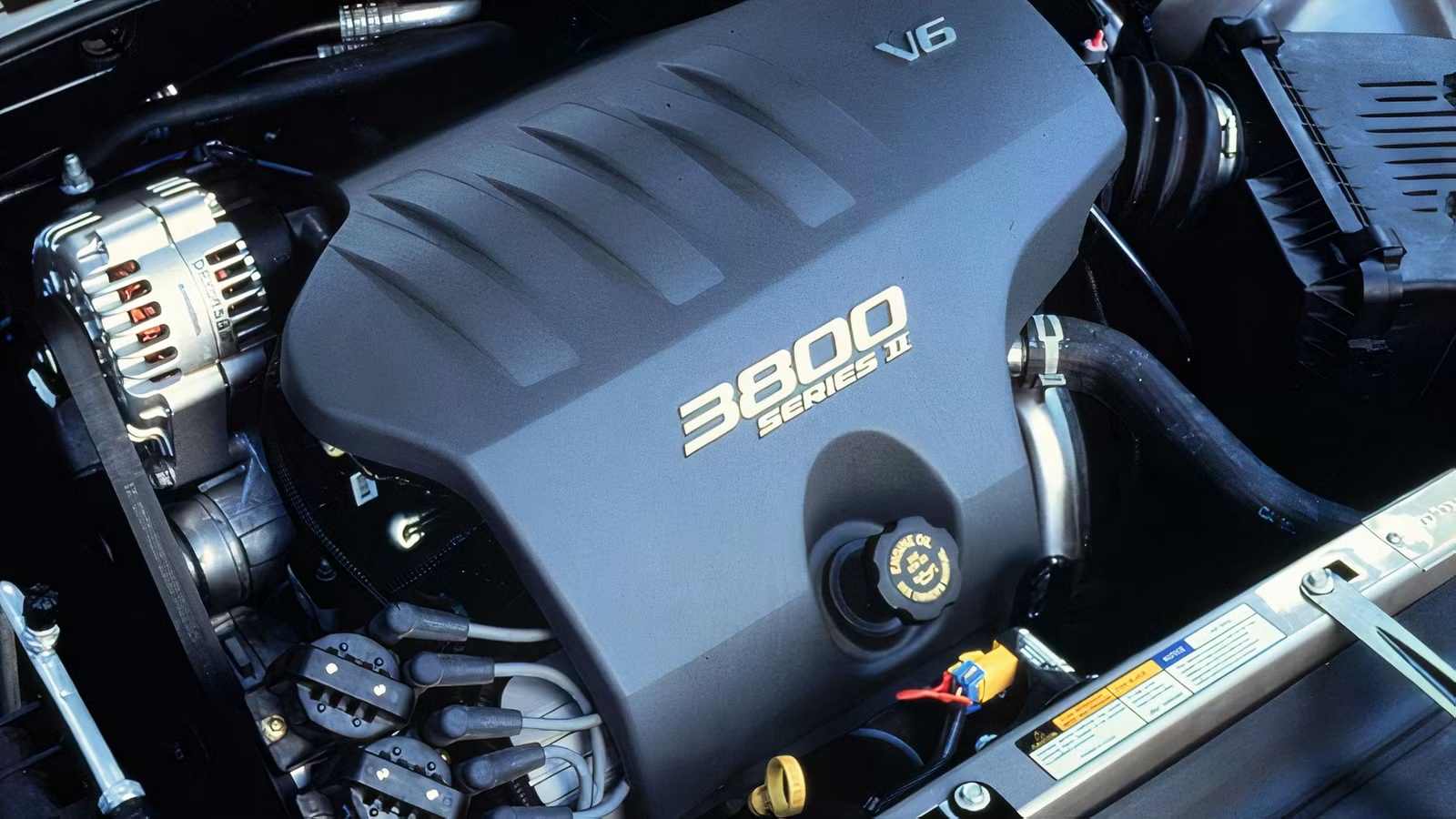
In the grand scheme of things, numerous automakers have, at one point, produced an engine that earned itself worldwide fame. Some easy examples include the Chevrolet small-block V8, which has consistently shown itself to be one of – if not the – most versatile engine(s) ever produced. You also have mills like the Jaguar XK inline-six and the Honda K-Series inline-fours. There are tons of other examples, but we’d fill up too much space listing them out.
However, some engines that deserved fame simply slipped under the radar. One of the most shining examples of this unfortunate fact is Buick’s 3800 Series V6. It was based on an old design, and ended up being one of the most dependable engines ever produced in the United States, perhaps even the world. It stuck around for a few decades, and spanned three total generations before its axing at the end of the 2000s. If any engine deserves a crown that didn’t get one, it’s this one.
What Makes The 3800 So Reliable
1996 Buick Regal 3800 V6Bring A Trailer
At its core, the Buick 3800 V6 was a very old engine. Its forefather, the Buick Fireball V6, first hit the market in 1961. It was based on Buick’s 215 CID V8, which was an all-aluminum design, something virtually unheard of at the time. However, the Fireball forwent the aluminum construction and opted for cast iron, instead. From there, Buick continued to produce the Fireball V6 in various sizes and iterations until 1988, when it was significantly updated. That year, the first 3800 Series V6 hit the market as the “Pre-Series I”, followed by the Series I in 1990, the Series II in 1996, and the Series III in 2004. The latter two are widely considered to be the most reliable, especially the Series II flavor.
As far as its reliability is concerned, the Series II and III are regarded as extremely reliable, especially the former. In essence, the 3800 was overengineered and under-stressed in its naturally aspirated variation. A large portion of its durability is owed to its cast iron construction, wherein both the block and cylinder heads utilized the material. This is especially notable considering, by the 2000s, a large majority of road-going engines had switched to aluminum construction.
1997 – 2003 Pontiac Grand Prix SedanPontiac
In addition to its iron-clad make-up, the 3800 is also designed as a pushrod engine. This means that its camshaft is buried within the mill, rather than placed on top of the valvetrain like in overhead cam motors. This allows the 3800’s valvetrain to be much less complicated, and uses a simpler valvetrain layout than an overhead-cam engine.
Related
Here’s How You Can Have The World’s Most Reliable V6 For Pocket Change
On a budget, but needing reliability? This V6 has you covered in droves.
Changes Through The Years: Series II and III
2001 Buick LeSabre finished in tan with tan interiorCars & Bids
Series II (1995–2005)
By 1995, the Series II iteration entered the fold, widely regarded as the best of the three 3800-Series versions. Like the Series I, the Series II sported things like a balance shaft, which countered the vibrations caused by the crankshaft’s rotation. It also came standard with multiport fuel injection. However, its deck height – or the distance from the crankshaft’s center line to the cylinder head mating surface – was shorter. Upon its debut, the naturally aspirated Series II offered 205 horsepower and 230 pound-feet of torque.
Numerous other upgrades were seen, as well. Its crankshaft was completely redesigned to offer a smoother method of operation, and the connecting rods were shortened to match the smaller deck height. A higher compression ratio, larger valves, and a better-breathing intake manifold was installed, too. Interestingly, despite its near-peerless penchant for reliability, the 3800 Series II engine did not offer any forged internals.
As far as applications go, the Series II saw use in numerous models, many of which weren’t Buicks:
1996–2005 Buick LeSabre
1995–2005 Buick Park Avenue
1996–2004 Buick Regal LS
1995–1997 Buick Riviera
1996–2002 Chevrolet Camaro
2000–2005 Chevrolet Impala
1998–1999 Chevrolet Lumina LTZ
1998–2005 Chevrolet Monte Carlo
1995–1996 Oldsmobile Ninety-Eight
1995–1999 Oldsmobile Eighty-Eight
1998–1999 Oldsmobile Intrigue
1996–1998 Oldsmobile LSS
1997–1998 Oldsmobile Regency
1995–2005 Pontiac Bonneville
1996–2002 Pontiac Firebird
1997–2003 Pontiac Grand Prix
Series III (2004–2009)
buick 3800 v6Buick
While the Series II still had a year left in its tenure, GM released its Series III successor. Many of the core attributes of the Series II were carried over, such as its balance shaft and cast iron construction. However, an all-new aluminum intake manifold was installed. Electronic throttle control also came standard, replacing the old-school mechanical linkage. As of 2005, all Series III 3800s came with upgraded, sinter-forged connecting rods, replacing the older cast iron ones.
Another novel piece of engineering called returnless fuel injection was introduced. This means that the computer-controlled fuel injection system supplies the exact amount of fuel required for the motor’s operation at any given time, eliminating the need for a return line. Prior to the introduction of the tech, excess fuel that wasn’t needed was pumped back into the fuel tank to be reused later on.
In total, the Series III’s scope of application was vastly reduced compared to the Series II:
2004–2008 Pontiac Grand Prix
2005–2009 Buick LaCrosse
2006–2008 Buick Lucerne
You Could Have Your 3800 With Forced Induction, Too
2005 Pontiac Grand Prix supercharged 3800 V6Pontiac
On top of the huge number of naturally aspirated models, GM also offered the 3800 Series engine with a supercharger on loads of different models. The mill first started sporting forced induction in 1991 on the Buick Park Avenue Ultra, followed by a few other models. However, once the Series II hit the market, use of the supercharged 3800 exploded. It continued into the third Series, as well, albeit on a much smaller scale.
GM employed the use of an Eaton M90 Gen III supercharger for the Series II mill, which added 35hp and 50 lb-ft of torque right off the bat. The engine’s compression ratio was lowered, as well, via the use of different pistons. Series III supercharged models took advantage of an Eaton M90 Gen 5 supercharger, which upped horsepower output from the 240 seen in the previous Series II to 260 ponies. Premium fuel is recommended for both Series II and III supercharged versions.
Related
This Famous V6 Is The Second-Best Engine Ever, And It’s Bolted In A Dirt Cheap Car
Want to own a piece of General Motors history? Luckily, you won’t need very deep pockets to do so with this model.
Best 3800-Equipped Models To Buy
2001 Buick LeSabre finished in tan with tan interiorCars & Bids
Because the 3800 engine is so widely regarded as extremely reliable, you can’t really go wrong with buying any of the models that utilize the mill. However, you do need to keep in mind that cars, like people, age. When cars age, things begin to break down. Old gaskets begin to leak, rust eats through brake lines, and parts simply break due to having too much time under their belts.
Even the most reliable cars, when subjected to enough time passing, will begin to have issues. However, there are some 3800-equipped models that still hold up today.
2005 Buick LeSabre
2001 Buick LeSabre finished in tan with tan interiorCars & Bids
Power
205 hp
Torque
230 lb-ft
Current Used Pricing
$3,500
2005 marked the final year for the iconic Buick LeSabre namesake, ending a 46-year run. The 2005 model year is part of its eighth generation. Today, the ’05 LeSabre is 21 years old, but many folks still swear by its reliability. It packs a Series II 3800 V6 under its hood, and makes use of a 4T65-E four-speed automatic transmission. Some potential issues to keep in mind about the 2005 LeSabres are things like failing instrument clusters and power window actuators.
2008 Buick Lucerne
2008 Buick LucerneWikimedia Commons: Elise240SX
Power
197 hp
Torque
227 lb-ft
Current Used Pricing (CX)
$4,375
The final full-size Buick sedan to offer a 3800 Series V6 came about in 2008 as the Lucerne. The Lucerne as a whole was introduced in 2006 to replace both the Buick LeSabre and Park Avenue, along with acting as a large sedan for any folks who still preferred a big-bodied, soft-riding Buick. Under its hood is a Series III 3800 V6 hooked up to the same 4T65-E transmission found in the aforementioned Buick LeSabre. Some common issues include a failing heated washer fluid system, ignition issues, and failing fuel pumps.
Sources: GM Heritage, Kelley Blue Book.
