

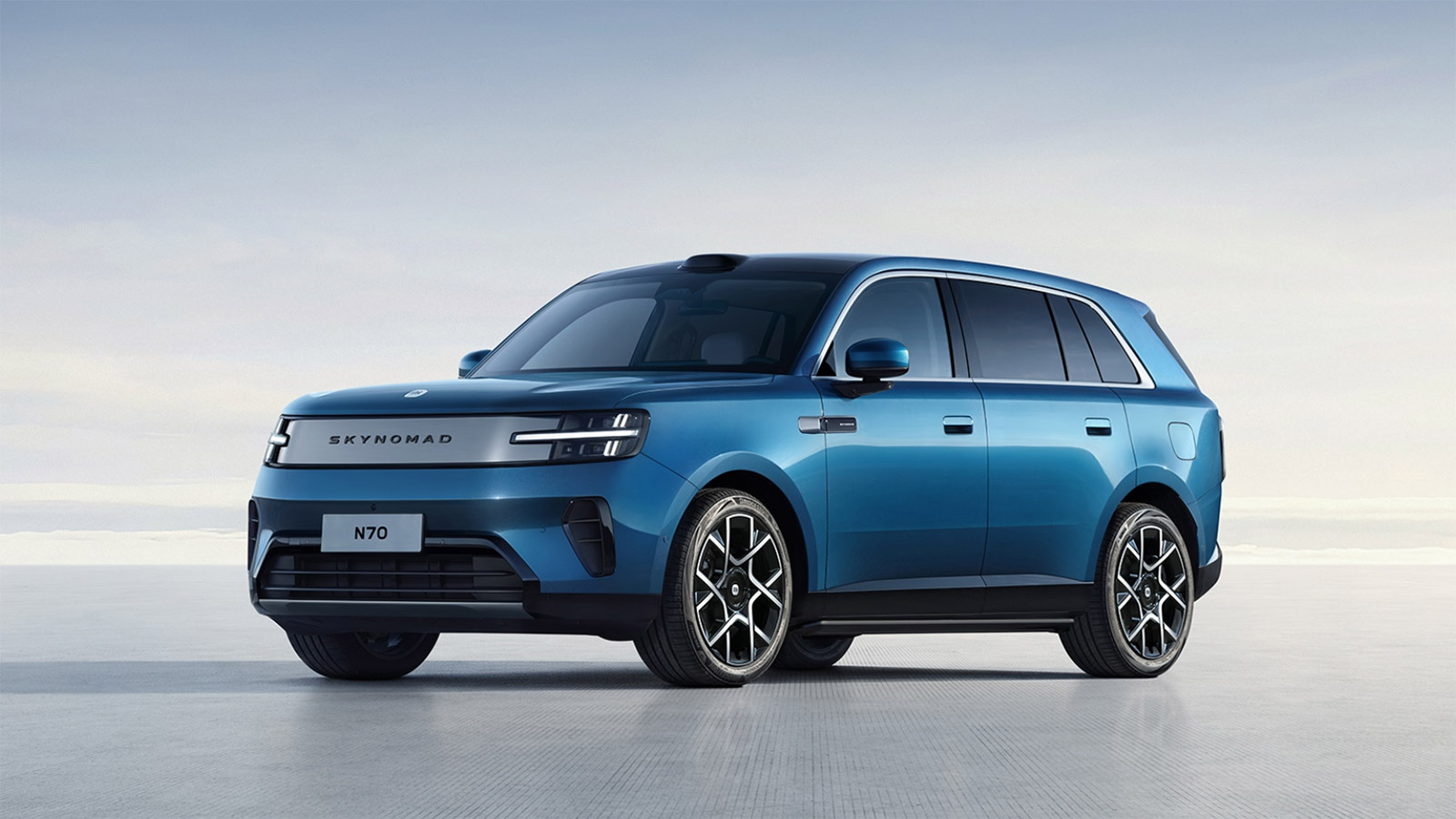
The Xiaomi Sky Nomad N70 series offers 5-seat extended-range SUVs starting at 209,900 yuan ($30,960). Credit: Xiaomi.
- The Sky Nomad lineup starts at 209,900 yuan ($30,960) and will be key to Xiaomi’s push for 550,000 deliveries this year.
- The new lineup offers 5-seat and 7-seat layouts, with up to 505 kilometers of battery range.
Xiaomi (HKEX: 1810) on Monday launched its Sky Nomad lineup of extended-range SUVs (sport utility vehicles), seeking growth through a broader price range and more family-oriented offerings.
The lineup starts at 209,900 yuan ($30,960), marking Xiaomi Auto’s first expansion beyond battery electric vehicles into the extended-range electric vehicle (EREV) segment.
The initial lineup includes the 5-seat N70 Pro and N70 Max, and the 7-seat N90 Max. The company also introduced a 5-seat N90 Max Explorer edition, extending its offerings to camping uses.
The N70 Pro and N70 Max start at 209,900 yuan and 239,900 yuan, respectively. The N90 Max and its Explorer edition are priced at 269,900 yuan and 299,900 yuan.
The N70 Max is priced 20,000 yuan below its pre-sales price announced on July 30, while the N90 Max is 30,000 yuan lower, reductions of about 7.7% and 10%, respectively.
Xiaomi Sky Nomad N70:
The lineup will broaden Xiaomi Auto’s potential customer base. Its automotive business previously relied on the SU7 sedan and YU7 SUV, both battery electric vehicles.
The N70 series is positioned as a mid-to-large-size 5-seat SUV, measuring 4,960 mm long and 1,998 mm wide, with a 2,950 mm wheelbase. It emphasizes rear-seat space and flexible cabin layouts.
The entry-level N70 Pro has a single-motor, front-wheel-drive powertrain with a maximum output of 210 kW (282 hp). It can accelerate from 0 to 100 km/h in 7.9 seconds.
That version carries a 52-kWh lithium iron phosphate battery, delivering a CLTC electric range of 351 kilometers and a combined range of 1,351 kilometers with a full tank and battery.
The N70 Max upgrades to dual-motor all-wheel drive with a maximum output of 310 kW, cutting the 0-to-100 km/h acceleration time to 5.5 seconds. Air springs and continuously variable dampers are standard.
Its 76-kWh ternary lithium battery provides a CLTC battery-only range of 505 kilometers and a combined range of 1,461 kilometers. Xiaomi said a 15-minute charge can add up to 310 kilometers of range.
Xiaomi Sky Nomad N90 Max:
Xiaomi Sky Nomad N90 Max Explorer edition:
The N70 series comes standard with a sliding center console and a 9-liter refrigerator. Optional swiveling front seats allow occupants to face each other while parked. A 21.4-inch rear entertainment screen is also optional.
The larger N90 Max has a 2+2+3 seating arrangement for 7 occupants. It measures 5,285 mm long, 1,998 mm wide and 1,825 mm tall, with a 3,080 mm wheelbase.
It also features a 76-kWh battery and a 310-kW dual-motor all-wheel-drive system, delivering a CLTC electric range of 464 kilometers and a combined range of 1,705 kilometers.
The N90 Max comes standard with air springs and can accelerate from 0 to 100 km/h in 5.9 seconds. Seats in the first 2 rows offer massage functions, while the sliding center console and swiveling seats expand the cabin’s uses while parked.
The Explorer edition’s main selling point is a factory-integrated power pop-top roof. When raised, it creates a separate upper-level space and increases the maximum interior height to 2,294 mm.
This version has 5 seats, rear seats that fold flat into a bed, and underfloor heating. Its CLTC electric range is 462 kilometers, with a combined range of 1,688 kilometers.
Xiaomi said the pop-top roof can only be used while parked away from public roads.
All Sky Nomad variants feature a 1.5-liter turbocharged range extender that supports China’s 92-octane gasoline. According to official specifications, each version can charge from 20% to 80% in as little as 18 minutes.
The lineup comes standard with Xiaomi HAD (Hyper Autonomous Driving) driver assistance, powered by a Nvidia (NASDAQ: NVDA) Drive Thor chip with 700 TOPS of computing power.
The N70 Pro and N70 Max each have 1 LiDAR sensor. The N90 Max and its Explorer edition have 2, facing forward and rearward. All versions also feature 4D millimeter-wave radar.
The cabin runs Xiaomi HyperOS and uses a Snapdragon 8 Gen 3 chip. It supports Xiao AI voice control and connectivity between smartphones, vehicles and smart home devices.
The launch comes as Xiaomi Auto seeks to accelerate deliveries and narrow the gap with its annual target. The company’s founder, chairman and CEO Lei Jun said earlier Monday that cumulative vehicle deliveries had exceeded 800,000.
Xiaomi Auto delivered 216,322 vehicles in the first 7 months of this year, up 14.83% from a year earlier, according to data compiled by CnEVPost. The company previously said August deliveries exceeded 30,000, without disclosing an exact figure.
Xiaomi Auto Monthly Deliveries 2024-2026
Month
2024
2025
2026
January
22,897
39,002
February
23,728
20,414
March
29,244
21,440
April
7,058
28,585
36,702
May
8,630
28,013
32,759
June
14,296
25,459
34,738
July
13,120
30,452
31,267
August
13,111
36,396
September
13,559
41,948
October
20,726
48,654
November
23,156
46,249
December
25,815
50,212
Xiaomi Auto monthly deliveries
2024
2025
2026
Using the August lower bound of 30,000 vehicles, Xiaomi would have achieved about 44.8% of its 550,000 annual delivery target in the first 8 months. It would need to average about 75,900 deliveries a month over the final 4 months.
Xiaomi is entering an EREV market that has recently come under pressure, although Lei has repeatedly said he believes the segment still offers substantial opportunities.
China’s retail sales of EREVs fell 15.35% year-on-year to 535,000 from January through July, according to the China Passenger Car Association (CPCA).
Lei said on Weibo earlier today that peers including Li Auto (NASDAQ: LI) continue to demonstrate that consumers are willing to pay for well-designed extended-range vehicles.
Xiaomi Auto signed MoUs with an initial group of 8 German automotive dealer groups and will enter the European market in 2027.
($1 = 6.7795 yuan)
