

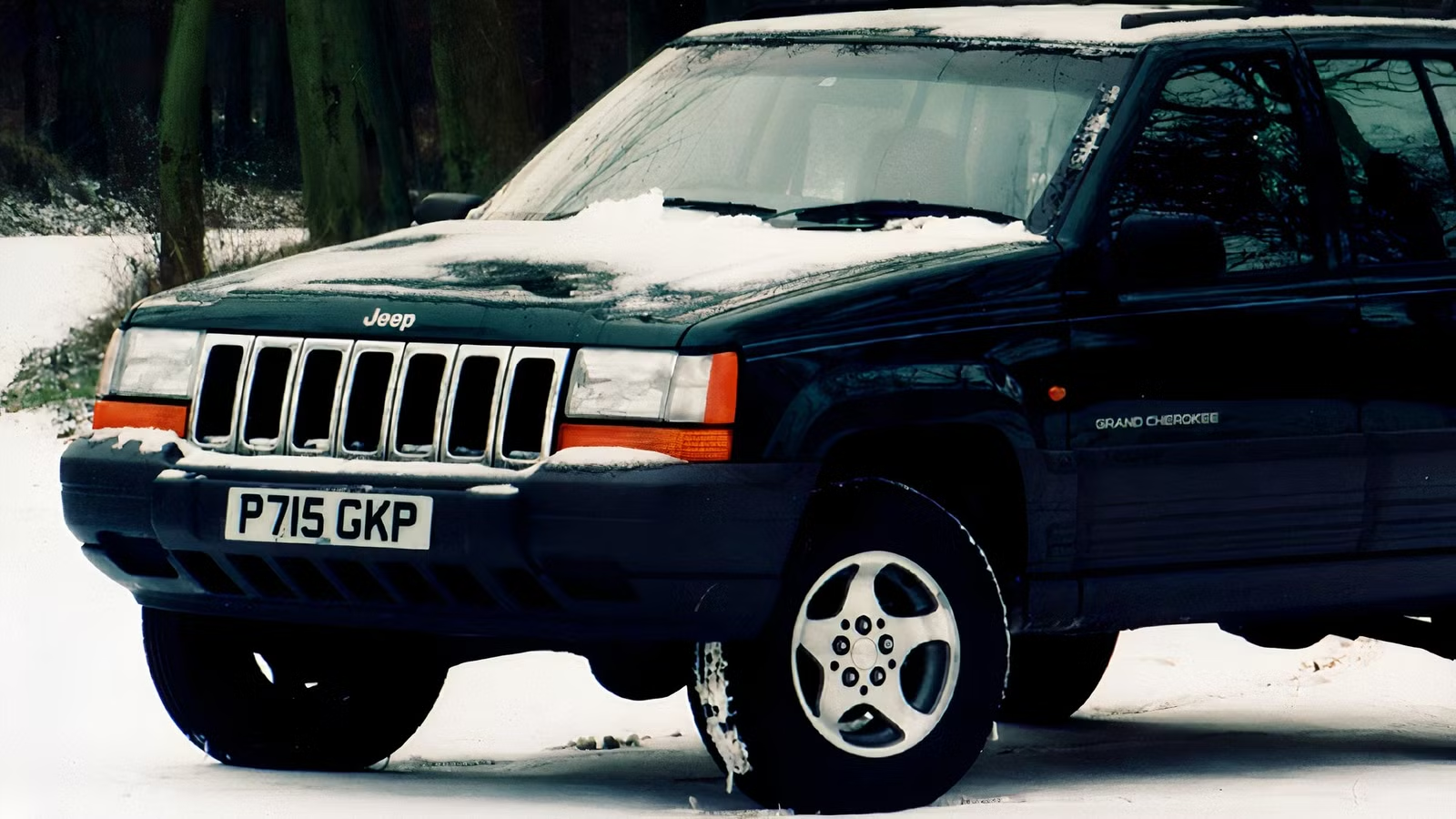
When it comes to famous automotive engines, the V8 typically receives most of the fame. There’s something about having eight cylinders arranged in a “V” formation that captivates most of the world’s gearheads. Its sound, its historical significance, and its use in virtually all classic muscle cars, pickup trucks, and the large majority of sports cars all come together to make the V8 one of, if not the most famous motor ever conceived by mankind.
Because the V8 gets all the credit, some other engines fall through the proverbial cracks. Take the AMC straight-six, for example. It was never particularly powerful or interesting, but it’s widely known as one of the most reliable engines made in the modern era. It was largely used by Jeep models, which carved out a reputation for reliable off-roading on the backbone of the humble six-pot. Because of this, many of AMC’s once-famous V8s were picked off one by one while its straight-six stood the test of time.
Here’s why.
One Of The World’s Greatest, Least-Exciting Engines
To find the Jeep 4.0-liter inline-six’s roots, you have to travel back to a time when The Beatles had just landed in the US and nobody had even heard of the Vietnam War on a massive scale yet. It was 1964, and AMC had just introduced the first member of its straight-six engine family: the 232 CID iteration. If you want to get technical, you can argue that the motor’s roots actually reside in the 1941 Nash engine, but those engines and AMC’s 232 CID mill did sport a few, distinct differences.
Once the AMC straight-six was off and running throughout the mid-1960s, few noticed it. It served as the base-spec power plant for a few models, including the AMC Marlin, Rambler Classic, and Rambler American. In 1965, another mill joined the then-new AMC straight-six family: a 199 CID iteration. Come 1971, another notable variation of the family entered the fold, the long-standing 258 CID mill.
AMC Straight Six 4 literBring a Trailer
In a nutshell, the philosophy behind the AMC straight-six engine family was pure simplicity, in both operation and maintenance practices. It was to be understressed, under-revved, and over-built in order to achieve the maximum amount of longevity and durability. All members of the engine family came standard with a seven-bearing crankshaft. It also had a cast-iron block and cylinder head, and featured a lower-than-typical compression ratio. At the same time, some members of the family, namely the 258 CID iteration, were under-square.
Until a lot of time has passed, most people don’t covet an engine for its ability to quietly keep running. Most of the time, the thumping-great, high-revving, loud engines get all the credit, even if they blow themselves up left and right. The AMC six, on the other hand, poured its greatest strength into its quiet ability to outlast everyone else on the market. There’s no shortage of AMC Six owners reporting total mileage amounts in excess of 200, and even 300,000 miles.
Related
Ford Quietly Made One Of The Most Reliable Engines In History
Unless you’re in-the-know, you may have never heard of this stupendously-reliable Ford engine.
Boring Turned Out To Be Brilliant
An image of the 1982 Jeep CJ-7 Jamboree Edition 4.2-liter inline-six.Bring A Trailer
AMC Straight-Six Family Specs
Displacement
199–282 CID (3.3–4.6 liters)
Horsepower
100–190 hp
Torque
182–280 lb-ft
Cylinder Bore
3.75–3.917 in
Piston Stroke
3.00–3.895 in
Compression Ratio
7.7:1–9.5:1
Production Timeframe
1964–2006
In engineering terms, the AMC straight-six’s highlights are as understated as you can get. For example, its seven-bearing crankshaft is unique in that every single one of its points is supported. This means that the likelihood of a catastrophic failure regarding the crankshaft is virtually impossible, as something else in the mill would probably go wrong before that crank came unseated or otherwise broke away from its lashings. Seven bearings also made the crank much more stable at high revs, and long-term wear is reduced due to said stability.
Its low-compression nature also helped it continue on long after other engines had faltered. A lower-than-standard compression ratio means that the AMC straight-six was anything but a hot engine. Basically, more compression in an engine increases engine power. This is because, in effect, combustion power is increased as an engine’s compression ratio is increased. But the AMC six wasn’t interested in making power; it was interested in living a long life. The highest compression ratio found on any stock AMC six was around 9.5:1. For context, many engines in the late 1960s and very early 1970s sported compression ratios of around 10.0:1 to 11.0:1.
An image of the 258ci inline-six in a 1983 Jeep CJ-7 Laredo.Bring A Trailer
The family’s under-square nature was another key ingredient in its long-lasting recipe. An engine that boasts an under-square configuration uses a piston stroke that is longer than its cylinder bores are wide. A setup such as this lends itself to more low-end torque at the expense of horsepower, as well as maximum revs. In an engine designed for longevity, you’d want an under-squared setup. Low-end torque keeps the engine from being taxed too heavily, and a lower rev limit means it carries less risk of spinning a rod bearing or floating valves. However, some iterations of the AMC Six family, such as the most famous 4.0-liter mill, were over-square.
Because AMC effectively refused to chase performance at any point during the AMC straight-six’s lifespan, the company inadvertently managed to create one of the world’s most reliable and trusted off-road engines ever produced, which is why the off-roading community is full of enthusiasts singing the engine family’s praises.
Related
Pros And Cons Of Inline-6 Engines
Simplicity makes the inline-6 one of the most well-loved engine configurations in the automotive world. But what are the drawbacks?
The V8 Was Flashier—But At A Cost
1974 Bricklin SV-1 5.9L 360 CI AMC V8 Engine Air Cleaner Side View StickerBring A Trailer
One of the most famous V8s ever produced by AMC was the 360 CID mill, which first hit the market back in 1970. While produced by the same company, the 360 CID engine was the natural enemy to the AMC Six. Both were featured in numerous models, prompting customers to choose between bulletproof longevity with modest power output or the opposite with the V8. When we say the 360 CID engine was unreliable, we have facts to prove it.
One of the hallmarks of the 360’s penchant for untrustworthiness was its very apparent and widespread oiling issues. Its oil pump was extremely prone to failure and was housed within the engine’s aluminum timing cover. Over time, the cover would degrade and warp, leading to slight losses in oil pressure which, in turn, would damage the pump slowly. After a while, the pump would fail completely and, if not caught in time, could lead to engine seizure due to oil starvation.
1974 Bricklin SV-1 5.9L 360 CI AMC V8 EngineBring A Trailer
Sure, the 360 mill made more power in 1970, with a horsepower output of up to 290 ponies with a four-barrel carburetor compared to the 232 CID straight-six’s 145 horses. However, what you lost in power with the six you gained in peace of mind, something you can’t really put a price on. Because of this, more and more Jeep owners turned to the humble six over the 360 V8 due to the latter’s issues with oiling, allowing the former to quietly outlive its main rival.
Related
The New Technology Giving BMW M Inline-6s A New Lease On Life
BMW M Ignite technology: Innovative new technology for all six-cylinder in-line engines from BMW M.
What Came Next Proved The AMC Six’s Success
The two main members of the old-school AMC straight-six family, the 232 and 258 CID engines, managed to clear a path through an amalgam of unreliable and otherwise problematic AMC engines throughout the years, the 360 CID V8 being one of them. As time wore on and more and more emissions regulations changed, the AMC six needed to continue to evolve. However, once AMC was purchased outright by Chrysler in 1987, the now-former automaker’s inline-six engine was revamped into a next-gen iteration informally referred to as the 4.0-liter.
Little was changed regarding the original AMC straight-six formula, apart from all-new RENIX engine diagnostic technology, which itself was complex. However, the 4.0-liter engine as a whole went on to become the most famous member of the original family by far. It was used by virtually every Jeep from its introduction in 1987 to its eventual discontinuation in 2006, 42 years after the first member of the AMC Six family hit the market. These days, off-road enthusiasts and others still seek out Jeeps built with the 4.0-liter six under their hoods. The engines still enjoy extensive aftermarket support, not to mention ease of repair and affordable components.
Interestingly, while many other domestic automakers are remembered for their fire-breathing V8s, AMC is remembered for a very different engine that was nearly the exact opposite of all the other popular ones.
Sources: Stellantis/Jeep, TheAMCForum.com, Jeep Wrangler TJ Forum, Motor Trend.
