

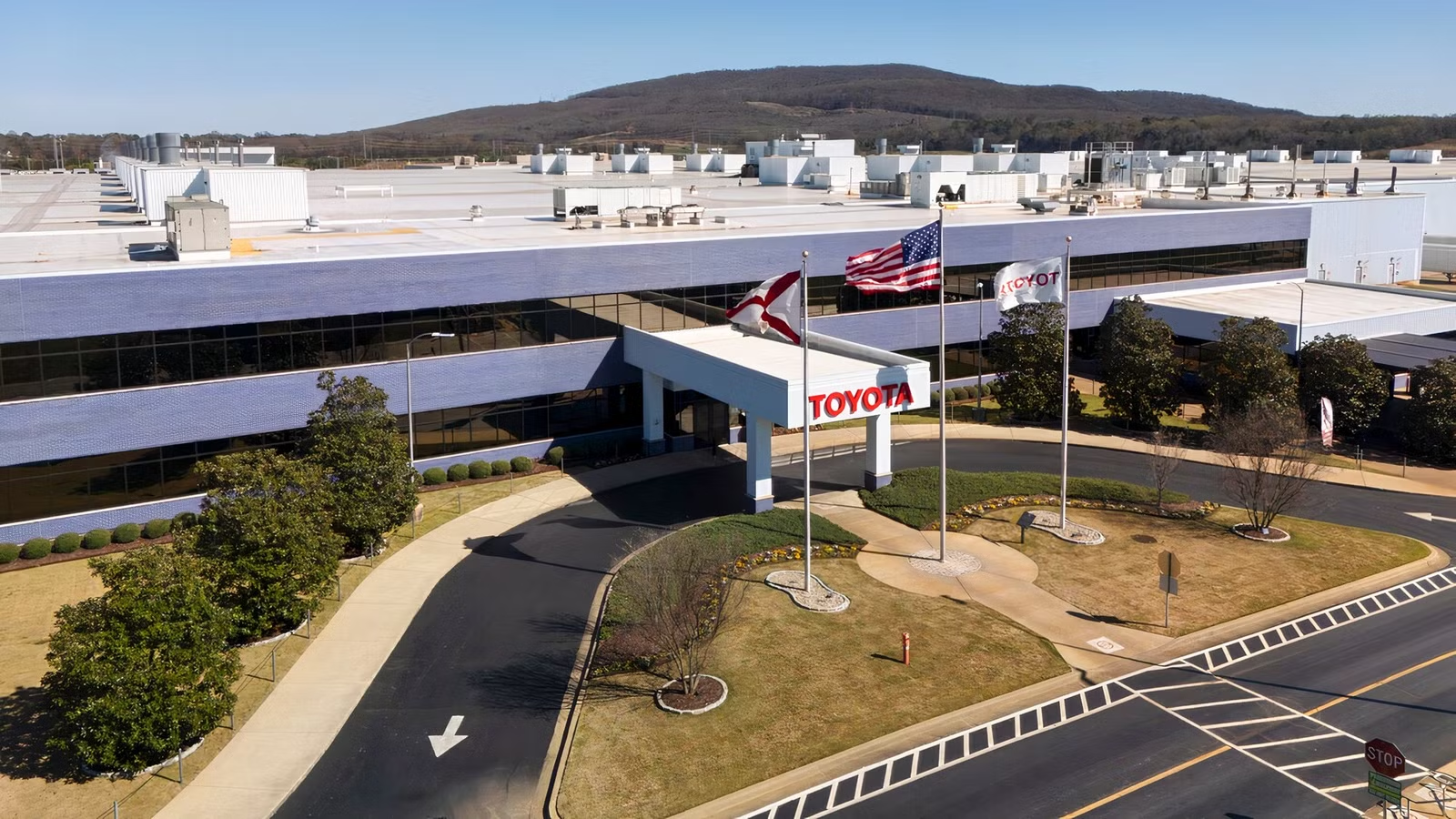
Toyota has a strong manufacturing footprint in the US, and one of those places is celebrating a birthday. Venture south – way south – and you’ll find a place solely dedicated to engines. It’s been that way for 25 years, and Toyota shows no signs of letting up. In fact, the investments are ongoing.
We’re talking about Toyota’s big Huntsville, Alabama plant, which at its current pace assembles almost one million engines and 500,000 differentials each year. Toyota says the total engines made at the plant is around 11 million so far. Back in 2001, the plant started out as a $220 million investment but has grown into a $1.7 billion manufacturing facility. In 2025, another $282 million investment expanded the plant’s production capabilities to include the assembly of three new differentials.
Here’s how it all started, and how it’s all going so far.
It Started With A Truck Engine
Exterior view of the Toyota TundraToyota
When the first line opened in Alabama, it produced the 3.4-liter V6 for the Toyota Tundra. At that time, the Tundra’s optional 4.7-liter V8 was built in Japan. However, the 3.4-liter had a much shorter trip from assembly line to truck, as it was assembled in Princeton, Indiana. Now, the Huntsville plant builds four- and six-cylinder engines for the majority of Toyota vehicles assembled in North America.
”Toyota Alabama’s decades of growth and success are a testament to our 2,400 committed team members. Their dedication, skill, and passion make Toyota a leader in quality and innovation. We are proud of every team member who contributes to this legacy.”
– Marc Perry, president of Toyota Alabama.
Toyota is keen to point out that it celebrated its legacy by awarding five local nonprofits with $25,000 donations, totaling $125,000 and supporting students at Driving Possibilities schools. Driving Possibilities is a national STEM (Science, Technology, Engineering, Math) education initiative. Which, in Toyota vehicle terms, is the equivalent of giving each nonprofit a Toyota Corolla Hybrid LE.
Toyota Isn’t Slowing Down In Alabama
Mazda Toyota plant in Huntsville, AlabamaMazda Toyota Manufacturing
In 2018, Toyota and Mazda announced a joint $1.6 billion investment in a new automotive production facility in Huntsville, which grew to 2.3 billion. The deal was reported to include roughly $800–900 million in tax incentives to Toyota and Mazda through municipal, county, and state sources, including $380 million from the state. It wasn’t just about giant tax incentives, though, as much of Toyota’s supply chain is built up in Alabama and nearby states.
Related
Toyota Has Built A Whole Bunch Of Hybrids In Indiana
It’s also built a lot of non-hybrid cars there.
“We are honored to have Toyota Alabama as one of the premier members of our business community,” said Chip Cherry, Huntsville/Madison County chamber president and CEO. “Toyota Alabama is the gold standard for community engagement. We are proud that one third of Toyotas on the road in the US have an engine made in Huntsville. The Toyota Alabama team has worked to help make our region stronger through their engagement in civic and educational endeavors. We look forward to working with Toyota Alabama for many years to come!”
CarBuzz Insight – Why This Matters
Mercedes Tuscaloosa Alabama FactoryMercedes
Toyota has a massive presence in Indiana and Kentucky, as well as Alabama. Indeed, the American South has become the backbone of the US automotive industry for foreign automakers. There are a multitude of reasons the south has ended up producing what’s estimated to be half the cars manufactured in the US. Those reasons include, but are not limited to, strong tax incentives and a large pool of willing, hard-working – but crucially non-unionized – workers.
Related
Honda’s Engine Plant In Ohio Just Celebrated A Big Milestone
Honda has been busy building things in the US for decades.
Foreign automakers have increasingly spread operations into the US since the early days of Volkswagen and Honda, back in the late 1970s and early 1980s.Currently, BMW, Mercedes-Benz, Hyundai, Kia, Subaru, Nissan, and, of course, Toyota all have significant production capability in the US. That amounts to significant investments in American manufacturing, resources, and workers.
