

The inline-six is having a genuine moment. After years of being sidelined by downsized four-cylinders and turbocharged V6s, the configuration is back in the spotlight — this time as a premium powertrain choice from Stellantis, which markets a modern 3.0-liter twin-turbo inline-six under the Hurricane name. It’s a bold badge for a bold engine, but what many buyers don’t realize is that the Hurricane name itself stretches back more than seven decades, to a very different, post-war America.
Underdog American manufacturer Willys Overland first applied the Hurricane badge to a family of engines in the early 1950s, covering both four- and six-cylinder designs. The four-cylinder Hurricane went on to enjoy a long service life in Jeep applications like the CJ from 1953 to 1971, permanently tying the name to off-road durability.
But perhaps the most compelling link between the Hurricane inline-six and the configuration Stellantis employs today is Willys’ early-1950s passenger-car push, embodied by the Willys Aero — a story that traces back over 70 years. There is no direct engineering lineage connecting these two bookends, but the philosophical connection is hard to ignore.
After all, as the industry faces another pivotal moment of transition, it may be rediscovering some original mechanical answers to help it through — and the inline-six is one of them.
Willys Introduced The Hurricane Inline-Six Long Before Stellantis
1952 Willys AeroBring a Trailer
Comparison (Hurricane Inline-Six Engines)
1952 Willys Aero
2026 Jeep Grand Wagoneer
Vehicle
Compact passenger sedan
Full-size luxury SUV
Engine
2.6-liter naturally aspirated
3.0-liter twin turbocharged
Power
75–90 hp
420 hp
Torque
140–160 (Approx)
468 lb-ft
Valvetrain
F-head (intake OHV / exhaust in block)
24-valve DOHC
Compression Ratio
7.6:1
10.4:1
At the beginning of the 1950s, Willys Overland was working to reposition itself beyond basic utility machines and military contracts. The Hurricane inline-six was central to that effort, debuting in the 1952 Willys Aero as a 2.6-liter unit producing around 90 hp — engineered for smooth, dependable everyday use rather than outright excitement.
The engine used the company’s F-head architecture, which placed intake valves in the cylinder head and exhaust valves in the block. Willys considered this a practical middle ground: better breathing than a flathead design, without the added complexity and cost of a full overhead-valve layout. Its long-stroke proportions further reinforced relaxed drivability and strong low-speed torque.
The Hurricane inline-six had a relatively short life in the US passenger-car market, but the idea didn’t vanish altogether. Willys continued building and evolving the engine in markets like South America long after withdrawing it from domestic passenger-car production. Versions of the Hurricane inline-six powered models such as the Willys Aero 2600 and Itamaraty 3000, extending the engine family’s life into the early 1970s. That chapter closed when Ford acquired Willys’ Brazilian operations and transitioned those platforms to its own engines.
The Original Hurricane Delivered Torque, Not Thrills
1955 Jeep CJ-5 with Willys Hurricane F-head inline-four (F134)Bring a Trailer
There was nothing spectacular about the Hurricane inline-six in terms of raw output, but it was dependable and predictable at a time when American buyers prized effortless performance over anything flashy. The inline-six layout is inherently well-balanced, reducing vibration and earning the engine a reputation as a genuinely smooth operator. Willys engineers tuned it conservatively, prioritizing durability and reasonable fuel economy for a cost-conscious public.
Alongside the inline-six program, Willys also developed four-cylinder variants. Most notably, the F-head four was produced in large numbers and became a staple of Jeep manufacturing. It powered a wide range of CJ models that buyers chose for rugged reliability rather than refinement, and in doing so, the Hurricane name became synonymous with off-road dependability — a reputation that would resonate with enthusiasts for generations.
Perhaps the four-cylinder variant ultimately defined the Hurricane’s public legacy, but the inline-six was the engine that expressed Willys’ passenger-car ambitions. Both engines were simple and built for long-term durability with generous usable torque, yet the inline-six would soon fade from mainstream awareness even as the inline-four endured.
The Hurricane Name Disappeared, Even Though The Idea Never Did
Stellantis Hurricane 4 EngineStellantis
The Hurricane inline-six was never a flawed engine — its disappearance owed more to corporate priorities than any technical shortcoming. As Willys shifted its focus increasingly toward Jeep products, particularly through its Kaiser ownership phase, passenger cars became a secondary concern. With V8 engines coming to dominate the American market, the inline-six was steadily pushed toward more utilitarian roles or overseas production, while the four-cylinder Hurricane lived on in Jeep CJ models.
The company also licensed production abroad — including Mitsubishi-built Jeeps in Japan — reinforcing the engine’s image of off-road toughness. As a result, the Hurricane name survived, but in four-cylinder form rather than six. Those inline-six origins gradually faded from memory, and there is no continuous development path connecting the original Willys Hurricane engines to later Chrysler or Jeep inline-six programs.
The Stellantis Hurricane Inline-Six Proves That The Industry Has Come Full Circle
2023 Jeep Wagoneer Maroon Front View Parked at a HouseJeep
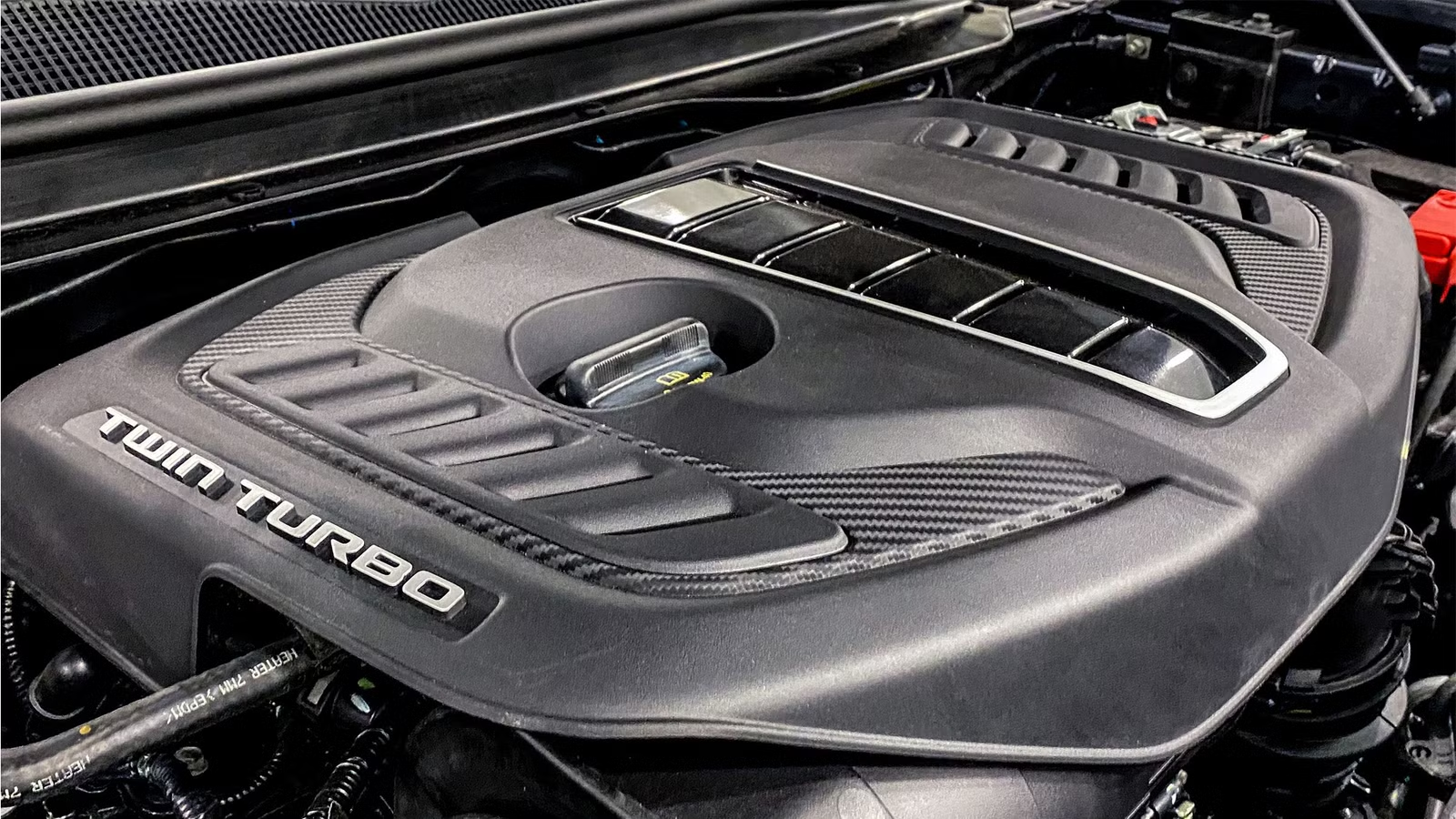
Stellantis revived the Hurricane name for its twin-turbo inline-six program as a clean-sheet engineering exercise. The modern engine shares no mechanical relationship with the Willys units; instead, it features aluminum construction, forced induction, dual overhead camshafts, and design priorities centered on low emissions and high efficiency. Even so, a sense of philosophical familiarity is hard to shake.
Stellantis chose the inline-six for its torque density, inherent smoothness, and refinement — and to sidestep unnecessary mechanical complexity. Those are precisely the qualities Willys pursued decades ago, albeit in an entirely different era and with far more rudimentary tools and far lower expectations.
Interestingly, both engines emerged during periods of upheaval. Willys introduced its Hurricane inline-six just as America was moving on from wartime austerity, while Stellantis launched its version as the industry grapples with tightening emissions regulations and an uneven transition toward electrification. In both cases, the inline-six offered a measure of balance at a moment when extremes were no longer viable.
The Hurricane Was Not So Much About Rebellion, As Balance
2023 Jeep Grand Wagoneer with Stellantis 3.0-liter twin-turbo Hurricane inline-sixJeep
From its very first appearance, the Hurricane name has consistently stood for restraint rather than excess. Across both the four- and six-cylinder members of the original Willys engine family and through to the present day, it has always spoken more to strength and smoothness than to outright performance. Its makers never intended it as a performance badge; they wanted it to deliver durability and refinement to buyers who valued those qualities above all else. Over the years, the Jeep CJ ensured the Hurricane name would endure, while the Aero demonstrated it could anchor a passenger-car inline-six.
Today, Stellantis shows that the same fundamental configuration can still make sense in the right circumstances, even in a radically different automotive landscape. The idea of a Hurricane inline-six is certainly not new — but it appears to be returning at precisely the moment the industry needs it most.
Sources: Stellantis, Jeep, Bring A Trailer, Old Willys Forum.
