

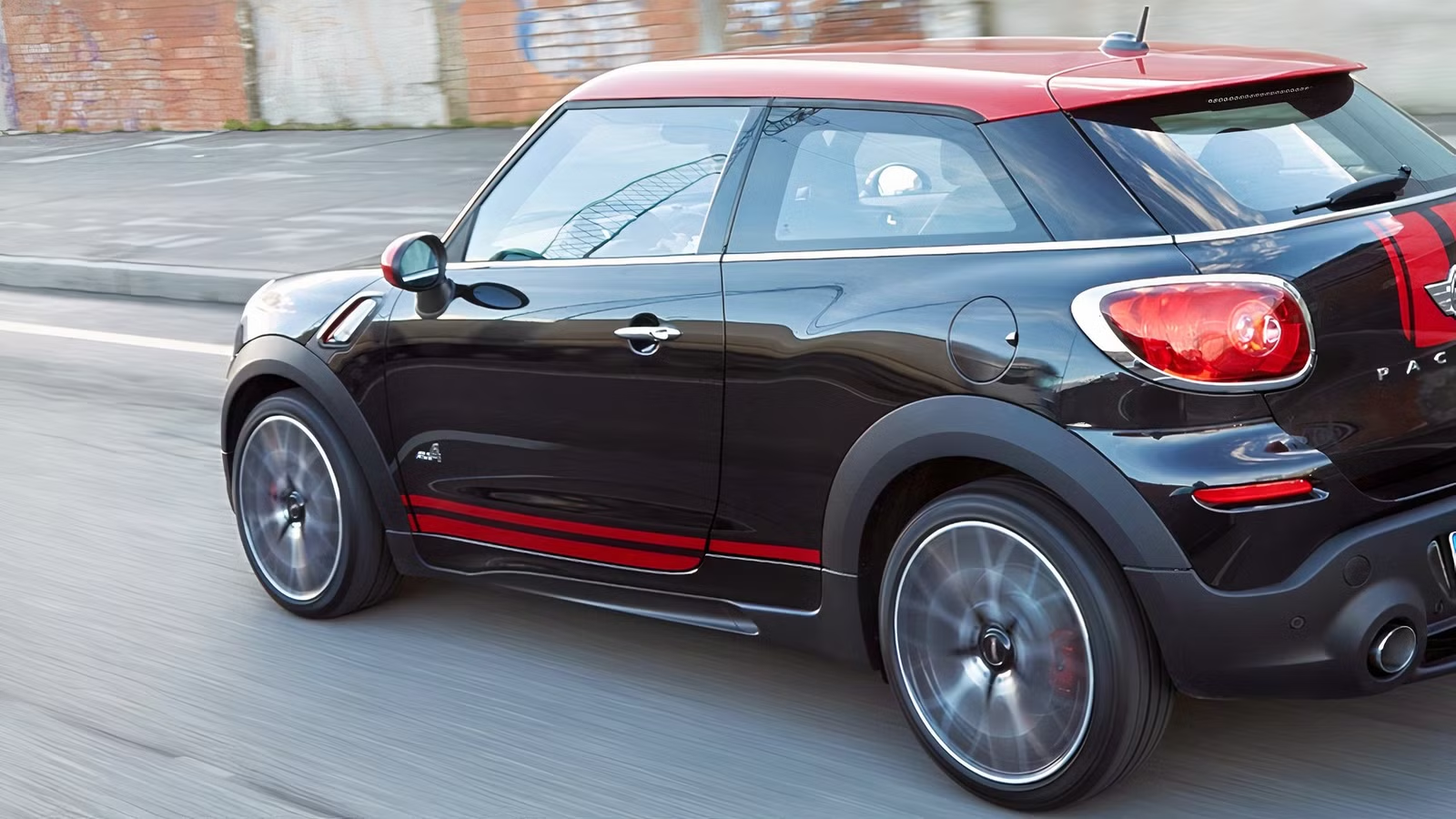
Mini has always played a strange game with its own identity. The name conjures images of the tiny, culturally iconic classics that defined 1960s Britain, yet the brand’s modern lineup — shaped by years of BMW stewardship — has drifted steadily upmarket and upsize. Today’s Minis are roomier, heavier, and more SUV-adjacent than the name implies, and the range keeps growing.
Among the brand’s more unusual detours is the Paceman, a short-lived model that left production nearly a decade ago. The Paceman never quite found its footing: pitched as a crossover but behaving more like an urban runabout, it struggled to carve out a commercial identity and was ultimately discontinued for being too similar to its closest sibling, the Countryman.
Yet time has a way of rehabilitating the overlooked. With used-car prices still elevated across the board and genuinely characterful small cars growing scarce, the Paceman — particularly in John Cooper Works trim — is starting to look like a smart, affordable find. Let’s take a closer look at this quirky crossover and whether it deserves a spot in your garage.
Here’s What You Need To Know About The Coupe SUV
Mini Paceman Specs
Engine
1.6L NA I4
Horsepower
121 hp
Torque
118 lb-ft
0-60 mph
~10.5 seconds
Top Speed
119 mph
The Paceman was a short-lived member of the Mini family, sold only between the 2013 and 2016 model years. A subcompact crossover SUV, it served as a smaller, two-door counterpart to the first (R60) generation of the Mini Countryman. Unlike the Paceman, the Countryman is still in production today, with two further generations following the R60.
The Paceman made its debut in concept form at the 2011 North American International Auto Show in Detroit. Billed as a “sports activity coupe,” the concept blended car and SUV elements and was fitted with the most powerful engine in the Mini lineup at the time: a 1.6-liter turbocharged John Cooper Works unit producing 211 hp. Visually, the concept hewed closely to the Countryman, sharing most of its exterior lines and interior features.
The production Paceman arrived in September of the following year, carrying a powertrain lineup broadly mirroring the Countryman’s. Both front-wheel drive and all-wheel drive — badged ALL4 in Mini parlance — were available. The engine range spanned two gasoline units and two diesels across an equivalent set of trim levels.
The base Cooper trim used a 1.6-liter naturally aspirated gasoline engine (the BMW/PSA Peugeot Citroën Prince unit), while the Cooper S received a turbocharged version of the same block. On the diesel side, the Cooper D and Cooper SD drew on the 1.6-liter and 2.0-liter variants of BMW’s N47 engine, respectively. A six-speed manual and a six-speed automatic were both on offer, and the ALL4 system was available as an option on select trims and markets.
The Paceman On The Used Market Today
Design, Interior & Tech
The Paceman’s design retains most of the classic elements seen across the Mini range, most notably borrowing from its larger sibling, the first-generation Countryman, which had arrived three years earlier. That shared DNA was, in fact, a significant factor in the Paceman’s eventual discontinuation. Even so, designers gave it a sportier edge over the Countryman; the Paceman also sits a few inches lower, a subtle but effective visual differentiator between the two models.
Inside, the Paceman departs from the first-gen Countryman in a few small but notable ways: the central locking controls and window switches migrate from the center console to the doors, for instance. The broader interior character, however, remains consistent with the Countryman’s, leaning on vintage-inspired styling cues that give the cabin a retro-futuristic charm.
The infotainment system follows Mini’s brand-wide approach: a circular screen dominates the dashboard, running a BMW-designed operating system that will feel familiar to anyone who has spent time in a modern Mini or BMW product.
Why Did The Paceman Fail?
After just four model years on sale, the Paceman was retired toward the end of 2016. BMW’s reasoning was straightforward: the model was simply too close to the Countryman to justify its own place in the lineup. Adding to the awkwardness, the Paceman carried a price premium over the Countryman throughout its entire production run — roughly $1,000 more than the equivalent Countryman trim at any given point.
The Paceman’s exit was part of a broader retreat of smaller, two-door vehicles from the American market. The shift away from compact cars is well-documented: as SUVs came to dominate showrooms, buyers began prioritizing passenger and cargo space above almost everything else, leaving smaller models increasingly stranded.
Two-door cars have felt this pressure especially acutely. A growing share of drivers simply aren’t willing to sacrifice rear doors, whether for practical reasons or because they regularly carry children or older passengers for whom climbing into a two-door rear seat is genuinely inconvenient.
The Paceman’s crossover positioning compounded the problem. Buyers shopping for crossovers have come to expect spaciousness, rugged capability, and family-friendly versatility — none of which were the Paceman’s strong suits. Its slightly raised ride height and added weight made it feel too heavy to be a true city car, yet it lacked the space and practicality crossover shoppers demanded. It fell squarely between two stools, and neither camp was particularly interested in claiming it.
The John Cooper Works variant tried to thread an even narrower needle: a chunky crossover with the soul of a hot hatch. Hot hatch enthusiasts tended to look elsewhere for a purer driving experience, while buyers who simply wanted a capable crossover had little reason to pay a premium for performance they didn’t need. There was no natural constituency for the Paceman, and the market made that verdict clear.
Sources: Mini
