

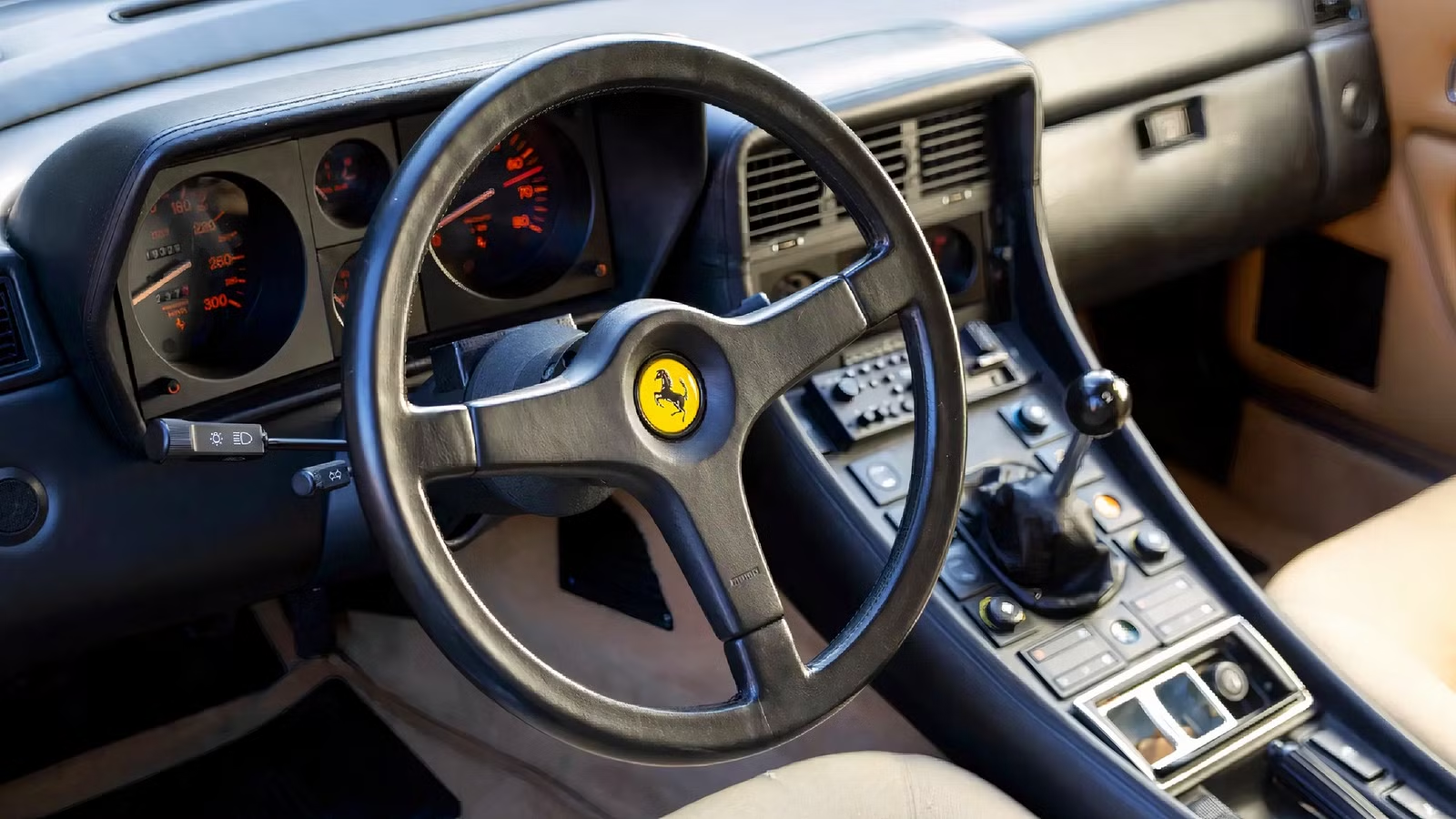
If you’re rummaging around looking for some Ferraris to add to your collection and focusing on cars that the company built in the late 80s, you may be particularly drawn to flamboyant vehicles like the Testarossa or 328 GTB.
However, lurking quietly in a few corners you might find an often overshadowed 412, which may well be one of the most practical and forgotten V12 grand tourers from that era. It’s well worth looking at, especially if you find one with a manual transmission, as it’ll likely deliver you an equal amount of pedigree, drivability, and practicality.
The Forgotten Family V12 Ferrari
1988 Ferrari 412 frontFerrari
1985 Ferrari 412
Engine
4.9-liter DOHC V12
Transmission
Five-speed manual or three-speed automatic
Drivetrain
Rear-wheel drive
Power
340 hp
Torque
333 lb-ft
In the 412, Ferrari was trying to mix the idea of supercar performance with that of everyday usability, which was an unusual path to take with a front-engined V12 GT. But it did succeed to a large degree and came up with this family-sized true four-seater, which also had a large trunk and plenty of comfort-enhancing features like power steering and air conditioning.
Crucially, it was also capable enough in the performance stakes, with a potential top speed of 155 mph and a 0–62 time of 6.7 seconds. So, Ferrari went ahead and built 576 of these cars and slightly less than half left the factory with a five-speed manual transmission. Aficionados will tell you that the manual box is far more exciting than the period-fashionable three-speed automatic, and it’s certainly the one that collectors quietly covet.
Related
Ferrari 456 Used Values Show How Much A Gearbox Can Devalue A Car
The cost of not shifting your own gears is higher than you’d think.
Design Evolution Combined Quiet Dignity With Practical Design
1988 Ferrari 412 front quarterFerrari
Ferrari introduced the 412 at the 1985 Geneva Motor Show, and it was to be the final expression of the company’s Pininfarina-styled 2+2 lineage that started out with the 365 GT4 2+2 back in 1973. The 412 wore a steel body, with color-coded bumpers replacing the earlier black units and a raised trunk line to cater for more luggage space.
Maranello also redesigned the sill panels and added clear-lens indicators to modernize the face-lift, but there was nothing particularly exciting about the look of the vehicle, with a largely understated silhouette. It was long, purposeful, and elegant in its own way, but certainly didn’t stand out like some of its cousins.
Extra revisions included black window trim, a reshaped front spoiler and rear apron, and updated mirrors. The wheelbase was the same as it had been since the 365 GT4 2+2, and this provided plenty of space for adults, which was (and still is) something of a rarity in Ferrari cars. On board the 412, you’d get revised seats, an ergonomic center console, and updated instrumentation. Standard equipment included electrically operated seats, power windows, air conditioning, central locking, full Connolly leather upholstery, and a large trunk that could certainly cope with a transcontinental adventure.
The Technical Heart and Manual Engagement
1988 Ferrari 412 engineSimon Clay Copyright 2024 Courtesy of RM Sotheby’s
One of the most appealing features of the 412 is its engine and transmission package. And the almost five-liter V12 was to be the final road-going evolution of the Colombo architecture that Ferrari first developed in the late 1940s. This was the peak of Ferrari’s traditional front-engine design and the 412’s engine had an output of around 340 hp at 6,000 rpm and 333 lb-ft of torque at 4,200 rpm. It also featured Bosch K-Jetronic injection and Marelli Microplex ignition.
Related
10 Supercars And High-End Sportscars That Have Become Relatively Affordable
You’ve dreamt about them – and now you could possibly own them. Here are 10 supercars that no longer cost the earth.
The internally built five-speed gearbox and limited-slip differential combined well to help deliver an old-school and involving GT feel. With this box on board, you would get noticeably sharper performance than the automatic. Testing suggests quarter-mile performance in the mid-15-second range, and many owners report that the manual car seems to be much quicker than those numbers might imply, with plenty of driver engagement on tap.
Suspension, Ride, And Grand-Touring Credentials
1988 Ferrari 412 rearSimon Clay Copyright 2024 Courtesy of RM Sotheby’s
Ferrari developed the chassis of the 412 well, fitting independent double wishbones at the front and back, self-levelling Koni rear shocks, and vented disc brakes all round. This was the first car from the factory with standard Bosch ABS, as a nod from Maranello towards improved real-world drivability. The car also had power steering, nicely adjusted damping, and wider tires, making it quite maneuverable at low speeds and well-behaved at highway pace. And all of these results were exactly what Ferrari was originally looking for in the well-rounded 412.
With twin tanks on board giving a combined capacity of 104 liters or 27.5 US gallons, you could do a good stint without stopping. That long journey wouldn’t be particularly tiring either, as the vehicle’s long wheelbase and broad track delivered high-speed stability along with confident and predictable handling.
Related
Every Automaker Keeping The V12 Engine Alive In 2025
You’ll need a small fortune to buy one though.
The 412 In The 1980s Ferrari Lineup
1988 Ferrari 412 interiorSimon Clay Copyright 2024 Courtesy of RM Sotheby’s
When you look at the other vehicles available from Ferrari in the mid-1980s, you can see just how the 412 stands apart. After all, if you were searching for something spectacular, you would choose the Testarossa and, if you were rev-happy, it would be the 328. If you were particularly practical, you’d buy a Mondial, but in the other corner sat the 412, with its combination of discreet luxury, genuine everyday usability, and four places of accommodation. Clients loved it because they were buying some status without too much spectacle, and they found that the vehicle was perfect for business meetings in the city center or long-distance holidays, and they could simply enjoy this rev-happy V12 without turning too many heads.
The 412 never officially came to the US due to emissions and safety constraints, but there are some examples around, featuring both right- and left-hand-drive cars, through grey-market importers. They’re also attainable under the 25-year rule for American enthusiasts who want to go down that road.
Options, Value, And Rarity
1988 Ferrari 412 center consoleSimon Clay Copyright 2024 Courtesy of RM Sotheby’s
You didn’t have too many add-on choices when buying your 412 from the factory, apart from some different interior trims, a sunroof, and some Schedoni luggage. However, the biggest single variable was that transmission type, and as there were slightly fewer manuals, they can be considered rarer than automatics. So, a manual – with its special appeal for collectors – could sell for between $35,000 and $45,000 today for tired examples, $90,000 to $125,000 for good options, and up to $160,000 or more for immaculate, Classiche-certified, or very low-mileage cars. Most surviving vehicles seem to be automatics, though, and if you really want a factory manual in great condition, you may need both patience and a deeper pocket.
Market Evolution And The 412’s Place In The Ferrari World
Prices for good 412s have more than doubled in recent years as collectors value their blend of practicality, maturity, and traditional engineering. And there’s plenty of interest from collectors looking for mint manual cars who might once have only focused on the more obvious hero vehicles. It may be that the car’s understated style, long production lineage, and usable reputation have helped to secure its cult status, and as Ferrari never sold any factory versions in the US, American owners can certainly add a dose of exclusivity to their motoring should they find one today.
The Ultimate Stealth Ferrari
1988 Ferrari 412 clocksSimon Clay Copyright 2024 Courtesy of RM Sotheby’s
For Ferrari fans with a family or enthusiasts who just love analog craftsmanship with old-school engineering, a manual 412 is the stuff of excitement. It’s certainly one of the least ostentatious V12 Ferraris, but it still combines practicality and a refined interior layout with some undoubted V12 performance. And so, Ferrari 412s with a clutch pedal are getting a lot of attention from collectors today. These buyers realize that this is the oft-overshadowed but genuinely family-friendly V12 that many people may have simply overlooked.
Sources: Ferrari, Encycarpedia, Bonhams
