

The full-size luxury SUV segment is entering a period of rapid change, with automakers pushing further into space, technology, performance, and flagship-level luxury. As these vehicles increasingly serve as alternatives to traditional luxury sedans, buyers expect more than three rows and a premium badge.
Established benchmarks can quickly become vulnerable when a generation approaches the end of its life cycle. Newer rivals can arrive with larger dimensions, more practical cargo areas, dedicated electric architectures, and substantially newer technology. For one long-standing segment leader, that timing could hardly be worse, with several formidable challengers arriving just as the current formula begins to age.
The Full-Size Luxury SUV Arms Race Is Getting Serious
The largest luxury SUVs have evolved into much more than oversized family vehicles. For automakers, they are increasingly important flagships that demonstrate what the brand can achieve when practicality, technology, performance, and luxury are combined without the packaging restrictions of a sedan. Three-row seating remains fundamental, but buyers in this class now expect sophisticated infotainment systems, premium materials, powerful drivetrains, advanced driver-assistance features, and increasingly elaborate rear-seat accommodations. In other words, the biggest SUV in a luxury lineup is often expected to make the same statement that a flagship four-door once did.
The segment is now considerably more competitive, particularly as established luxury brands expand their offerings at the top of their SUV ranges. New arrivals aren’t simply positioned as alternatives; they are being developed to occupy the highest rung of their respective lineups. That gives them the opportunity to challenge established products on more than price or equipment, with manufacturers using size, packaging, power, and technology to redefine what a full-size luxury SUV should offer.
The timing is particularly awkward for one of the segment’s established leaders. Its current-generation flagship is approaching the end of its production run, leaving it facing competitors that are either entirely new or arriving with significant advances. That puts the incumbent in an unusual position. It still has the brand recognition and dynamic reputation that helped establish its place in the segment, but the surrounding market is moving rapidly. As several challengers prepare to arrive, the advantage of being the established benchmark, such as the BMW X7, is becoming increasingly difficult to maintain.
Audi Built Its Biggest SUV To Beat The Established Benchmark
Audi is making its intentions clear with the 2027 Q9, its largest SUV yet. Its dimensions give the vehicle an immediate advantage in the full-size luxury class. The Q9 measures 209 inches long and rides on a 123.5-inch wheelbase, making it 5.4 inches longer than the BMW X7.
More importantly, that additional length goes to practical use. Audi says the Q9 offers 19 cubic feet of cargo space behind its third row, compared to 12.8 cubic feet in the X7. For families using all three rows, that is a meaningful difference.
The Q9 also demonstrates that Audi has not treated size and performance as competing priorities. The standard model uses a twin-turbocharged 2.9-liter V6 producing 429 horsepower and 442 pound-feet of torque. Audi claims the SUV can accelerate from 0 to 60 mph in 4.9 seconds, giving it the pace expected of a premium performance vehicle.
Then there is the Audi SQ9, which takes the performance formula considerably further. The twin-turbocharged 4.0-liter V8 produces 591 hp and 590 lb-ft, and Audi claims a 0-to-60-mph time of just 3.8 seconds. The Q9’s enormous exterior dimensions, useful three-row capacity, and sports-car-like acceleration make it a direct challenge to established players. Audi didn’t just build a bigger SUV; it built one designed to make its size an advantage.
Genesis Is Attacking From The Opposite Direction
Rather than adapting an existing combustion-powered platform, Genesis developed the GV90 around its dedicated eMP architecture. The result is a flagship SUV with an electric-only proposition from the outset. The dual-motor all-wheel-drive system produces a formidable 657 hp and 590 lb-ft of torque. The 123.5-kWh battery pack provides an estimated 310 miles of range for the seven-seat model. The battery can charge from 10% to 80% in about 22 minutes using a 350-kilowatt fast charger.
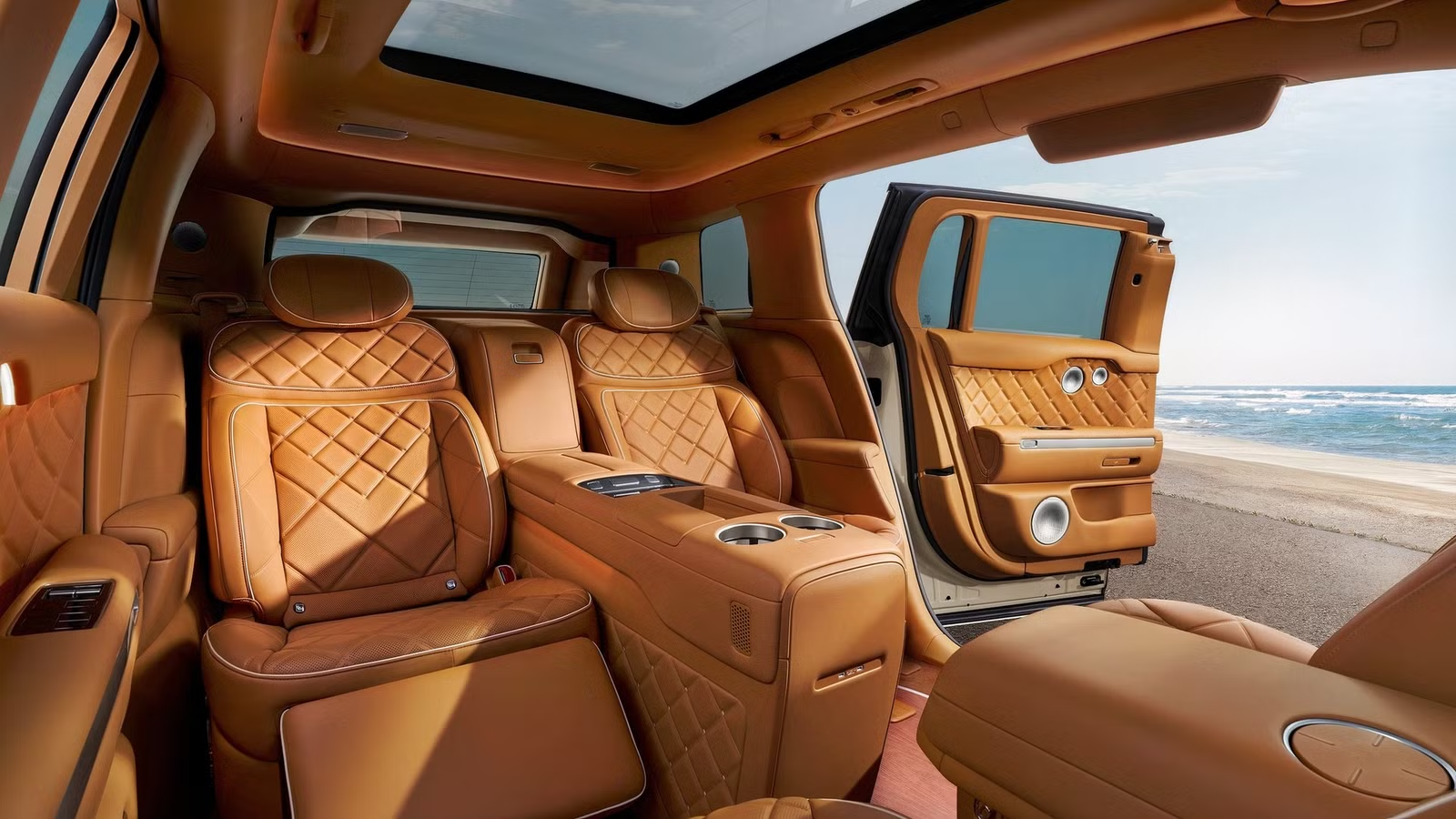
But the GV90’s significance extends beyond its powertrain. Genesis is using the model to establish itself at the very top of the luxury SUV market, rather than simply offering another premium three-row alternative. The conventional GV90 is aimed squarely at established rivals such as the BMW X7 and Mercedes-Benz GLS, while the GV90 Neolun takes a considerably more ambitious approach. It has pillarless coach doors, a lounge-like rear cabin, swiveling front seats, heated wood flooring, and a four-seat Executive Suite configuration. The result pushes it toward the territory occupied by the Mercedes-Maybach GLS.
That two-pronged strategy makes the GV90 particularly significant. Genesis can use one flagship to challenge the established German three-row SUVs while simultaneously testing whether its brand can command attention in the ultra-luxury space. The GV90 is therefore not merely another electric SUV, but an attempt to move Genesis further up the luxury hierarchy at precisely the moment established players face new competition.
Mercedes And Lincoln Bring Old-School Size To The Fight
The Mercedes-Benz GLS remains one of the most credible threats because it does not need to reinvent the full-size luxury SUV formula to compete. Its combination of three-row seating, substantial road presence, strong performance, and Mercedes-Benz’s long-established luxury credentials gives buyers a familiar alternative to BMW.
The current GLS also offers a broad powertrain lineup, including the 603-hp Mercedes-AMG GLS 63, which demonstrates that choosing a more spacious luxury SUV doesn’t necessarily mean giving up performance. More importantly, the GLS competes directly on the qualities that increasingly matter in this class: passenger accommodation, premium appointments, technology, and flagship presence.
Then there is the Lincoln Navigator, which approaches the segment from an entirely different direction. Its American interpretation of luxury prioritizes sheer scale, with the standard Navigator measuring 210 inches long and the extended Navigator L stretching to 221.9 inches. The Navigator also offers up to 107 cu-ft of cargo capacity with the rear seats folded, making it considerably more focused on maximum interior utility than the European alternatives.
That matters because the Navigator shows there is more than one way to challenge a premium three-row SUV. Buyers who value enormous dimensions and usable interior space have an option that makes European rivals look comparatively restrained. With the GLS providing a direct German alternative and the Navigator attacking from the opposite end of the size spectrum, the established benchmark faces pressure from both sides. Its driving character remains important, but it can no longer be assumed to settle the argument when buyers are also measuring how much vehicle they get for their money.
BMW’s Biggest Problem Is What Comes Next
BMW’s problem is less about whether the current X7 can still compete and more about where it sits in the product cycle. The 2027 model is expected to carry over largely unchanged before a new generation arrives, potentially for 2028. The 2027 X7 might be the final year of the current generation, with a new model potentially coming as a 2028 model. That leaves the flagship SUV defending its position with essentially the same formula as newer competitors enter the market.
The timing becomes more significant when you consider BMW’s broader technology strategy. The automaker’s Neue Klasse program represents a major technological transition, bringing a new electrical architecture, BMW Panoramic iDrive, advanced driver assistance, and the Heart of Joy control system. The new iX3 is the first production model to use the technology, while the 2027 BMW 7 Series is the company’s first large luxury model to receive Neue Klasse technology. BMW says it will eventually roll out the tech across the brand’s portfolio.
The outgoing X7 therefore occupies an awkward middle ground. It remains a capable and desirable luxury SUV, but it doesn’t yet benefit from the technology defining BMW’s next-generation vehicles. That distinction could become increasingly obvious as customers encounter newer BMWs with substantially different interfaces, software, electrical systems, and driving technology. The question is no longer simply whether the X7 remains competitive on its own merits.
Sources: BMW, Mercedes-Benz, Lincoln, Volvo, Genesis,
