

Gearheads looking for practical but affordable fun have gravitated towards hot hatches for decades now, since the original Volkswagen Golf GTI essentially created the segment way back in 1975. While being small enough to thread through cities with ease, their hatch-styled trunks offer plenty of cargo space, so they’re ideal as everyday runarounds. At the same time, their accessible front-wheel-drive handling balance makes them a joy for everyone, and not just the most skilled of drivers.
For the most part, RWD is traditionally known to provide more fun, so it may seem strange that so few hot hatches use it. Well, maybe not.
Volkswagen’s Newest Hot Hatch Sends Its Power Rearwards
Volkswagen ID.3 GTIVolkswagen
This is an interesting topic, primarily because Volkswagen has elected to go against the grain with its latest hot hatch offering: the ID.3 GTI. The second of the German brand’s electric vehicles to sport the legendary GTI badge, the ID.3 goes against the traditional recipe used by its gas-powered siblings, much like the ID.Polo GTI, by sending its power to the rear wheels rather than the fronts. The change makes sense when you factor in just how much power it produces, though.
The ID.3 GTI only utilizes a single electric motor, which is mounted on the rear axle, but it pumps out a commanding 322 horsepower. That’s only one more than the gas-powered Golf GTI Edition 50, so you’d think they could get away with sticking with the tried-and-tested GTI recipe. Well, while the Golf makes do with 310 lb-ft of torque, the ID.3 GTI has an instantaneous 402 lb-ft of the stuff being thrown at the driven wheels, which is another challenge altogether. Keeping the front wheels under control, seeing as they also have to deal with steering and the bulk of the braking, would have been an extraordinary challenge.
With the powertrain’s might being sent to the rear wheels instead, that leaves the front wheels to focus on just two jobs, which allows them to preserve some crucial grip. It also means the car can perform powerslides, and enjoys more low-speed traction than other high-powered FWD hot hatches. Either way, it’s a big deal, since it’s the first ever VW GTI model not to be FWD. Even outside of the VW bubble, RWD hot hatches are a rare event.
Not Many RWD Hot Hatches Have Been Built
2003 Renault Clio V6 Exterior Finished In Blue Renault
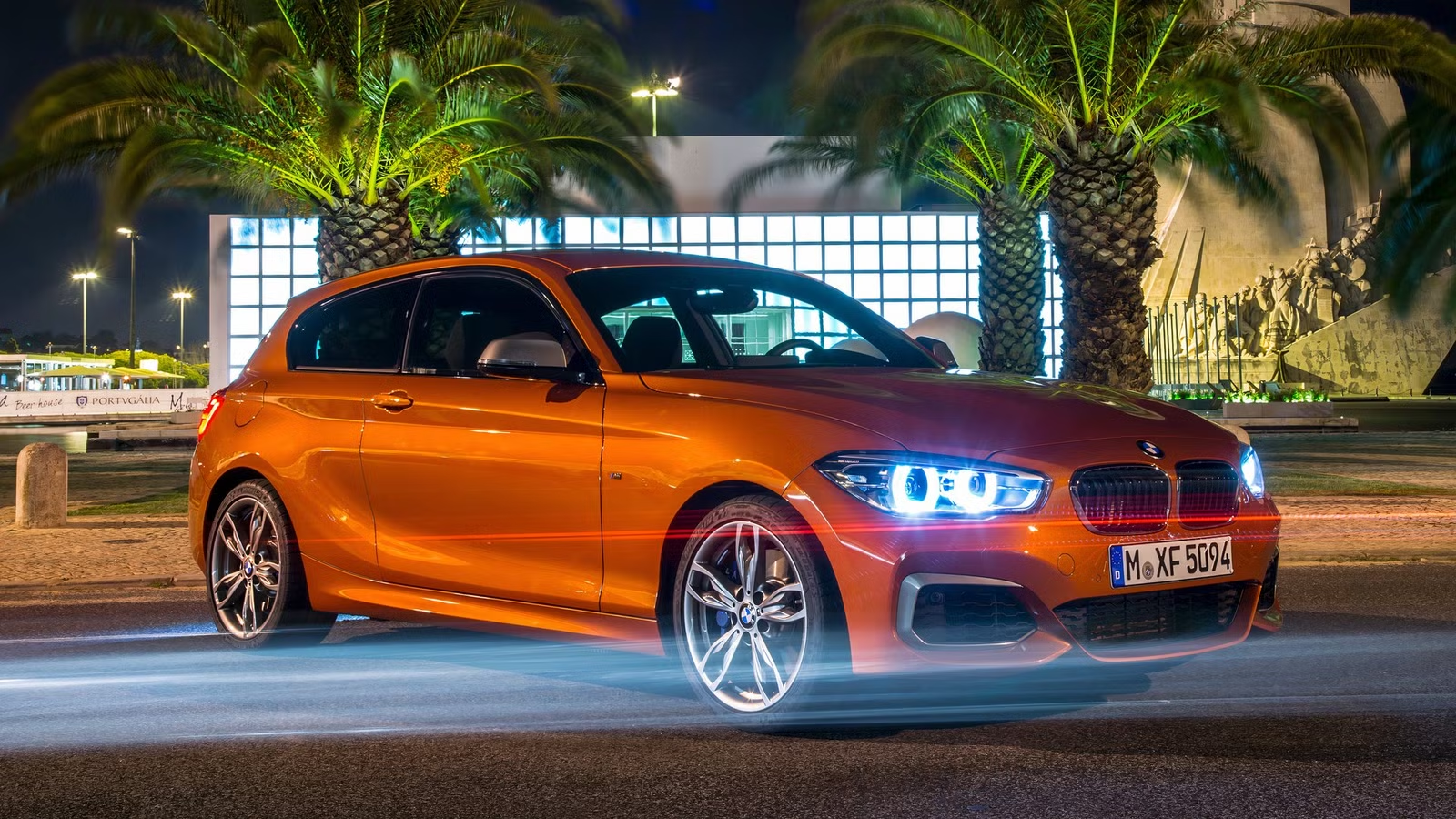
If you take a look back through history, only one brand has consistently churned out such cars that have their power being sent to the back. That would be BMW, which has prided itself for decades on producing nearly all its cars in RWD form, since it affords a more balanced handling platform and better weight distribution. The E87 1 Series was the first of the breed, with models like the 130i and 135i twinning the practicality of a hatch with the sort of handling you’d usually expect to find in something like an M3 or Z4. Later variants, like the M135i, brought even more performance to the party.
The BMW was very much in a class of one when it came to mass-produced hot hatch daily drivers, since other higher-powered options like the Audi S3 and VW Golf R32 relied on all-wheel drive systems to help put their power to the ground. And then there was the Alfa Romeo 147 GTA, which fired its 250 hp to the front wheels anyway, even if the lack of any limited-slip differential meant the tires would last for about half a mile. That said, there was another car from the early 2000s that did the whole RWD hot hatch thing before the BMW.
In 2001, Renault built a bonkers version of its Clio city car called the V6. As hinted at by its name, the four-cylinder engines typically found in the model were replaced by a 2.9-liter naturally aspirated V6 power plant, which was placed in the middle of the car to aid weight distribution. From there, the resulting 223 hp was channeled to the rear wheels. The thing is, while it was a hatch, it wasn’t exactly practical. The mid-mounted V6 took up so much room that the rear seats had to be deleted, while its handling could be described as challenging at best, and lethal at worst. Not ideal, then.
Some RWD hatches were around before the new millennium, like the 1986 Dodge Shelby Omni GLHS, the rather overlooked Lotus-engineered Sunbeam Lotus from the late 1970s, and the eccentric Renault 5 Turbo, but most examples of the breed have remained true to the FWD recipe.
Keeping Costs Down Is Crucial For A Hot Hatch
fiesta st side red parkedFord
One of the main reasons for this is cost. One of the primary drawbacks of building an RWD car is that, because you need longer driveshafts to connect the front-mounted engine to the rear wheels, as well as a rear differential, they are more complicated to design and build than a FWD machine, which has all of that mounted together at the front. This makes it easier to package, and quicker to install. The longer production times and extra materials needed for an RWD car naturally add cost, which then has to be swallowed by the manufacturer, or be tacked onto its eventual MSRP.
Seeing as one of the main aims of a hot hatch is to be extremely affordable, wasting money and resources on producing an RWD model is seen as unnecessary by most manufacturers.
Beyond that, such designs require a more sophisticated rear suspension setup to go along with the front, since the driven rear wheels need more support than the same non-driven wheels on a FWD offering. This adds further cost to the production process, and also makes them more expensive to maintain for their owners in the longer term, since the parts are more advanced and expensive.
An RWD Hatch Isn’t As Practical
Interior view of the Volkswagen Golf GTIVolkswagen
Aside from being more complex and expensive to produce, placing the differential and the extra drivetrain components at the back of the car also compromises the amount of space. Since they have to be cut into the floor to keep them well clear of the road, the amount of rear passenger and cargo space is naturally decreased. This largely defeats the point of a hot hatch, which needs to be as practical and usable as possible.
Otherwise, you may as well spend your money on something that’s even more fun and still not particularly practical, like some form of sports coupe or sports roadster like an MX-5.
FWD Hot Hatches Are More Accessible From A Handling Standpoint
renault meganeStellantis
Aside from the practical and production cost compromises that manufacturers have to make with RWD vehicles, there’s also the issue of them being harder to drive. Due to the weight being more evenly spread throughout the car, rather than being concentrated at the front, the vehicle dynamics shift from favoring understeer toward oversteer should the car be over-driven. Understeer is easier to control, since you can lift off slightly or turn into the skid to help the front tires regain grip. If you lose the rear, powering through will help keep the vehicle in line.
If you lose the back end, only more skilled drivers will know how to calm things down and prevent the car from spinning. There is generally less time to sort any problem out, increasing the chances of suffering a crash for less seasoned pilots. Hot hatches are envisioned as being approachable and easy to drive, so keeping them FWD ensures that a wider audience will be able to drive them with vigor, but without getting themselves into too much trouble.
Drivers with larger budgets will likely have prior experience with higher-powered and better-balanced RWD cars, so they’ll be more used to it. Fewer cars exist at the more affordable end of the market, so there is a greater chance of less experienced drivers trying a little too hard and discovering just how unforgiving oversteer can be. Beyond pure handling, RWD cars also struggle more when things get slippery, such as during the winter.
FWD cars benefit from having the weight of the engine pushing them into the road, affording extra traction in snowy or icy conditions. Since most conventional RWD vehicles don’t have this advantage, the rear wheels have a harder time biting into the road, which increases the chances of getting stuck, or even spinning out. Once again, this element boosts the versatility of such a car, which is a crucial ingredient that goes into making a successful hot hatch.
RWD certainly has its advantages in higher-powered or more focused sports cars, but in most cases, the configuration pushes costs and complexity too far for a budget hot hatch, robs them of the practicality they promise, and makes them much less approachable for most drivers. And besides, a well-set-up FWD car provides some of the most fun you can have behind the wheel.
Sources: Volkswagen.
