

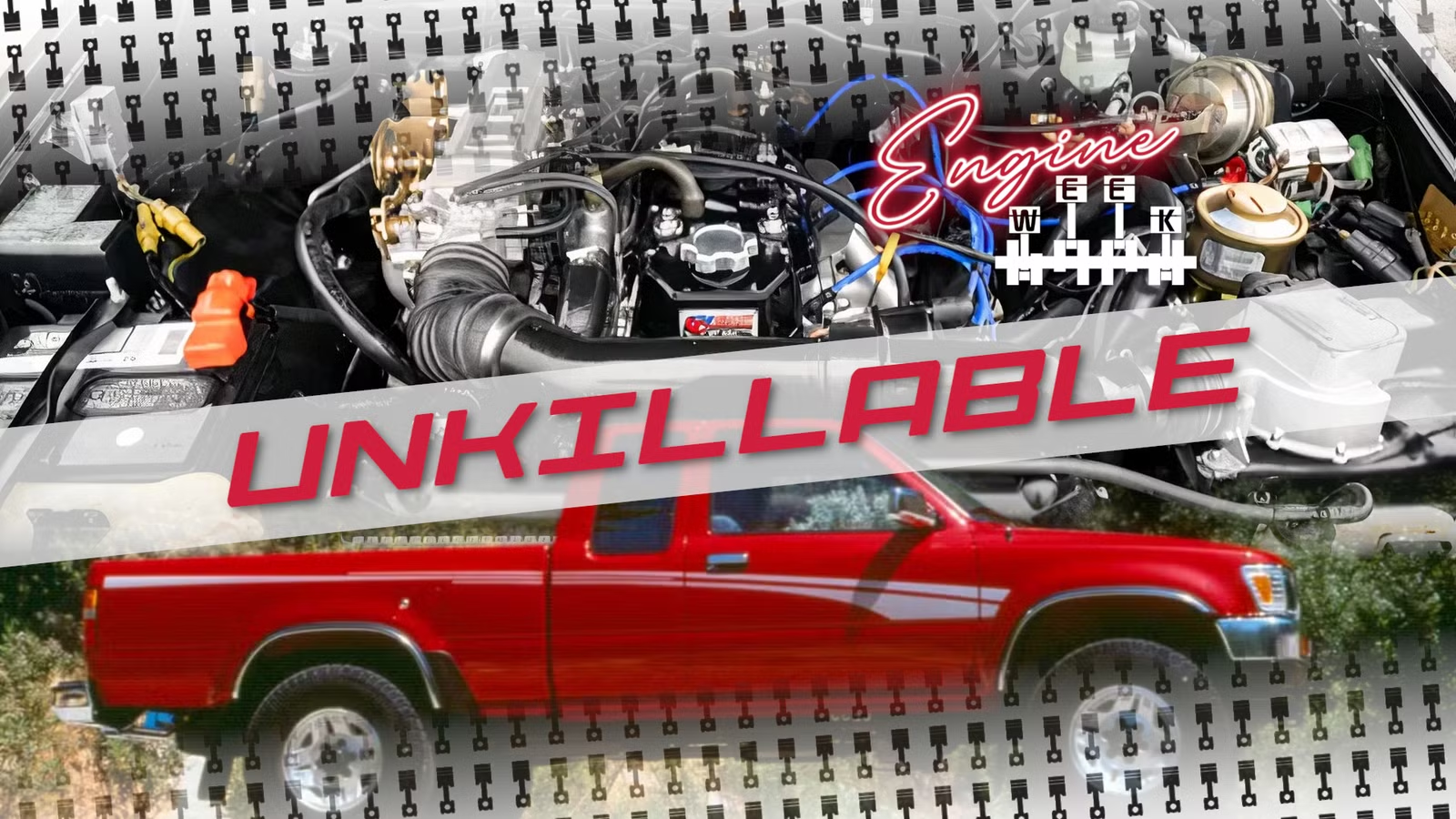
The auto industry’s history is littered with complex powertrains that promised the world but delivered nothing but expensive mechanic bills. Yet, amidst the rush for dominance in the 1980s, a much simpler four-cylinder block quietly established a new, unquestionable benchmark for engine durability. It wasn’t exotic, it didn’t shatter speed records, and its architecture was unashamedly basic. And so, the Toyota 22R became the backbone of an entire generation of trucks.
It’s Engine Week at CarBuzz, which means we’re looking into great engines, weak engines, weird engines, or downright charming engines all week long. Join us as we look at some of the biggest hits and misses of the internal combustion engine.
What Is The Toyota 22R Engine?
Toyota 22R-E engineDave 7 via Wikimedia
Toyota 22R History At A Glance
Production Years
Engine Code
Horsepower
Torque
Notes
Models Used*
1981–1990
22R
97 hp
128 lb-ft
Introduced to succeed 20R with enlarged bore and revised combustion chambers
1981 – 1997 Hilux
1984 4Runner
1984 – 1989 Land Cruiser
1983–1984
22R- E
105 hp
136 lb-ft
Fuel-injected ‘E’ variant arrives
1983-1985 Celica
1983 Corona
1985–1997
22R-E
113 hp
140 lb-ft
2nd-gen ‘Laser Block’ released with laser-etched cylinder bores
1985-1995 4Runner
1985-1995 Hilux
1986–1988
22R-TE
135 hp
173 lb-ft
Turbocharged ‘TE’ released
1986-1988 Pickup
1986-1988 4Runner
1990–1995
22R
109 hp
138 b-ft
Revised injectors, updated ignition timing, improved cooling
1991 Cressida
1990-1997 Hilux
*Examples are not exhaustive
The 22R engine debuted in 1981 as the successor to the 20R. Toyota needed a larger, torquier power plant to accommodate the growing dimensions of its light truck and SUV lineup in the American market. Displacing 2.4 liters (2,366 cc), this naturally aspirated inline-four featured a heavy-duty cast-iron block mated to an aluminum cylinder head. It utilized a single overhead camshaft (SOHC) configuration with two valves per cylinder, driven by a timing chain rather than a fragile belt. The 22R ended up being one of the most reliable four-cylinder engines ever made.
The bore and stroke measured 92 mm by 89 mm, creating an almost square architecture that favored low-end grunt over high-rpm horsepower. In its initial carbureted form, emissions equipment choked its potential flow, but this engine was never about quarter-mile times; it was about yielding consistent torque for hauling and crawling.
Toyota 22R In The USA
During the 1980s and early 1990s, the American automotive landscape wanted robust utility vehicles. The Toyota 22R engine found its way into several iconic chassis, cementing its reputation on construction sites, off-road trails, and suburban driveways alike.
Most notably, the Toyota Pickup (badged globally as the Hilux) relied on this power plant. When consumers bought a 22R Toyota 4×4, they were purchasing a vehicle built on the premise of absolute mechanical survivability. Whether it was a regular cab workhorse or an XtraCab lifestyle truck, this powertrain provided the necessary low-end torque to take on rutted trails and steep inclines without hesitation.
Related
Toyota’s New V8 Engine Is Coming To Change The Game
Toyota is ready to disrupt the engine game again; this time with an all-new 4.0L V8 with hybrid technology.
The first-generation Toyota 4Runner, introduced in 1984, also utilized this 2.4-liter block. Essentially an SUV built on the Pickup’s platform, it required an engine that could handle the added weight of passengers and gear without thermal stress. The Celica utilized this engine in the early 1980s (1981–1985), proving its torquey nature could translate to a rear-wheel-drive car, despite lacking the rev-happy nature of traditional sports car engines.
Toyota’s 22R Engine Lineage
The 22R-E Motor & Its Use
Toyota 4Runner – N60 – (1984-1989) exterior rear three-quarters angle.Bring A Trailer
The engineering division in Aichi, Japan, realized the standard carbureted setup had reached its evolutionary limit. The carburetor, while mechanically simple, struggled to provide the precise air-fuel mixtures required for cold starts, steep-angle off-roading, and stringent smog testing. Consequently, Toyota developed specific iterations of the block to address modernizing market demands.
Introduced in 1982 for the Celica and later adopted by the Pickup and 4Runner in 1985, this variant replaced the carburetor with electronic multi-port fuel injection, with the “E” designation signaling a massive leap in everyday usability. While the core block remained identical to the carbureted version, the electronic fuel injection (EFI) system optimized fuel delivery.
Output marginally improved, typically rated around 105 to 112 hp and 136 to 142 lb-feet of torque, depending on the model year and specific emissions equipment. More importantly, the EFI system provided a smoother idle, better throttle response, and improved fuel economy. The intake manifold was also redesigned to accommodate the injectors, and an engine control unit (ECU) was introduced to manage ignition timing and fuel mapping.
22R-TE Goes Turbo
1985 Toyota Pickup 22RBring A Trailer
To address complaints regarding sluggish highway acceleration, Toyota introduced a turbocharged variant in late 1985. The ‘T’ denoted the addition of a CT20 turbocharger. Operating at a relatively low boost pressure of roughly six to seven psi, this system was not designed to create a street-racing monster. Instead, it was engineered to compensate for the weight of the heavier 4Runner chassis and provide better passing power at highway speeds.
This forced-induction engine produced approximately 135 hp and 173 lb-ft, and to handle the increased cylinder pressures, Toyota fitted the block with lower compression pistons, a different cylinder head, and a heavy-duty head gasket. While the power increase was welcomed, the turbocharged model introduced new thermal loads to the cooling system and oiling network. It was discontinued by 1988 because the new 3.0L 3VZ-E V6 offered similar power without the complexity and heat of forced induction.
22R-TE performance benefits:
- The turbocharger bumps output to 135 hp, resolving sluggish high-speed acceleration.
- Torque increases to 173 lb-ft.
- Toyota strengthened the engine’s architecture by utilizing lower-compression pistons and a heavy-duty head gasket.
- The turbocharged engine suffers far less power loss at high elevations.
- The uprated engine maintains the rigid cast-iron block and oversized bearings that defined the platform’s legendary lifespan.
How Reliable Is The Toyota 22R
Second Gen 1991 Toyota 4Runner 4×4 5-Speed 4-cylinderBring A Trailer
The big question is, is the 22R reliable? While the abbreviated answer is a definite yes, it’s not without some low points that are important to consider.
On the positive side, it is practically indestructible. The cast-iron block is incredibly rigid, preventing the kind of warping and distortion seen in early aluminum-block attempts by competitors. The main bearings and rod journals are oversized for the power output, meaning the engine experiences very little internal friction-related wear under normal conditions. It is not uncommon to see these motors surpass 300,000 miles without requiring a rebuild. The valvetrain, being a simple two-valve SOHC setup, is under-stressed and inherently robust.
However, the “invincible” moniker has limits. The engine’s low specific output means it has to work exceptionally hard to maintain highway speeds, particularly in heavy four-wheel drive configurations, and this constant high-load operation can accelerate wear if maintenance is neglected. The early carbureted engines are notoriously cold-blooded, meaning that they feature a complex web of vacuum lines that degrade over time, leading to erratic idling, poor fuel economy, and failed emissions tests.
Common Toyota 22R Problems
1985 Toyota Celica front 3/4Bring A Trailer
The biggest flaw on the 2.4L 22R involves the timing chain guides. Prior to 1983, Toyota utilized a dual-row timing chain, which was incredibly strong. But to reduce noise and production costs, they switched to a single-row chain with plastic guides from 1983 onwards. Over time and thermal cycling, these plastic guides will become brittle and shatter. Once the guide breaks, the slack in the timing chain allows it to slap against the aluminum timing cover. If ignored, the chain will eventually run a hole right through the cover and into the water pump galley, mixing coolant with engine oil – effectively destroying the bearings.
Head gasket failure is another concern, particularly on turbocharged and post-1985 blocks. The aluminum cylinder head and cast-iron block expand at different rates, and over thousands of heat cycles, this disparity compromises the gasket seal, leading to coolant leaks or fluid mixing. If, by some miracle, you’re still running a vehicle powered by a version of the 22R in 2026, regular coolant flushes remain critical to prevent electrolysis, and valve adjustments are also required very regularly because the mechanical lifters do not self-adjust. Despite the lows, it is still one of the most reliable engines Toyota ever built.
The 22R Legacy
2016 Toyota RAV4 detail shot of the engineToyota
The 22R engine did not directly give rise to modern Toyota power plants. This 2.4L SOHC cast-iron block architecture was retired in the 1990s and replaced by lighter, more efficient, dual-overhead-cam, all-aluminum engines like the 2.7L 3RZ-FE (1994-2004) and its successor, the 2.7L 2TR-FE (this engine served North America from 2005-2023). So while the 22R could not keep up with fast-changing emission demands, its influence on Toyota’s modern engineering philosophy is undeniable.
Toyota’s modern reputation for building unkillable trucks in the US market was laid by the durability of this 1980s four-cylinder. The brand learned that overbuilding the engine’s foundation and prioritizing low-end torque pay massive dividends in long-term consumer loyalty. Modern engines like the 2TR-FE (still in use in some global markets) still utilize the same philosophy of long-stroke dimensions to prioritize torque over horsepower, directly mirroring the geometric principles established in 1981. The 22R may not share parts with Toyota’s engines today, but it established the institutional blueprint for how a reliable engine should behave under load.
Sources: Toyota, My Motor List, Ice Performance, IMSA, Battle Born Clothing
FAQ
Q: Which car has a Toyota 22R engine?
In the US market today, no vehicle is powered by this engine. However, it was primarily fitted to the Toyota Pickup (1981-1995), the first-generation Toyota 4Runner (1984-1995), and the Toyota Celica (1981-1985).
Q: How much HP does a 22R make?
Output varies depending on the year and emissions equipment, but the standard carbureted version typically produced between 97 and 100 hp.
Q: What is the difference between a 22R and a 22re?
The 22R utilizes a traditional mechanical carburetor and a complex network of vacuum lines to manage the air-fuel mixture. The “E” variant utilizes an electronic multi-port fuel injection system that’s managed by an engine control unit.
Q: Is a 22R a 4 cylinder?
Yes, it is a 2.4L, naturally aspirated inline four-cylinder engine that utilizes a single overhead camshaft (SOHC) with two valves per cylinder.
