

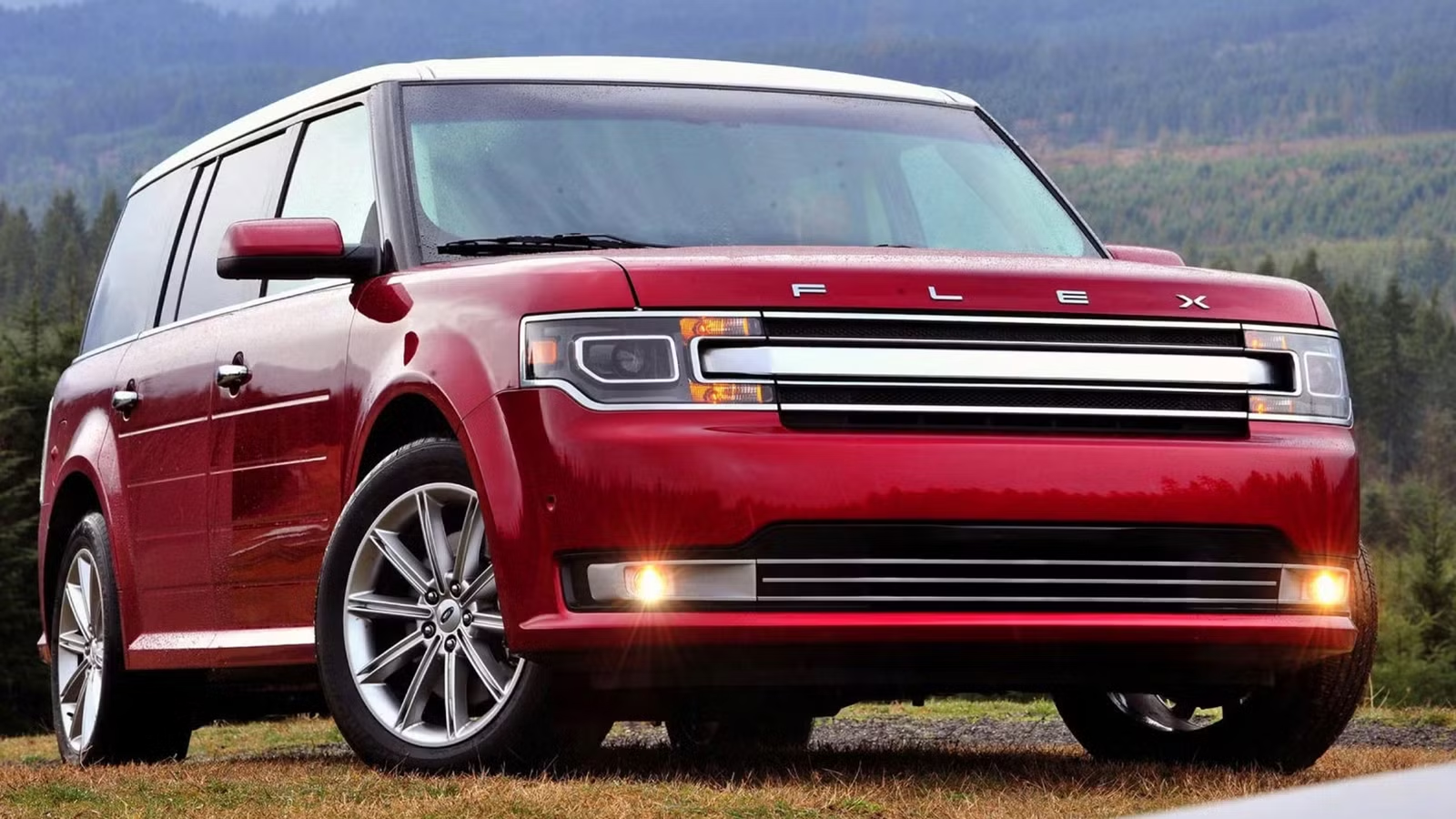
The Ford Flex was a largely overlooked SUV in its heyday, and it remains underappreciated today. Despite commendations from Consumer Reports and US News, it never came close to its initial sales goal of 100,000 units a year.
Ford’s loss is your gain. These SUVs never really found their niche fanbase, and that means it’s a buyer’s market. Anyone selling a Ford Flex will be happy to see it go. But, not all model years are created equal. So here’s our buyer’s guide for anyone shopping around for a reliable used family car.
Look For 2016–2019 Model Years
Ford Flex model year chart from Car ComplaintsCarComplaints
A quick glance at CarComplaints tells us that you can’t go wrong with a Ford Flex from the model year 2016 or later. The 2015 model sees 20 complaints on file, while no model year after that has more than seven complaints.
The website shows zero complaints on file for the 2020 model, but the 2019 model was actually the last Ford Flex ever produced. Anything sold as a 2020 Ford Flex would have been a leftover 2019 model.
JD Power awarded the 2018 model a Quality & Reliability rating of 81/100, while the 2019 model earned an 82/100. Both of these numbers earn the car a dependability ranking of Great, according to JD Power.
The 2016 Ford Flex Is Hard To Beat
2016 Ford Flex exteriorFord
If you’re going to zero in on a single model year, we have to recommend the 2016 Ford Flex. CarComplaints shows just two complaints on file, one for a broken automatic lift gate, and one for an issue with the SUV’s “out of date” GPS system. We wouldn’t call these complaints trivial, but they’re easy to live with if you’ve got Google Maps on your phone, and you don’t mind opening the lift gate yourself.
More importantly, the 2016 Ford Flex managed to dodge a recall affecting the 2017–2019 models, for B-pillar door trim detaching while you’re driving. The 2016 model also avoids a recall for rear-view camera images failing to display in 2017 and later models, but it was included in a separate recall for the same problem, so that’s a wash.
The most worrying recall affecting the 2016 model include a potential oil leak from the turbocharger, although this only affects 1,163 Fords in total. The biggest recall faced by the 2016 Flex involves fractured rear suspension toe links in 211,207 Fords. The 2016 Flex shares both of these recalls with later model years.
Later Ford Flexes Benefit From A Mid-Cycle Refresh
2019 Ford Flex Gray Front Angled ViewFord
The Ford Flex only ran for a single generation, but it received a welcome facelift in 2013. Paddle shifters replaced a push-button system, and the SUV received a visual overhaul with a new grille and a three-spoke steering wheel.
Mechanically speaking, the biggest difference pre- and post-facelift was a power boost. The base 3.5-liter Duratec V6 was bumped from 262 horsepower to 287 hp, while the optional twin-turbo EcoBoost V6, available in the all-wheel-drive models, was upgraded from 355 hp to 365 hp.
Running down some of the other changes that were made from year to year:
- 2010 – Ford introduces the optional EcoBoost V6 engine.
- 2012 – Automatic parking system is added in certain trims.
- 2013 – Mid-cycle facelift.
- 2016 – Ford introduces Sync 3 infotainment system.
- 2019 – Apple CarPlay and Android Auto become standard features.
The introduction of the EcoBoost engine in 2010 and the 2013 facelift, were the biggest changes the Flex saw over its lifecycle. Beyond that, it’s difficult to tell one model year from another at a glance.
Early 2010s Models Are Best Avoided
2013 Ford Flex finished in with black interiorFord
It would be a stretch to suggest that the pre-facelift Ford Flex was a clunker. The car scored a Q&R rating of 74/100 in its first year out, and an 81/100 for 2012. But, the nameplate’s worst problems do seem to be concentrated in the first half of the 2010s.
CarComplaints sees 62 reports on file for the first model year, with 12 engine complaints, and five transmission complaints. Drivers report stalling and stopping, and oil leaks, with one driver stating that the engine had to be pulled, and the leaks sealed in order to get everything working again.
The website names the 2010 Flex as the worst model year, with 47 complaints on file, 16 of them for engine problems. Six drivers report “engine blown,” and four report engine failure. This typically involves replacing the engine, costing the driver around $5,000.
It is not specified which engine is being replaced, but a pair of turbocharger failure complaints suggest that you’ll see fewer problems with the naturally aspirated Duratec powerplant.
We would name the 2009 and the 2010 Ford Flex as the model years best avoided.
The 2013 Ford Flex Has A Lot Of Complaints On File, But Few For Engine Problems
2013 Ford Flex exteriorFord
At a glance, the 2013 Flex seems to be the most troubled model year, with 88 complaints on file, but 35 of those are for the door ajar light staying on when you shut the door. That can pose a potential safety hazard if you’re driving around like that, but simply removing the light renders the issue more of a nuisance than anything.
In any event, our advice would be to avoid anything from 2015 or earlier. You’re saving enough money on a 2016 model that you don’t need to chase after a bargain on a 16-year-old SUV with half a million miles on the odometer.
What Will A Ford Flex Cost You In 2026?
2016 Ford Flex exteriorFord
Running down our own trending prices for every entry-level Ford Flex from 2016 to 2019, here’s what we get.
- 2016: $10,675
- 2017: $8,538
- 2018: $10,782
- 2019: $13,806
Checking in with our marketplace, we can find the following models for sale.
- A 72,820-mile 2019 SEL is selling for $19,834 in Florida.
- An 88,732-mile 2018 SEL is selling for $11,995 in California.
- A 117,501-mile 2019 SEL is selling for $9,450 in Michigan.
- A 74,973-mile 2019 Limited is selling for $16,590 in California.
- An 81,937-mile SEL is selling for $14,250 in North Carolina.
There’s no telling what will be available in your area, and in your price range, when you’re ready to shop around, but these numbers should give you an idea of what’s out there. It shouldn’t be hard to find something with fewer than 100,000 miles on the odometer selling for under $15,000.
Some of these listings have seen recent price drops to the tune of several thousand dollars. As we said, it’s a buyer’s market. If you find a car you like at a price you don’t, ask the seller if there’s any wiggle room, because there probably is. These SUVs are largely forgotten, meaning they’re just taking up space on used car lots.
The Ford Flex Is Cheap To Maintain, But Expensive To Refuel
2016 Ford Flex Black Interior DashboardFord
According to RepairPal, you should expect to pay around $713 a year to keep your Ford Flex running. The most expensive common problems include the following.
- Exhaust pipe replacement $1,964–$2,103
- Fuel pump replacement $1,438–$1,696
- Heater core replacement $1,368–$1,932
- Thermostat replacement $861–$963
- Fuel injector replacement $313–$424
The Zebra estimates a Ford Flex to cost around $1,696 to insure, while FuelEconomy.gov estimates a front-wheel drive model to cost around $3,250 in annual fuel expenses, assuming 15,000 miles a year, split 45/55 highway/city. This adds up to an annual ownership cost of $5,659, with most of that going to the gas pump.
Gas prices being what they are, fuel expenses are the only reason we might be hesitant to recommend the Ford Flex to somebody. If you absolutely need a three-row SUV, and you’re not interested in going electric, you could do a lot worse, but making this two-ton beast your daily driver can get expensive.
On the other hand, five-dollar gas is the perfect excuse to get your steps in when you drive something this big.
Sources: Ford, RepairPal, CarComplaints, The Zebra, FuelEconomy.gov.
