

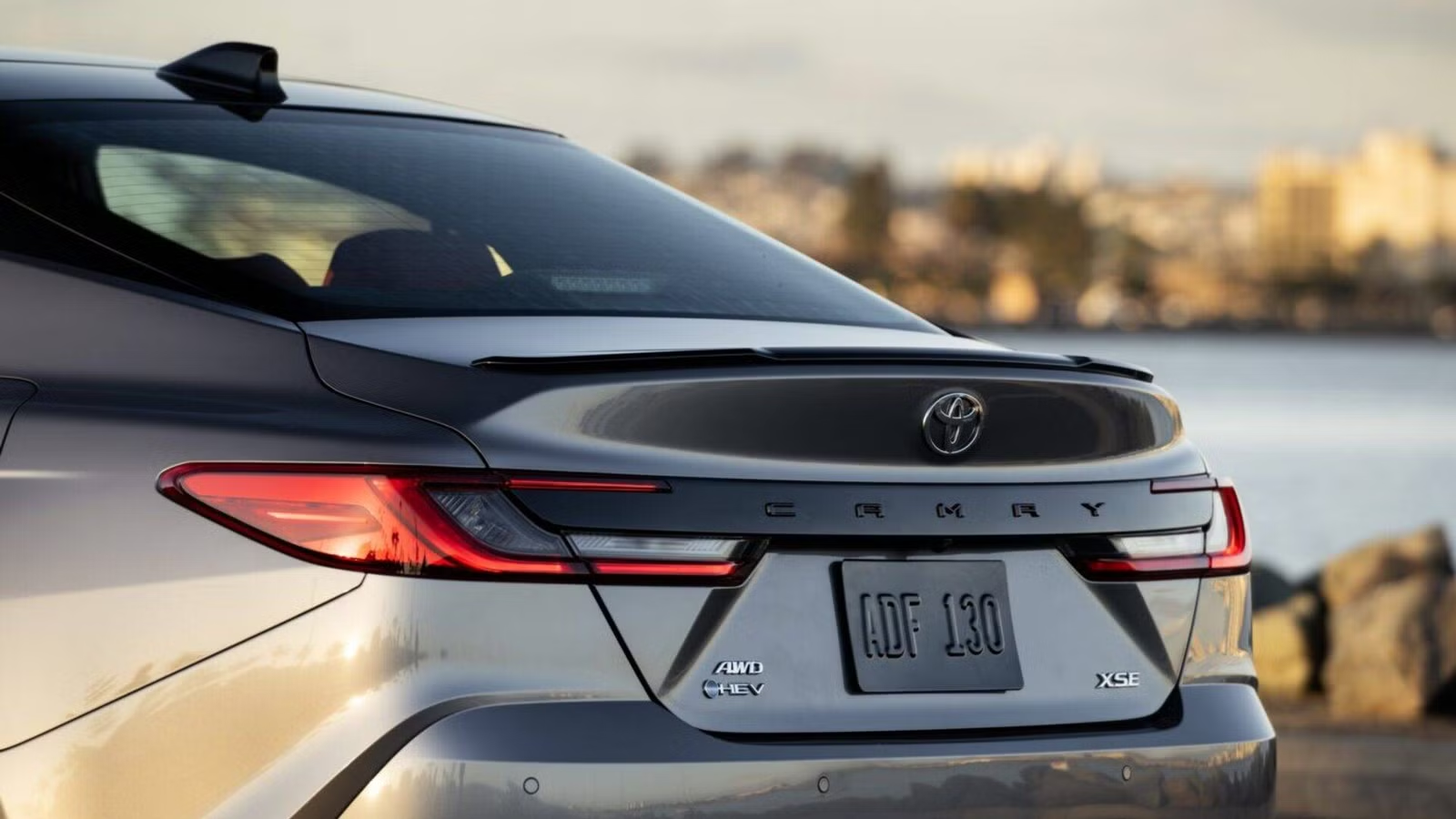
You don’t have to be a gearhead to know that Toyota builds some of the most reliable cars on the mass market. Not to mention, the brand has also produced some of the most dependable engines to ever grace the modern automotive scene, such as the 1UZ-FE V8 and the 5S-FE inline-four. Engines aside, though, the model that gets a good chunk of the glory is the Toyota Camry.
However, as of this year, the Camry has suffered a major blow to its near-peerless reputation for reliability. Recently, Toyota has recalled roughly 508,000 Camrys for an instrument cluster issue. The affected models utilize a seven-inch screen. Because the issue is hardwired into the instrument cluster, Toyota can’t simply send an update to the Camry’s infotainment system. Instead, the brand needs to get down and dirty.
Toyota Has A Software Fix, But Owners Still Have To Visit The Dealer
2026 Toyota CamryToyota
Perhaps you own a newer Camry, and are lamenting the need to fix your brand-new or near-brand-new car. This is understandable, as a new car should, in theory, be free from defects for at least the first few years of its life. Unfortunately, in our age of technology, automotive defects aren’t just mechanical anymore. Luckily, though, the recall remedy is free.
Normally, when a modern car has some sort of software or software-adjacent defect, manufacturers can simply release an over-the-air (OTA) update for the models, since most cars built within the last few years are connected to some sort of 4G or 5G network. They can also be connected to a Wi-Fi connection to facilitate the update, too. OTA updates mean owners don’t need to waste a Saturday at the dealership getting a software refresh.
2025 Toyota Camry SE AWD Supersonic Red Front 3/4 viewToyota
However, in the case of the ongoing Camry recall, an OTA update simply isn’t possible. In order to actually fix the issue, Toyota requires the affected models to be hard-flashed, or connected to a computer, in order to receive the necessary software fix. In total, about 655,000 Camry owners worldwide will have to spend time at a dealership while their car is fixed. For some, this means work hours will need to be missed, childcare will need to be arranged, and a few hours of their time will need to be spent sitting on a leatherette chair in a dealership service center waiting room, thumbing through out-of-date magazines.
While the recall has been announced, Toyota is slated to begin issuing formal letters to affected owners starting around mid-September of this year and will finish at some point in October.
More Than 500,000 Camrys Have A Digital Dashboard That Can Go Completely Dark
2025 Toyota Camry SE AWD in Supersonic Red.Toyota
Adding to Toyota’s unfortunate string of recalls over the past few years, the brand has now recalled about 508,000 Camrys in the US market, along with 11,159 in Canada and 16,238 in Australia. The recall itself covers models which utilize a seven-inch digital gauge cluster, and were built between August 2024, and June 2026. That means lower-spec grades are the only ones affected, and the higher-spec models remain untouched.
The issue itself is rather major. When a modern vehicle is started up, a digital instrument cluster typically has some sort of little greeting, followed by the gauges actually loading in, ready to go. In the affected Camrys’ case, the cluster simply won’t turn on at all. The car can still be driven, but no info will be displayed on the screen. That means speed, fuel level, engine temp, and any other means of monitoring the car’s various systems are invisible. While the issue is related to a software defect, Toyota still requires the affected cars to physically come to a Toyota dealer for repair.
Toyota Camry NightshadeToyota
The issue goes further than that, too. Toyota has found that, alongside the blank screens, the problem also affects turn signals and hazard flashers, rendering them completely inoperable. The seatbelt reminder system won’t work either, both the visual flasher and the audible reminder chime. So, not only is this problem extremely inconvenient, it’s also a genuine safety issue, too.
The Camry is not, and has never been, known for having strange electrical gremlins that need dealing with. However, this recent recall is massive and affects roughly 500,000 folks across the globe. If just one of those affected folks decides they’re not buying a Camry again, and they tell everyone in their lives to do the same, Toyota has lost a little bit of ground on the reliability stage.
The Cheap Camrys Are The Ones That Need Help
2025 Camry SE AWD SupersonicRedToyota
As far as which Camrys are actually affected, it’s most of the lineup. The bottom three grades are the ones afflicted, those being the Camry LE, SE, and Nightshade trims. All three of these models use the standard, seven-inch digital gauge cluster, which Toyota refers to as a “combination meter”. What happened to cars, especially base models, having analog instruments? We don’t know, but this issue could be a great reason to bring them back to more cars in the future.
Regardless of our soap-boxing, it’s important to note that the unaffected Camry models are the higher-spec XSE and XLE grades. Both use a larger, more complicated 12.3-inch digital gauge cluster which has managed to avoid any defects. It’s funny, you’d normally bet on the more expensive, complicated models to have the strange software glitches. Now, that’s not to say the 12.3-inch setup is more reliable, per se, but it doesn’t currently have a recall bulletin issue against it, so we’ll leave the final judgment up to you.
2025 Camry SE AWD SupersonicRed front shotToyota
What this differentiation tells us is that these days, differing trim levels in cars goes beyond higher-spec models simply having more stuff to offer, like more horsepower and leather seats instead of cloth or vinyl. In the new Camry’s case, the XLE and XSE models utilize fundamentally different electronic architectures. That means someone who’s springing for a cheaper Camry is getting something entirely different than the guy buying the higher-spec trim, at least when it comes to what’s behind the dashboard.
This points to a broader trend that’s becoming more and more obvious on the modern automotive stage: the measure of any given car’s reliability goes beyond simply seeing how long the engine and transmission last. Now, automakers need to spend a good chunk of time developing sound and dependable electronics to boot, and because they are much more finicky than, say, a power steering pump, things can go wrong with tech more often. Not to mention, the fix can be a lot more in-depth and complicated than tearing out a part with wrenches and bolting a new one on.
Toyota’s Definition Of Reliability Is Changing, And The Camry Is The Harbinger
2025 Toyota Camry SE AWD in Supersonic Red.Toyota
For the vast majority of Toyota Camry owners, they choose the model because they want a practical, four-door sedan that won’t bother them with constant maintenance-related headaches or expensive repairs when things go wrong. They want an easy-drama-free ownership experience, and Toyota has always been exceptionally well-versed in providing just that thanks to decades of dedicated, almost obsessive attention to detail in its production process.
Now, though, a software-dependent, seven-inch screen has dealt a major blow to that once-peerless reputation, and there’s little that can be done to rectify the situation. In the old days, all we needed to really worry about when it came to vehicular reliability was how long it took for the original engine, transmission, or drivetrain to literally fall apart. Now, myriad wires stretch all over our car’s body and bones, and each one connects one system to the next, and the software running said systems can potentially fail without warning, and you can’t really take a wrench to it.
2025 Toyota Camry front three-quarter angle in redToyota
What this also shows us is just how ingrained electronics have become in our cars. A few decades ago, electronics mainly handled things like the stereo, cruise control activation, and fuel injection. Now, thanks to electrical failure on the Camry’s part, the affected models are rendered unsafe to operate, since you can’t use turn signals, hazards, or see how fast you’re going.
Toyota has been shown the way forward. The brand should now realize that its models’ electronics need to be as reliable, if not more so, than their mechanicals. Having reliable engines and transmissions is excellent – and Toyota has those in droves – but fallible electronics can take a car down these days, and that’s exactly what’s happened with the Camry. It’s especially a shame because you can’t just download a patch for the issue like you can with a smartphone. Instead, you need to get yourself to a dealer and sit there, waiting.
Sources: Toyota, NHTSA.gov, Motor1.com.
