

The Drive 🤝 your inbox. Every weekday
The Daily Brief wraps up the biggest stories and our exclusive reporting on the auto industry and car culture.
If you’re a photography enthusiast, you know that low-quality cameras are having a moment. They may be far from the best in terms of image sharpness or range of capabilities, but old point-and-shoots, instants, and other obsolete cameras produce unique effects that can be tools for artistic expression in their own right. The same goes for the cameras built into cars, apparently.
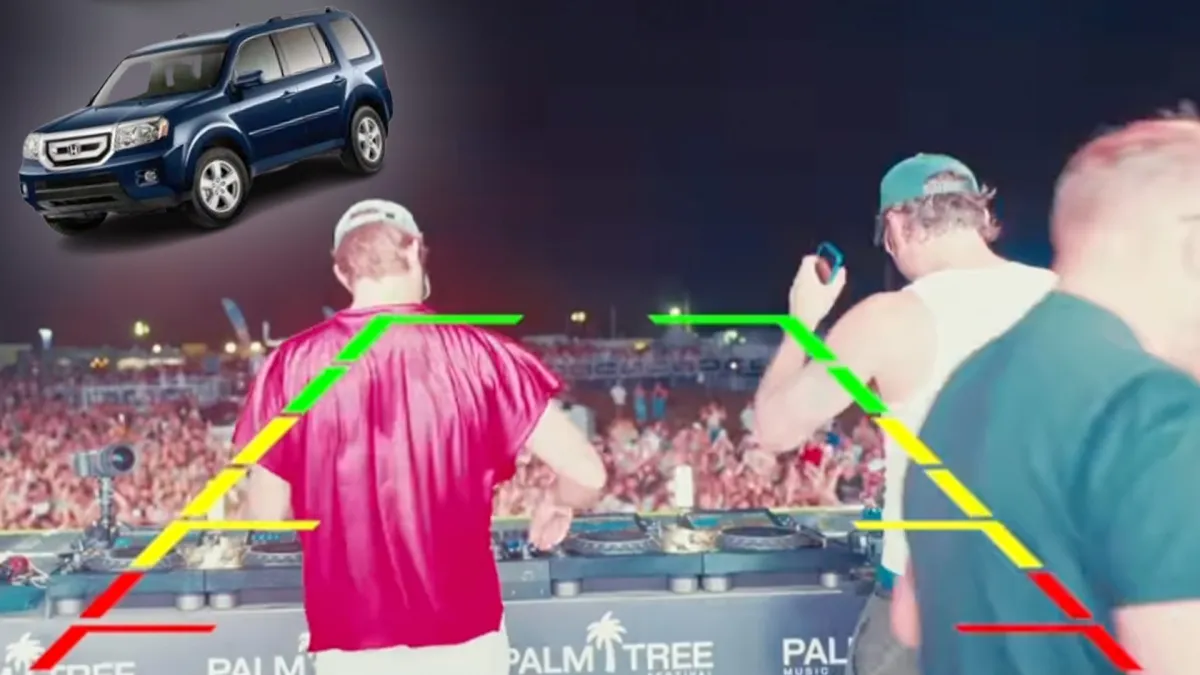
“The 2010 Honda Pilot rearview mirror backup cam is, objectively speaking, the perfect cinema camera for filming The Chainsmokers,” videographer Jack Skelley said in a recent Instagram post showing off some of the camera’s output. “Everyone is out here arguing about FX5 color science, Sony autofocus, and 14 stops of dynamic range, but nobody is talking about the organic, raw pixel degradation of a 16-year-old OEM parking sensor.”
“The aggressively wide focal length bends the pyrotechnics into an immersive, hyper-distorted bubble, and the chromatic aberration is simply unmatched,” Skelley explains. “But the real magic is the in-camera UI. The permanent ‘Check Entire Surroundings’ overlay provides this brutalist, avant-garde framing device. Watching the beat drop exactly as The Chainsmokers cross into the red ‘Imminent Collision’ zone? Pure cinema.” And looking at the results, how could you not agree?
If you want to create your own cinematic masterpiece, the in-mirror display used here was available only on the Pilot EX-L trim level for 2010, while the Touring got a more conventional in-dash display because it had a navigation system. This was before rearview cameras were federally mandated, and before the widespread adoption of infotainment touchscreens, so having a place to show the camera feed was not guaranteed. Lower trim levels of the 2010 Pilot did without rearview cameras entirely.
Shelley explained in one of the comments that he attached it to a Ronin RS4 gimbal. Nice.
Honda
It’s worth noting that the Cameron Gulbransen Kids Transportation Safety Act, which directed federal regulators to issue a rearview-camera mandate, was passed in 2007, three years before the 2010 Pilot arrived for the second model year of the Honda crossover’s second generation. As is often the case, issuance of the rules was delayed, in this case until 2018. By then, most new cars already had rearview cameras, though.
Improbably, this isn’t the first time someone has attempted to use a car’s rearview camera for artistic purposes. In 2016, somebody made a short film using only a Toyota Prius backup camera. It was meant as a spoof of auteur filmmakers’ use of esoteric formats, according to an Inverse post from the time. That was filmed with the camera still installed in the car, something I would love to see an enterprising videographer attempt at a concert.
Add The Drive as a preferred source on Google to see more of our reporting.
Stephen has always been passionate about cars, and managed to turn that passion into a career as a freelance automotive journalist. When he’s not handling weekend coverage for The Drive, you can find him looking for a new book to read.
