

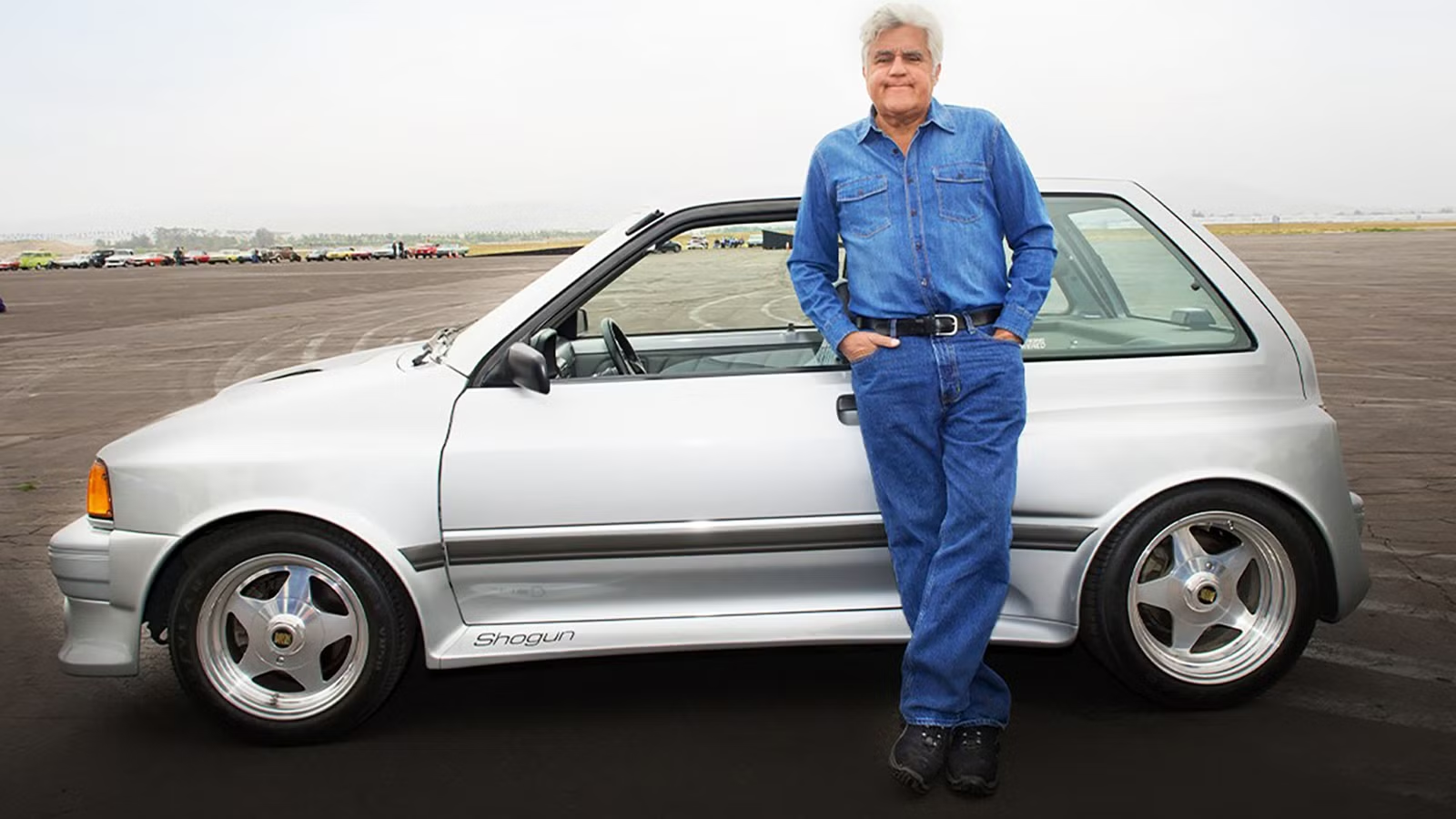
We’ve been tracking Leno’s Law from the start, through all its ups and downs, and we’re very happy to report that it’s finally been passed. California Governor Gavin Newsom signed the bill into law on September 16, making life easier for car collectors. Here’s what you need to know.
What Exactly Is Leno’s Law?
1981 Pontiac Firebird TurboBring a Trailer
Leno’s Law refers to California Senate Bill 1392, which we call Leno’s Law because of the public support it’s drawn from comedian Jay Leno, famously one of the state’s biggest car collectors.
Californians deal with some of the most stringent emissions laws in the world. Anything built in 1976 or later has been subject to smog checks every two years. Under Leno’s Law, that year is bumped to 1985, exempting a decade of cars from the hassle. To go over some key points…
- Newly exempted cars will need to be insured as collector vehicles, meaning a limit of 1,000 annual miles.
- Cars that were already exempt will not be subject to the 1,000-mile provision.
- The bill goes into effect January 1, 2028, when 1981 models will be phased in. Then 1982 models the next year, 1983 the year after that, and so on, up to the 1985 model year in 2033.
- This is the second version of the bill.
- Governor Newsomalso signed Assembly Bill 2541 into law this session, introducing a license plate to honor lowriders, and State Bill 1069, expediting the state approval process for aftermarket part manufacturers. Both of these bills suggest a positive attitude shift toward classic cars in the Golden State.
Leno’s Law may seem like it covers a fairly niche area of automotive law. How many 1981 Cadillac Eldorados do you really see in a day, anyway? Well, Senator Shannon Grove, one of the bill’s authors, reports having asked the California DMV for registration numbers, learning that the state is home to more than 320,000 vehicles dated 1976 to 1991.
Classic cars make up a minority of all cars on the road, but they’re a critical part of American culture and history, especially in California. Imagine a car show with no C4 Corvettes, simply because the owners couldn’t find a smog check place in time.
California Has Always Led By Example
1982 Ford EXPBring a Trailer
If you don’t live in California, it’s easy to brush this whole story off with a disinterested “good for them.” We would argue that any American driver with more than a passing interest in cars should keep an eye on California, though.
Smog checks are mandated and overseen in California by the Bureau of Automotive Repair (BAR). BAR enforces classic car smog checks through the California DMV, and works with the California Air Resources Board to test and manage regulations. CARB-compliance extends to not just California, but 17 states and Washington DC.
According to federal law, states cannot enact their own extra-strict emissions standards, but they can adopt California’s stricter standards. In states like Colorado and New Mexico, California quite literally sets the example.
How Collectors Outside California Can Use Leno’s Law As A Template
2026 Ford Mustang Mach-E GT California Special rear angle in white while drivingFord
Leno’s Law does not automatically take effect in all CARB-compliant states. But, in especially restrictive states like Massachusetts and New York, where emissions inspections are required every single year, classic car enthusiasts at least have Leno’s Law to point to as a precedent.
Why Did It Take So Long To Pass Such A Simple Bill?
The 1981 Mazda RX-7 combines lightweight sports car with a small-capacity but powerful and rev happy rotary engine.Mazda
Leno’s Law was first introduced as Senate Bill 712 in March 2025. The bill went up for a vote in April that year, successfully passing the Senate Transportation Committee with a 12-2 vote. Then the bill was dumped into the lap of the Assembly Appropriations Committee, where it stalled out.
The bill was reintroduced in February this year as SB 1392 with some revisions, passing the legislature in 2026, to be officially signed into law in September. So, what changed?
Well, the key change was to the rolling phase-in. As explained on Senator Grove’s own website: “Leno’s Law (Senate Bill 1392) will extend full smog check exemptions to qualifying classic and collectible vehicles, beginning on January 1, 2028, with collector motor vehicles manufactured from 1976 to 1980 and then adding one model year annually, until reaching 1985 models.”
SB 712 would have introduced a permanent, rolling 35-year smog-check exemption. SB 1392 puts a cap on the rolling exemptions, so that the exemptions stop at the 1985 model year in 2033. As the language on Bill Track 50 puts it:“Starting January 1, 2027, (Senate Bill 712) will fully exempt motor vehicles that are at least 35 model years old.”
It’s difficult to say exactly why the first version of this bill failed. SB 712 was dropped into the AAC’s suspense file, never advancing to a full floor vote. Basically, “Don’t call us, we’ll call you.” But the changes to the proposed exemption rollout seem to have gotten the job done.
We owe Jay Leno, Senator Grove, bill author Senator Dave Cortese, Governor Newsom, and everyone who’s supported the bill along the way a debt of thanks.
Sources: California State Senator Shannon Grove, Californians for Classic Car Smog Exemptions, BillTrack50.
