

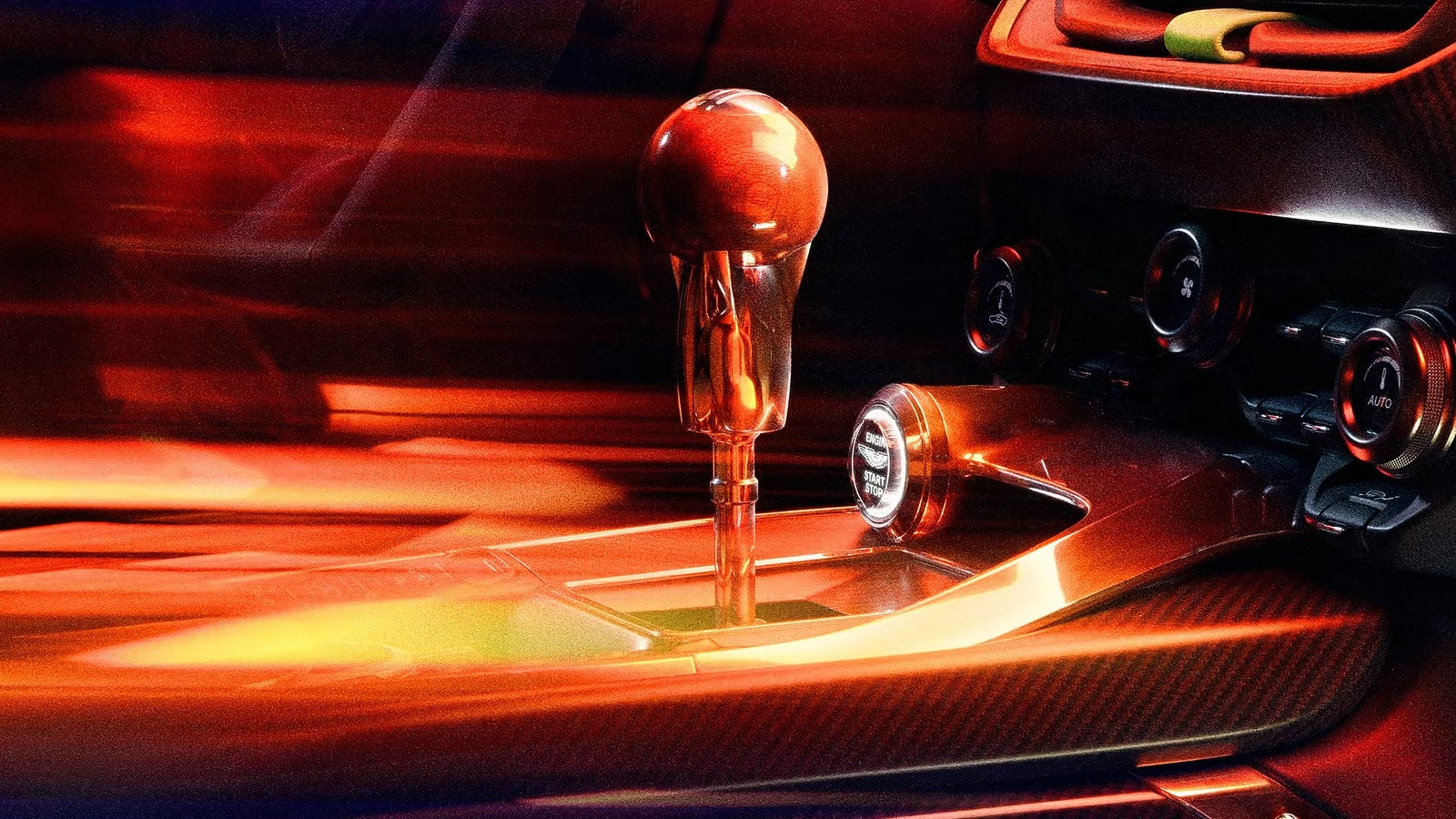
Recently, Aston Martin released two limited-production models toting V12 engines: the Valour and the Valiant. The former was limited to 110 units worldwide, produces 705 horsepower, and was built to commemorate the brand’s 110th anniversary. The Valiant was a more track-focused version, limited to just 38 examples and boasting 735 ponies. Both make use of a 5.2-liter, twin-turbocharged V12 engine.
While their horsepower figures are impressive, the V12’s torque output had to be limited to 555 pound-feet. Because of both models’ use of a special manual-shift transaxle, Aston was forced to dial back torque output. On a broader scale, Aston Martin has commented that manual transmissions in the modern era require a thick layer of electronic integration. All of this serves to say: keeping the V12 manual alive today is no easy task.
Aston Started With A V12 That Made Too Much Torque
Aston Martin Valour Front 3/4 ViewAston Martin
The tamer of the two V12 Astons, the Valour, uses the aforementioned 5.2-liter V12 paired with a six-speed manual. The engine itself has roots that stretch back over 30 years, to Ford’s original Genesis engine platform, which debuted in 1994. In order to keep the Valour and subsequent Valiant tame enough to sport a conventional manual, Aston took the transmission first and tailored the engine to it. Normally, it’s the other way around.
Aston did little to limit the engine’s horsepower output for both the Valour and Valiant, but both models’ 555 pound-foot torque measurement was a strict limit. At low and mid-rpm, it was found that the engine, when allowed to produce as much torque as possible, could potentially destroy the bespoke manual transaxle setup. Instead of trying to find a way to make it work, Aston simply limited the engine’s torque output.
The V12’s horsepower output didn’t need to be limited, luckily. However, because a torque measurement is simply related to how much twisting force an engine can generate, too much twisting can wreak havoc on things like transmissions and drive axles if they’re not up to the task of handling it. If you’ve ever seen a classic muscle car revving its engine, and it looks like the car is tilting to one side, that’s a representation of torque’s twisting force in action.
Aston was set on using its rear-mounted manual transaxle chiefly due to its ability to distribute weight across the vehicle more evenly than a separate mid-mounted gearbox and rear differential. The rear-facing mechanical connection between the transaxle and the gearstick in the cabin is also exposed, making the shift linkage a part of the car’s overall artistic appearance rather than being hidden away, as it usually is.
The Aston V12’s 555 LB-FT Ceiling Shows What Modern Torque Can Do To A Manual
Is this the most beautiful stick shift ever made? The mad Aston Martin Valiant, a car partly developed by Formula One legend Fernando Alonso, has a manual gearbox that is also a work of art.Aston Martin
Because the V12 found in the Valour and Valiant employs two turbochargers, it can produce a huge amount of torque. Additionally, the huge amount of torque can be delivered at extremely low rpms, meaning the entire drivetrain is subjected to twisting force almost immediately upon full-throttle acceleration. A stick shift has to absorb all the grunt through the clutch, gears, shafts, and diff without the space-age torque management tech found in modern dual-clutch automatics.
We can find the unlimited torque figure from the very same 5.2-liter V12 engine in the current Aston Martin Vanquish. Because it uses an eight-speed automatic, Aston could let the V12 run wild with a full 738 pound-feet of torque. The 183 pound-foot reduction in torque between the Vanquish and the Valour/Valiant means Aston has to limit roughly a quarter of the engine’s overall torque output, just to preserve the manual transaxle.
The Aston Martin Valiant gets 730 hp and a six-speed manual gearbox. It also looks like a million dollars.Aston Martin
If Aston wanted to chuck 738 pound-feet at the bespoke transaxle setup, it’s likely an extensive amount of work would need to be put into the entire setup before it could handle it. This would mean incurring greater development costs, forcing Aston to charge more for the models as a result. At the same time, strengthening those components could potentially make the delicate shift feel of the gearbox heavy and imprecise.
Be that as it may, what the Valiant and Valour do end up proving is that massive amounts of horsepower can be supported by a conventional manual transmission. However, horsepower is just how fast an engine can apply its power, and that doesn’t necessarily have to do with how much it twists. To make a manual transmission that can withstand a torque-heavy engine, though, Aston shows us that some reverse engineering is required.
The Electronics Surrounding Modern Manuals Inject Another Problem
The Aston Martin Valiant gets 730 hp and a six-speed manual gearbox. It also looks like a million dollars.Aston Martin
Adrian Hallmark, Aston Martin’s current CEO, recently commented on the issues facing manual gearbox integration in modern cars. According to him, the issue isn’t sourcing or building the transmissions itself. Rather, it’s how many electronic systems the gearbox has to integrate with once it’s installed in the car. Modern driver-assistance technology, such as adaptive cruise control and automatic crash avoidance, poses problems for the human-operated stick shift.
At the same time, manual transmissions change how systems like torque management and launch control actually function. Going back to the drawing board and completely altering how systems such as those operate for a relatively small pool of stick shift buyers can prove, for many automakers, financially unviable. In the Aston Martin Valour and Valiant’s case, this issue isn’t that troubling as they’re both low-volume models.
Think of models like the Honda Civic Si, though. It has to integrate many of the now-mandatory driver-assistance features with a manual transmission, of which fewer and fewer folks buy every year. The costs of the developments required therefore need to be spread across thousands of vehicles. The pair of bespoke Astons, on the other hand, can absorb development costs easily since, of course, they are quite expensive.
Another plus for Aston’s limited use of the manual gearbox in its Valour and Valiant sisters is the brand could spend money on designing bespoke mechanical components for its stick shift setup. Again referencing something like the Civic Si, Honda will not want to spend on things like that because the model needs to remain relatively affordable. In mainstream cars, the manual has become more and more difficult to actually justify, and at the same time, people are turning their noses up more and more at it.
Aston Shows Us What It Might Take To Keep The Manual Alive
Aston Martin Valour Interior View Gear ShifterAston Martin
Between the Valour and Valiant, only 148 examples were produced, all of which have already sold. Neither car was ever intended for regular production, meaning Aston could spend whatever it wanted on developing both. Hence, both received special gear sticks hooked into exposed gear shift linkages, which were then attached to rear-mounted manual transaxles.
Things like drivetrain efficiency and maximum engine torque figures were completely ignored due to the models’ limited-production nature. Instead, Aston could solely focus on building the ultimate machine based on its artistic and mechanical vision. Mechanical involvement was prioritized in both instances, as Aston likely wanted to build a pair of cars that felt as analog as possible, especially given the current proliferation of electronics-dominated vehicles.
2024 Aston Martin Valour in blackDuPont Registry
Both the Valour and Valiant represent unusual supercar formulas. On one hand, they produce huge amounts of horsepower, boast gorgeous designs both inside and out, and they both cost a huge amount of money; nearly $2 million in some cases. On the other, both had their torque outputs restricted because their transmissions weren’t up to the task of handling it. Credit where it’s due, Aston didn’t hide the fact that it needed to limit the engine’s potential, either.
Aston has shown us that the manual gearbox can survive in the modern world, but automakers will likely need to spend more and accept some compromises along the way to make it work. The real enemy, though, is modern electronics. Engines and people may not manage to kill the manual, but if there will ever be a time when the old-school stick shift bites the dust for good, modern tech may very well be to blame.
Base Trim Engine
5.2L Twin-Turbo V12
Base Trim Transmission
6-speed manual
Base Trim Drivetrain
Rear-Wheel Drive
Base Trim Horsepower
705 hp
Base Trim Torque
555 lb-ft
Fuel Economy
TBC
0-60 MPH
3.5 seconds
Sources: Aston Martin, Road and Track, Motor1.com, Evo.co.uk.
