

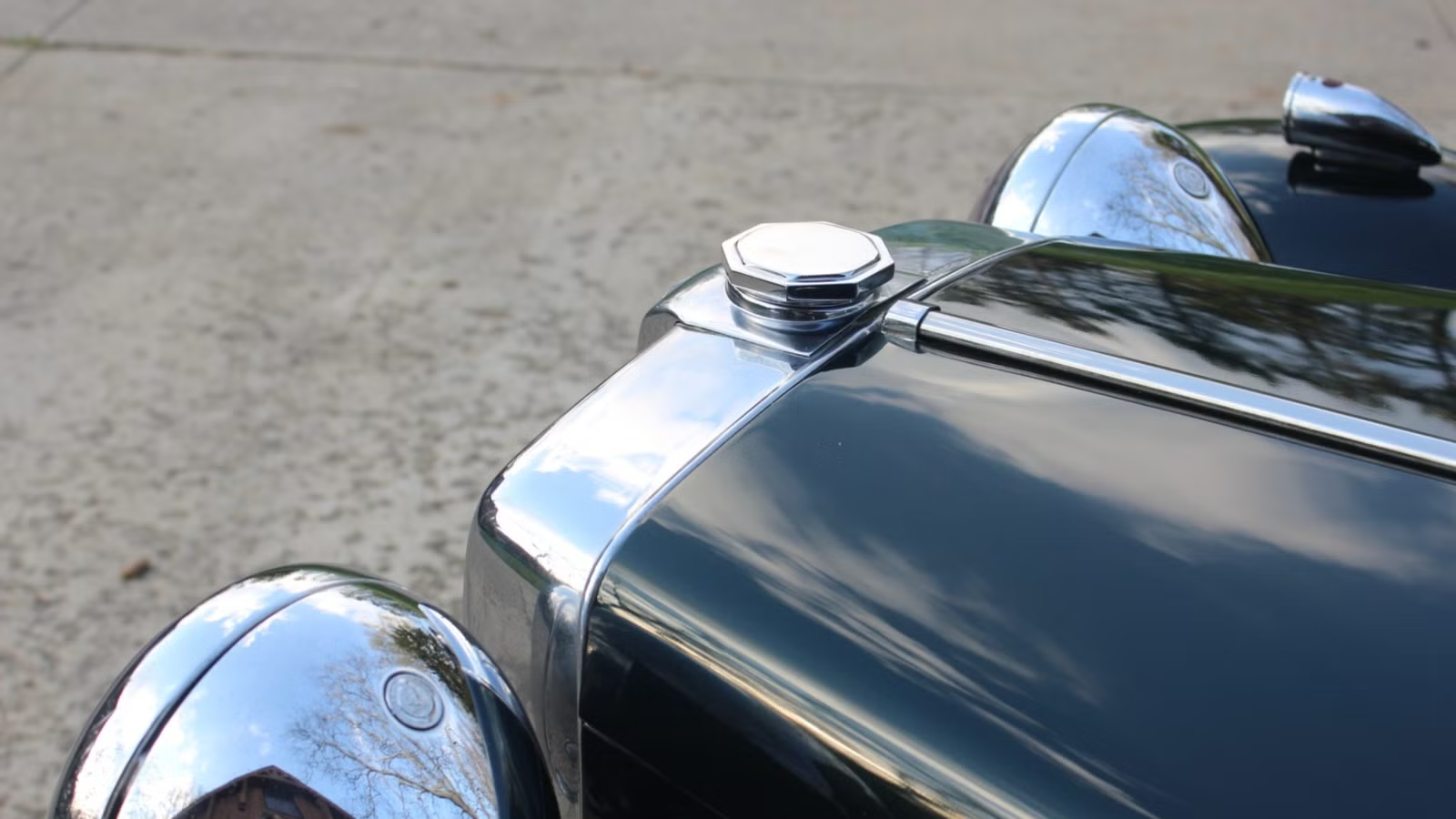
For much of its life, MG was a wholly British marque best known for building small roadsters and sports cars. A Chinese company has owned the brand since 2005, but MG was still a cornerstone of English automotive history.
The brand was also partially responsible for popularizing small sports cars in the United States. After the close of World War II, soldiers stationed in Europe returned to America wanting to get their hands on a small roadster of their own, having been exposed to them there. MG was among the first brands to capitalize on the demand with its TC, which became one of the first successful imported sports cars in the US. Not to mention, it sparked a lasting countrywide desire for sports cars.
The MG TC Arrived At The Perfect Moment
1947 MG TC finished in green with black interiorBring A Trailer
World War II brought hundreds of thousands of Americans overseas, to places many of them had never seen before, and to fight folks they’d never met. The war itself was tragic, and led to the widespread destruction of much of Europe. However, once the Allies claimed victory, Americans continued to be stationed on the Old Continent. Soldiers were exposed to new things, and many of them came back to the US with a yearning to get their hands on something like a small, lightweight roadster.
There was a growing demand in the US for cars imported from Europe. MG was ready to capitalize on the situation. The company began exporting its MG TC roadsters to the US in 1947, two years after the model was originally introduced. The car was never designed with American buyers in mind, but it had found a niche over in the Colonies nonetheless.
1947 MG TC finished in green with black interiorBring A Trailer
The MG TC’s formula is quite simple. It is extremely lightweight, weighing around just 1,735 pounds. There’s a convertible roof, with just a simple cloth roof that can be folded away into a compartment behind the seats. Up front sits a small, 1.25-liter four-cylinder engine pumping out 54 horsepower and 64 pound-feet of torque mated to a four-speed manual transmission. The whole purpose of the TC was nimble handling, with little regard given to power output.
1947 MG TC finished in green with black interiorBring A Trailer
The typical American sedan built in the late 1940s was heavy, albeit with much more power than the MG TC. Among American automakers at the time, engine power took precedence on the automotive totem pole, with handling taking a back seat. The MG TC’s reversal of that focus was novel to the US at the time, and many folks were looking for it.
The TC Made Americans Fall In Love With Driving
1947 MG TC finished in green with black interiorBring A Trailer
Between 1945 and 1949, roughly 2,000 MG TCs came into the US. While a relatively small figure, it was enough to ignite a passion for the small sports car over in the US that expanded beyond returning veterans of the European Theater. Of those cars, some entered the country when soldiers stationed in the United Kingdom bought them there and shipped the machines to the US.
In addition to its lightweight nature, the TC featured extremely simple engineering. Its steering was direct and, as was typical of the time, lacked any sort of power assistance. This meant every single aspect of the road surface was felt through the steering wheel, adding a huge amount of driver engagement into the mix.
1947 MG TC finished in green with black interiorBring A Trailer
During this period, cars were far more tailored to their markets. The US was more spread out, requiring folks to drive much farther on average than Europeans did. The situation meant the average American car had a design focused on long-distance cruising, with comfort and straight-line, highway-speed performance in mind rather than nimble handling. After all, if you’re traveling for a couple of hours on an arrow-straight highway, you won’t be very concerned with your car’s handling ability. Instead, you’ll be more keen on the softness of the seats or the suspension’s ability to iron out bumps.
However, the TC still managed to find its way into American car culture. Because of its niche appeal among fans, the little MG helped establish a grassroots sports car culture in the US. It even helped establish sports car driving clubs in certain areas across the country. Racing events, cruises, and autocross events featuring the vehicles like this cropped up. In other words, the TC’s revolutionary approach to motoring for Americans introduced a completely different way to enjoy cars.
It Fundamentally Changed The American Auto Industry
1947 MG TC finished in green with black interiorBring A Trailer
Before the MG TC’s success, imported cars were seen as bespoke, luxurious items that only the elite few could enjoy. Most folks likely thought of an imported car as something only a select few could ever hope to attain. However, the little MG TC was relatively cheap when compared to other imports, and it also served a purpose beyond looking flashy.
Following the MG TC, numerous other British roadsters began to trickle into the US. Models like the Jaguar XK120 and the MG TD, the TC’s successor. Once folks got a taste of the MG TC’s fun-loving, raw nature, demand for the small sports car really began to explode. American-based automakers also started to join in on the fun, with models like the Crosley Hotshot being introduced.
1947 MG TC finished in green with black interiorBring A Trailer
In 1953, the Chevrolet Corvette finally hit the streets. The idea behind the ‘Vette was influenced by the early British roadster invasion, which the MG TC spearheaded. At first, the Corvette wasn’t all that popular, as it was slow, heavier than some of its European counterparts, and lacked a V8 engine option – something that Americans wanted to see in a domestic sports car. By 1955, a V8 option was introduced, and the Corvette’s popularity exploded.
If it hadn’t been for the MG TC, though, the very scope of the American automotive industry may look much different today. There may never have been a small sports car revolution, meaning the Corvette itself may never have entered the fold. Imagining an American automobile market without a Corvette at its center is a strange, perhaps even uncomfortable, prospect, and we have the little MG to thank for changing what Americans expected of a sports car.
The MG Deserves More Recognition Than It Got
1947 MG TC finished in green with black interiorBring A Trailer
While the MG TC was popular during its production run, a slew of later, more recognizable models quickly forced it into the shadows. The incoming Jaguar XK120 offered even more performance, and the Corvette gave customers a legit American competitor to the foreign sports cars entering the country. After all, back then, most US citizens were much more keen to buy domestic than get something produced by a foreign brand.
Niche collectors, though, still appreciate the MG TC to this day, even if it flies well under the radar. Its rich American historical significance in the automotive market makes it a target for many collectors, alongside its lightweight, cat-like handling and extremely simple engineering. There are still numerous clubs operating throughout the US that feature the little MG, too.
1947 MG TC finished in green with black interiorBring A Trailer
Today’s MG brand isn’t much like the one that introduced the MG TC to the US, sparking a vehicular revolution. MG was removed from British ownership in 2005, when the Nanjing Automobile Group (NAG) bought it from the ailing MG Rover Group. As of 2007, MG is owned by Shanghai Automotive Industry Corporation (SAIC). The brand currently produces a lineup of SUVs, hatchbacks, and sedans, as well as an all-electric roadster called the Cyberster.
Of course, the modern MGs bear little resemblance — mechanically or otherwise — to the TC. The fact remains: without MG’s production of the TC nearly 80 years ago, the American sports car market might be fundamentally different from what it is now.
Sources: Beverly Hills Car Club, Victorville Daily Press, Hagerty, ChinaCarHistory.com.
