

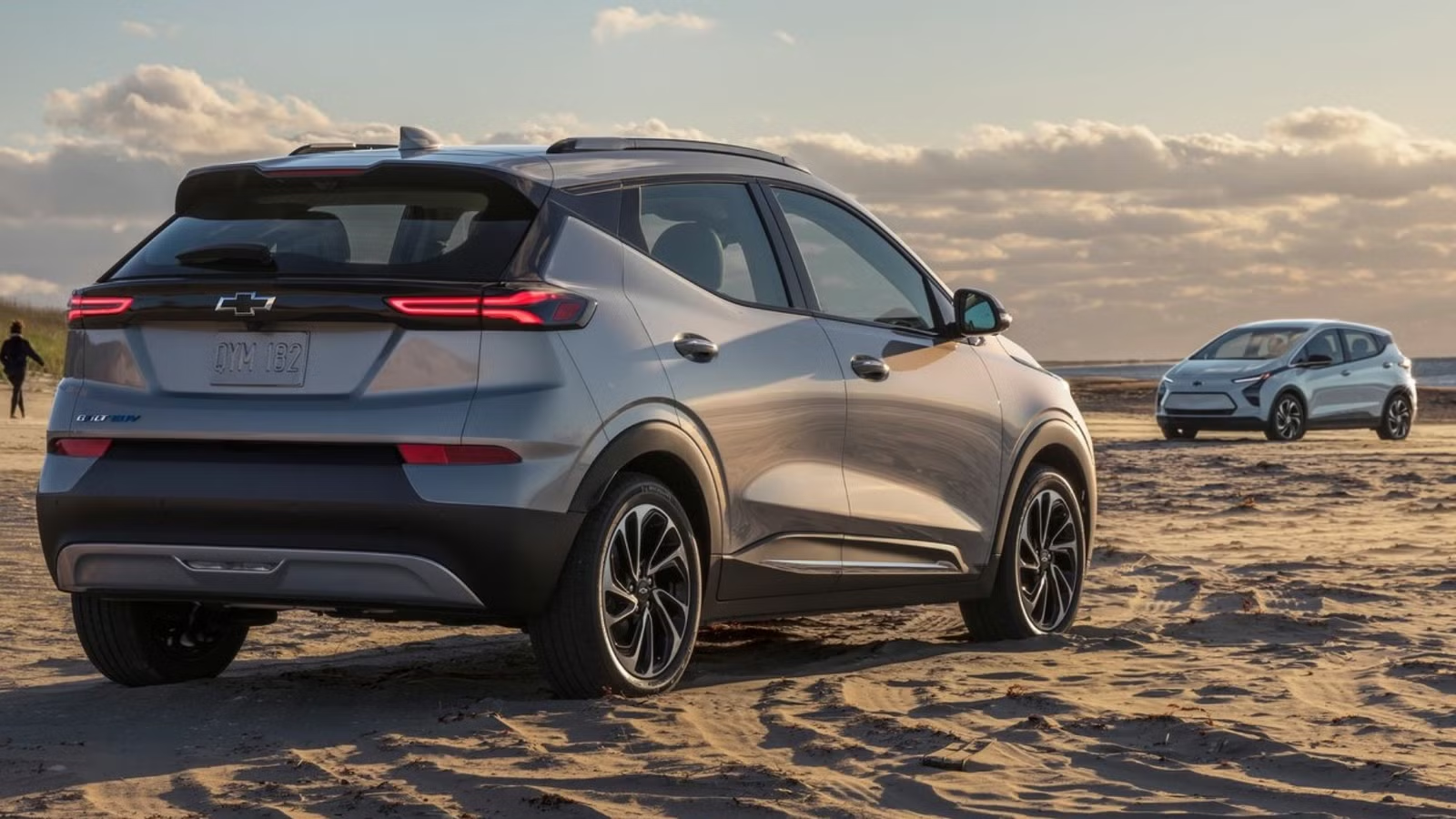
Two hundred thousand miles is a lot for any car, so when one vehicle covers far more than twice that distance, it deserves further inspection. And when this turns out to be an inexpensive entry-level electric car, that gives some insight into just how tough these vehicles might actually be.
One 2019 Chevrolet Bolt EV has now covered an extraordinary 471,616 miles while still retaining its original electric drive motor. It’s certainly needed some repairs along the way and has used more than one battery. But even after the second battery failed, the owner simply added another and took to the road again…
This Bolt Has Covered More Than 471,000 Miles
2017 Chevrolet Bolt EVChevrolet
In 2019, Chevrolet was selling its Bolt EV as a relatively attainable long-range electric hatchback. This wasn’t a luxury product or flagship by any stretch of the imagination. It used a 60-kWh lithium-ion battery and came with an EPA-estimated range of 238 miles. But as it turned out, one of these particular cars was destined for some heavy-duty service, logging more than 471,000 miles on its odometer over the seven years that followed.
Eventually, in 2026, its owner would take the car to an EV repair specialist, Out of Spec Renew, with a significant problem. Something had happened to the high-voltage battery so it wouldn’t charge, select Drive, or Reverse, and the instrument cluster was showing a battery fault warning. This visit provided an interesting opportunity to take a closer look at the overall condition of the car.
This Bolt Held Up Surprisingly Well
2017 Chevrolet Bolt EV rearChevrolet
When any car shows evidence of considerable longevity, it’s worthwhile to map its journey and see what may have failed during that time. In this case, the list of major failures for this Bolt is actually quite short. Crucially, the car’s electric drive motor is reportedly still original, so the same propulsion motor that left the factory in 2019 was good for more than 470,000 miles.
The shop carrying out the work also noted a leaking axle seal, and that the car needed an overdue reduction gear oil service. But while the owner had carried out other repairs along the way – such as new suspension components, wheel bearings, and steering rack work – none of that is particularly shocking for any vehicle with this kind of mileage.
Of course, electric cars have far fewer components than some of their internal combustion engine counterparts, but they still require parts like suspension joints, bearings, steering components, seals, and tires. Hundreds of thousands of miles would obviously take their toll on all those parts, but this car’s history doesn’t show evidence of any major challenges. The mechanical picture was surprisingly clean – but the battery tells a more complicated story.
Its Second Battery Lasted More Than 330,000 Miles
2019 Chevrolet Bolt EV battery packChevrolet
In 2022, Chevrolet conducted a large-scale battery recall, pulling in this Bolt for a new battery at around 138,000 miles. The replacement pack wasn’t identical to the original 60-kWh unit, reflecting progress in battery technology at that time. GM supplied these cars with new modules using what it described as its most advanced Bolt battery chemistry.
This replacement provided around 8% more capacity than the earlier pack and brought those early vehicles up to the later Bolt battery specification. GM had apparently found a rare combination of two manufacturing defects that led to this recall – involving a torn anode tab and a folded separator. Those issues could be present in the same cell, increasing the risk of fire.
Once that recall work had been completed, the replacement battery was good for the long haul and was able to cover more than 330,000 miles before it started to develop some problems of its own.
The technicians at Out of Spec Renew found cell voltage imbalances involving two battery modules, and those imbalances had caused the Bolt to shut down. Once the specialist removed and opened the battery, however, it found that widespread cell swelling was visible across the modules. And this meant that the battery was beyond repair and the only way forward was to fit a new one.
So the battery failed – but what does replacing it actually cost, and does it make financial sense to keep going at half a million miles?
Half A Million Miles Still Take Their Toll
2019 Chevrolet Bolt EV cutawayChevrolet
In a vehicle teardown study by Swiss investment bank UBS, analysts found that the Chevrolet Bolt EV’s powertrain had 35 moving and wearing parts, compared to no fewer than 167 in a comparable, combustion-enginedVolkswagen Golf.
So, there’s clearly a significant difference in areas where something could go wrong, and it may not be so unusual after all to see that, in some circumstances, an EV may last longer than an ICE car. That said, the vehicle surrounding that powertrain and all its components is still subject to the same physical punishment as anything else driven for hundreds of thousands of miles. Wheel bearings still have to rotate, and suspension components still have to deal with potholes.
But a gas car reaching 470,000 miles might have needed extensive engine work, transmission repairs, emissions equipment, fuel system components, exhaust parts, and countless oil and filter changes along the way. While the Bolt avoids a lot of that drama entirely, the fact that its propulsion motor was still operating well after this much use is nevertheless significant. And separately, both of its all-important batteries were able to last far longer than Chevrolet’s eight-year/100,000-mile limited parts warranty would cover. In the case of the second unit, considerably so.
Another Used Battery Puts It Back On The Road
2019 Chevrolet Bolt EV charging cableChevrolet
Out of Spec Renew sourced another Bolt battery from a 2017 Bolt to continue this vehicle’s remarkable story. That battery also turned out to be a replacement in its own right as part of a recall replacement in 2023. This meant that the transplanted battery had the same specification as the battery now coming out of the 471,000-mile car. Apparently, the donor battery had covered around 10,000 to 15,000 miles and cost around $1,800 to acquire. That seems to be quite a good deal, as a suitable used Bolt battery might usually cost between $2,500 and $3,000 for the pack itself and be subject to around $1,000 in labor costs in order to fit it.
But once the technicians had fitted the replacement battery, this long-suffering Bolt was ready to go again and perhaps on its way to that magical 500k figure. As it headed off on the latest stage of its journey, the Bolt was still running on its original electric motor even if it was now on its third battery. Its suspension and steering hadn’t magically escaped wear along the way, and almost half a million miles had shown that life had been relatively hard. But this 2019 Chevrolet Bolt EV had nevertheless told a very interesting story to this point and, in that respect, had done far better than most people would probably expect.
Sources: Chevrolet, Out of Spec Renew, UBS.
