

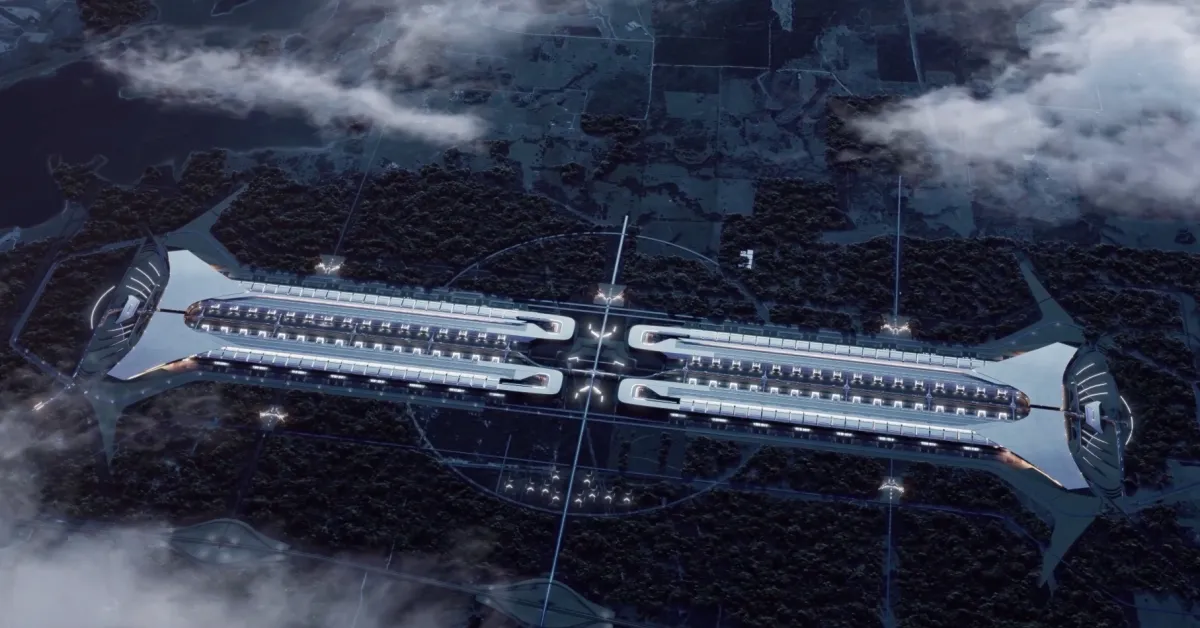
Tesla and SpaceX have confirmed where they’ll build Terafab, the semiconductor megafactory Elon Musk first teased in March. It’s going to Grimes County, Texas, about an hour northwest of Houston.
The companies put the initial phase at roughly $16.8 billion and said the finished site will span more than 100 million square feet, which they’re calling the largest chip manufacturing facility on the planet.
SpaceX laid out the plan in an update on its site Thursday, and Tesla echoed it on X. “Both Tesla & SpaceX will need far more chips than current & future global production can supply,” Tesla wrote, pointing to a goal of “producing over 1 terawatt of compute per year.”
Terafab will be built in Grimes County, Texas
In April, we broke ground on our research fab on the North Campus of Giga Texas – the precursor to Terafab.
Both Tesla & SpaceX will need far more chips than current & future global production can supply.
This is why we’re building… pic.twitter.com/je4jKXuQrY
— Tesla (@Tesla) August 6, 2026
The pitch is vertical integration at a scale nobody has attempted. SpaceX says Terafab will combine logic, memory, packaging, and testing under one roof, producing chips for Tesla’s Optimus robots and Cybercabs and for the “space-based data centers” SpaceX wants to launch. The first phase is $16.8 billion from the two companies, with “future expansion phases bringing total investment much higher.” At least 3,000 people would work there, most of them local hires.
The site has a backstory. Terafab will sit on the Gibbons Creek Reservoir, which used to cool a coal-fired power plant that shut down in 2018. SpaceX says it’ll pull water from the reservoir rather than local groundwater, a nod to a Grimes County community that’s already uneasy about water use and the data centers spreading across Texas.
The price tag keeps moving
That $16.8 billion figure is not the number Musk led with. When Tesla and SpaceX first announced Terafab in March, the headline number was $25 billion. Now it’s a $16.8 billion “initial phase,” with the rest left vague.
And in May, SpaceX’s own IPO paperwork undercut the pitch. The company’s S-1 filing described Terafab as only a “general framework” with no binding commitments, no finalized IP split, and no obligation for either side to keep participating. A month before that, we reported that Tesla wasn’t really going to build the fab itself, with Intel lined up to handle the actual manufacturing.
So the confident tweet naming a county sits on top of a paper trail that says a lot of this is still undecided.
Tesla already has its chips coming from Samsung and TSMC
None of this is about Tesla’s near-term supply, which is already contracted out. Samsung’s Taylor, Texas fab is in production on Tesla’s AI5 chip, and last year Tesla signed a $16.5 billion deal with Samsung to build its next-generation AI6 chip. TSMC covers the rest.
That makes Terafab a much longer bet, tied to Musk’s claim that his companies will eventually need more compute than the whole semiconductor industry can produce. It’s the same “1 terawatt of compute per year” math he laid out when SpaceX absorbed xAI in February and started pitching orbital data centers.
The scale claims are hard to square with anything that exists. 100 million square feet is more than ten times the floor space of TSMC’s biggest gigafabs. TSMC is spending roughly $165 billion to build six fabs in Arizona, and those are a fraction of Terafab’s stated footprint. No fab on Earth is built to output “a terawatt of compute” a year, because that number doesn’t come from the chip industry. It comes from Musk’s space ambitions.
Electrek’s Take
Terafab is more real today than it was in March. There’s a county, a site, permits moving, and SpaceX reps sitting down with residents. That’s more than a slide in a keynote.
But the gap between the tweet and the fine print is still wide. Tesla and SpaceX are calling this “the largest chip manufacturing facility ever” before pouring a foundation, while the same SpaceX told IPO investors three months ago that Terafab was a “general framework” with no binding commitments. Both of those can’t be fully true.
The number that matters for Tesla shareholders is how much of that $16.8 billion, and the “much higher” that follows, lands on Tesla’s balance sheet. Tesla already committed $16.5 billion to Samsung for chips it can build today, while its car business has stopped growing. Pouring billions more into a terawatt of compute for robots and orbital data centers describes a very different company than the one most Tesla investors originally bought into.
However, it fulfills Musk’s long-stated argument that “Tesla is not an automaker anymore.”
As data centers put mounting pressure on the grid and electricity rates keep climbing, home solar and batteries are becoming basic infrastructure rather than a luxury. With electricity rates up almost 10% last year and expected to keep climbing, going solar is one of the best ways to protect yourself against rising costs. And with lease and PPA options, you can do it with zero upfront cost and start saving immediately. If you want to find the best deal, check out EnergySage. It’s a free service with hundreds of pre-vetted installers competing for your business, so you save 20 to 30% compared to going it alone. No sales calls until you pick an installer. Get your free quotes here.
FTC: We use income earning auto affiliate links. More.
