

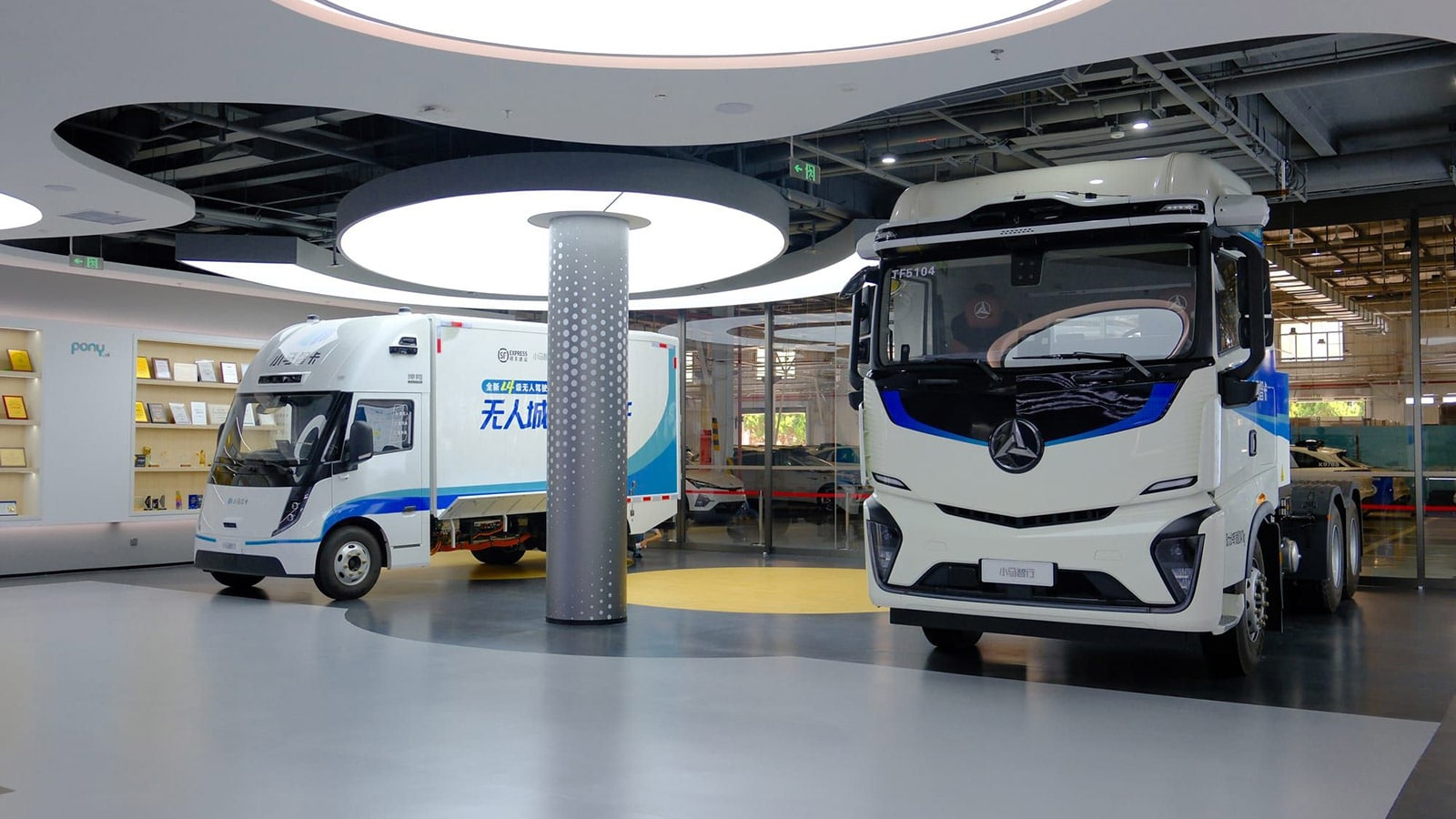
Pony AI’s autonomous heavy-duty and light-duty trucks. Credit: Pony AI
- Pony AI also plans to deploy 100,000 L4 autonomous light-duty trucks by 2030.
- Autonomous driving hardware costs for the Gen-4 heavy truck are about 70% lower than the previous generation.
Pony AI (NASDAQ: PONY) has set out clear scaling targets for its autonomous truck business.
The Chinese autonomous driving company expects to deploy 500 to 1,000 fourth-generation (Gen-4) autonomous heavy-duty trucks in China over the next two to three years.
The deployment will focus on three main scenarios: long-haul freight, bulk commodity transportation and port logistics, said He Xing, vice president of Pony AI and head of the company’s robotruck business, at a media briefing on August 3.
Light-duty trucks are expected to scale faster. Pony AI’s longer-term goal is to reach 100,000 L4 autonomous light-duty trucks by 2030, according to a statement on Thursday.
The targets rest on several developments maturing at the same time: a more capable autonomous driving system, lower hardware costs, automotive-grade redundant vehicle platforms, and deeper cooperation with vehicle manufacturers and logistics operators.
Pony AI entered the autonomous trucking business in 2018, when its early vehicles were largely hand-built prototypes. Subsequent generations moved progressively closer to automotive-grade production through partnerships with truck manufacturers.
Cost was the key factor in deciding when to scale. Autonomous driving hardware costs for the Gen-4 heavy truck are about 70% lower than the previous generation, and the vehicle is designed for a service life of 20,000 operating hours or up to 1 million kilometers.
“We had been waiting for the right moment,” He said. “Our truck technology had already reached a high level, but the cost of building an L4 robotruck remained high.”
The business has already moved beyond technology validation. As of November 2025, Pony AI operated about 200 trucks and had transported more than 1 billion ton-kilometers of freight.
In the first quarter of 2026, robotruck revenue reached $10.2 million, up 31% year on year, driven mainly by the expansion of commercial operations.
The Gen-4 heavy trucks are now in production and are expected to roll off the line in batches, entering commercial service across several use cases over the coming months.
Shenzhen’s Mawan Port will be among the first deployment sites. Pony AI has secured a project there and expects to put dozens of Gen-4 robotrucks into commercial operation.
Light-duty trucks address a different part of the logistics chain, moving goods between urban distribution centers, retail stores, delivery outlets and cold-chain facilities.
Those scenarios overlap substantially with the complex urban road conditions in which Pony AI’s robotaxis already operate.
The company introduced its first L4 autonomous light-duty truck in April 2026. Co-developed with CATL (HKEX: 3750) and built on the battery giant’s Kunshi Chassis Platform, the vehicle offers about 18 cubic meters of cargo space.
The first vehicles have entered intensive road testing in operating environments provided by logistics partners, with initial use cases including express delivery, retail distribution and food and beverage cold-chain logistics.
Based on current operating assumptions, fully driverless light-duty trucks could cut per-kilometer operating costs by 40% to 50% compared with human-driven operations.
The vehicle can carry 2.6 times the cargo volume of mainstream low-speed autonomous delivery vehicles, while operating at speeds suitable for regular urban and intercity roads, Pony AI said.
At the core of Pony AI’s strategy is applying the same Virtual Driver technology across robotaxis, heavy-duty trucks and light-duty trucks.
The light-duty truck uses the same core technology stack as the seventh-generation robotaxi, and the two can also share charging, ground support, service centers, fleet management and remote assistance capabilities. The company estimates the technological and operational synergies between the two platforms exceed 90 percent.
Heavy-duty trucks require more vehicle-specific adaptation, including for their size, weight, mechanical structure and longer braking distances.
Data and operating experience from the different platforms feed into a single development loop. PonyWorld 2.0, the company’s proprietary world model, is used to identify where the Virtual Driver falls short and to guide targeted data collection.
“Autonomous driving has to progress step by step — from technology driving product development, to the product enabling a business model, and ultimately to that model reshaping the industry,” He said.
Scaling also depends on partners. The Gen-4 heavy trucks were developed with manufacturers including Sany Truck, the light-duty truck was co-developed with CATL, and the company works with Sinotrans across long-haul freight and urban logistics scenarios.
Pony AI also sees potential for autonomous trucks in overseas markets, particularly at ports and other well-defined logistics sites, where driver shortages and labor costs make the economics of automation more attractive.
Pony AI’s first-quarter robotaxi revenue hit $8.6 million, surging 395.4% year-on-year.
