

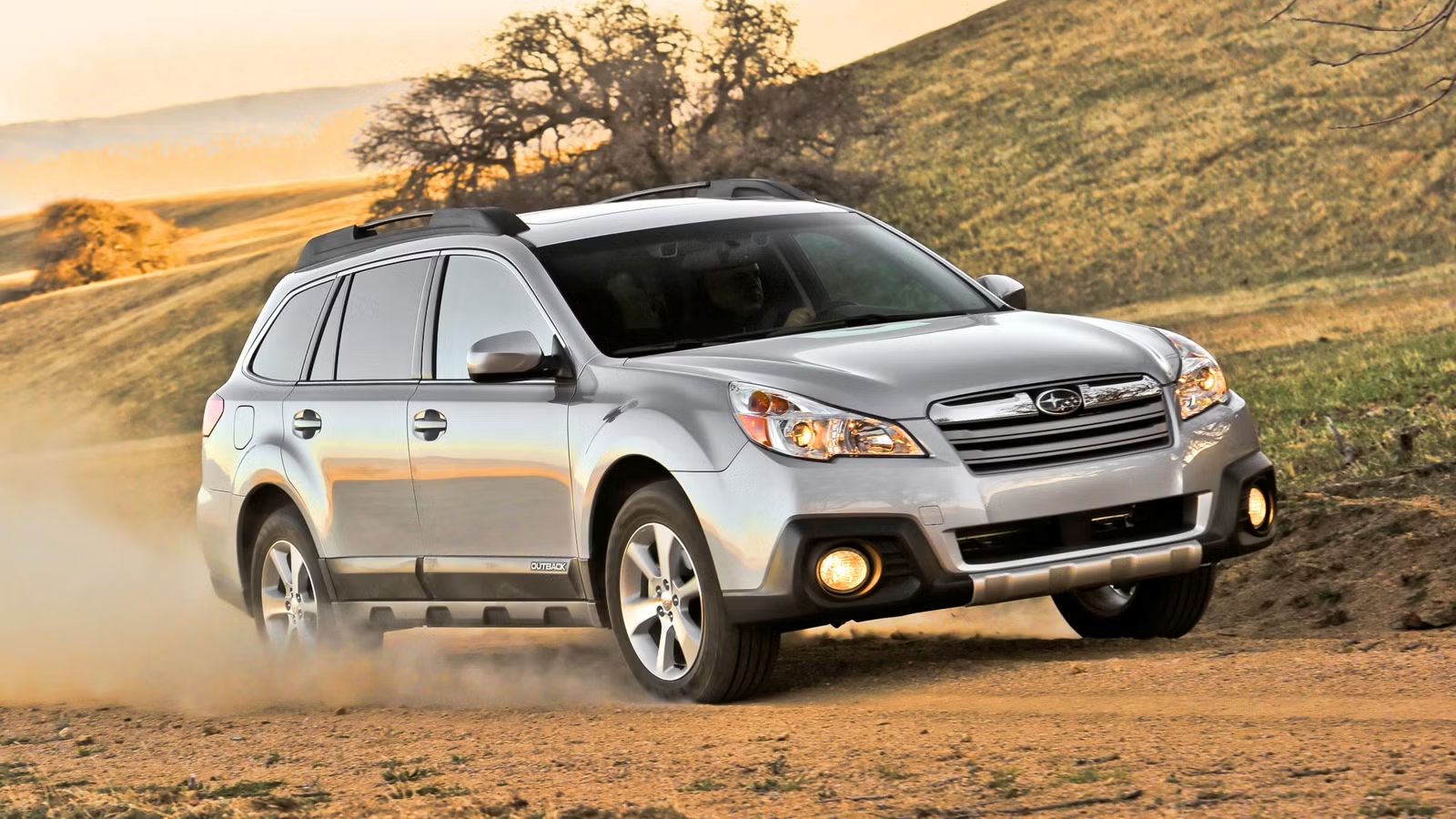
Subaru’s boxer engine really is one of the longest-lasting powerplants in the industry right now, and nobody’s disputing that. And yet, if we check in with our marketplace and look for the cheapest used Subaru Outbacks, we find very few models with more than 200,000 miles on the odometer. Even models in the 175,000 range are relatively scarce.
The problem with modern Subarus (and we can hear you saying “toldyaso” from here) is the Lineartronic CVT, a chain-driven transmission that has a reputation for giving out at between 120,000–150,000 miles, and the most likely reason a Subaru isn’t hitting a quarter of a million miles.
The Boxer Engine Is Everything It’s Been Made Out To Be
2026 Subaru BRZ boxer engineSubaru
The Subaru FA series has been the de facto powerplant for many Subarus since its introduction in 2012, powering the Subaru Forester, the Subaru Outback, the Subaru WRX, the Subaru Ascent, and, well, the list goes on. The FA’s predecessor, the FB line, is still in production, and has been since 2010. FBs can be found in everything from the Impreza Sedan to the Subaru Crosstrek.
A boxer engine is a flat-type powerplant, where you have opposing cylinders on each side of a central rotating crankshaft at a 180-degree angle. We’ve compared the oppositional layout to “two boxers throwing a bunch of jabs and straights at each other.” The beauty of this engine type is that you don’t need counterweights on the crankshaft, you don’t need balance shafts, since you have the opposing cylinders naturally balancing one another out. This is one reason why the boxer layout is so popular in airplane motors.
The longevity of a Subaru engine owes something to this smooth operation, with less wear and tear on various components. The flat design can also result in better heat dissipation. But there’s also the simple fact that it’s a Subaru. The brand is devoted to dependability, employing durable aluminum alloy blocks and heads with forged and cast iron crankshafts and connecting rods, along with iterative updates to help ensure that every new version of a given powerplant is more reliable than the last.
The Boxer Oil Leak Is Overblown
2027 Subaru Solterra Exterior Rear QuarterSubaru
We could go on all day praising the boxer engine layout, but we should mention its supposed disadvantages while we’re on the subject. Many Subaru drivers will tell you that oil leaks and excessive oil consumption are almost a given once you start putting six figures on the odometer. But, this typically comes down to one of two things: normal oil use, or negligence on the part of the owner.
As a user in the r/Subaru subreddit puts it, “Subaru purposely loosened the oil control rings to reduce friction, improving gas mileage. Pair that with thinner oil, and it’s more common for oil to get past the rings into the combustion chamber, resulting in it being burned off. This is 100% normal… Meaning that just because your low oil level light turns on between oil changes, it doesn’t mean you have an issue.”
If you’re seeing more extreme oil consumption, you could be looking at sludge build-up stopping the rings from moving freely. In any event, routine maintenance will keep these engines running until you’re passing them on in your will. If the transmission makes it that long, we mean.
What’s Wrong With The Lineartronic CVT?
The 2015 Subaru Outback uses the brand’s Lineartronic continuously variable transmission (CVT). It is one of the better examples of the CVT species.Subaru
If we check a random 10-year-old Subaru, like, say, the 2016 Subaru Outback, we find 10 transmission complaints on file under the following categories:
- Sticks in reverse (3 complaints)
- Grinding noise when shifting (2 complaints)
- Not accelerating (2 complaints)
- Rough acceleration (1 complaint)
- Shudder when decelerating (1 complaint)
- Transmission chirp when shifting from drive or reverse (1 complaint)
The Outback has run on a Lineartronic CVT since the 2010 model year and has not offered an optional conventional automatic transmission since 2014. This means that all 10 of these complaints are for the Lineartronic CVT.
You’ll find that this pattern repeats with most older Subarus. The Forester, for instance, switched to CVTs in 2014, and the 2015 model year has 22 transmission problems on file, including seven for transmission failure at an average of 96,600 miles, and a typical repair cost of $6,500.
The CVT Fluid Isn’t Really Good For A Lifetime
The 2015 Subaru Outback uses the brand’s Lineartronic continuously variable transmission (CVT). It is one of the better examples of the CVT species.Subaru
Around 2012, Subaru told buyers that the CVT fluid was good for a “lifetime,” using this factor to advertise a lower cost of ownership. But the thing about that is that “lifetime” doesn’t actually mean “forever” in automotive lingo. “Lifetime” means “for the duration of the factory warranty,” which, in Subaru’s case, is a three-year stretch for bumper-to-bumper coverage.
In other words, the CVT fluid lasts until it’s no longer Subaru’s problem. That doesn’t mean you never have to change it. Unfortunately, many Subaru drivers read “lifetime” to mean, well, a literal lifetime. Go figure, right? So there are plenty of Subarus out there with CVTs failing because of skipped fluid changes. In reality, you want to change the fluid every 30,000–60,000 miles or so.
Subaru has walked the “lifetime” claim back in recent years, but skipped fluid changes aren’t the only reason the Lineartronic kinda sucks. CVTs rely on friction-based mechanics instead of interlocking gear teeth, meaning they operate at higher heat and suffer more intense wear and tear. Additionally, maintenance can be challenging, because CVTs can’t be rebuilt in the same way as a multi-gear transmission and will require a total replacement.
Is It Worth Replacing The CVT?
2027 Subaru AscentSubaru
The cost of a new CVT may vary by any number of factors, such as model and model year, but a user in the r/SubaruForester subreddit reports a new CVT for their 2015 Forester coming out to $10,000, split $8,000/$2,000 between parts and labor. Thankfully, the replacement was under warranty, but this goes to show how expensive the part can be to swap out.
Subaru has been known to ship CVTs back to Japan for rebuilding, but the process is so difficult and expensive that you won’t find many facilities in the US willing to do it.
Automakers like CVTs because they’re lighter, cheaper to produce, and more fuel-efficient (meaning they keep the EPA off your back). Drivers hate them because they’re frequently unreliable and not a lot of fun to drive, feeling rubbery and somewhat sluggish on the road.
At the end of the day, $10,000 for a new transmission is a small price to pay compared to $40,000 for a new SUV. The Boxer engine will almost certainly last long enough to make the purchase worth it.
You Need To Go Way Back To Find A Subaru SUV With A Real Transmission
2015 Subaru WRX STI stickSubaru
Subaru started phasing Lineartronic CVTs in over 15 years ago, but some models were still packing real transmissions by the mid-2010s. The 2014 Subaru Outback 3.6R Limited is a solid off-roader, packing a 3.6-liter flat-six engine paired to a 5-speed automatic transmission (later 3.6Rs used a CVT) for 256 hp and 247 lb-ft of torque. Launched at an MSRP of $32,095, the 3.6R is trending at around $8,890, under a third of its original price.
The 2012 Subaru Forester comes with a 2.5-liter flat-four as its base engine, paired with a five-speed manual transmission for 170 hp and 174 lb-ft of torque. This one is trending at $7,908 from a $20,595 MSRP.
If you want a newer Subaru without the CVT, the 271-hp WRX runs on a six-speed manual as its base transmission, as does the 228-hp BRZ, but every Subaru SUV for sale in 2026 is CVT-only.
Is The Lineartronic CVT Reason Enough To Avoid New Subaru SUVs Entirely?
2022 Subaru WRXIan Wright/CarBuzz/Valnet
RepairPal estimates an annual maintenance cost of just $617 for a typical Subaru. The flat-four engine will outlast the majority of powerplants on the road, and Subarus tend to be more affordable than comparable Toyotas and Hondas.
If you really like Subarus, our advice would be to regard the lousy transmission as a cost of doing business.
Sources: Subaru, r/Subaru, @speedkar99, RepairPal, CarComplaints, JD Power, r/SubaruForester.
