

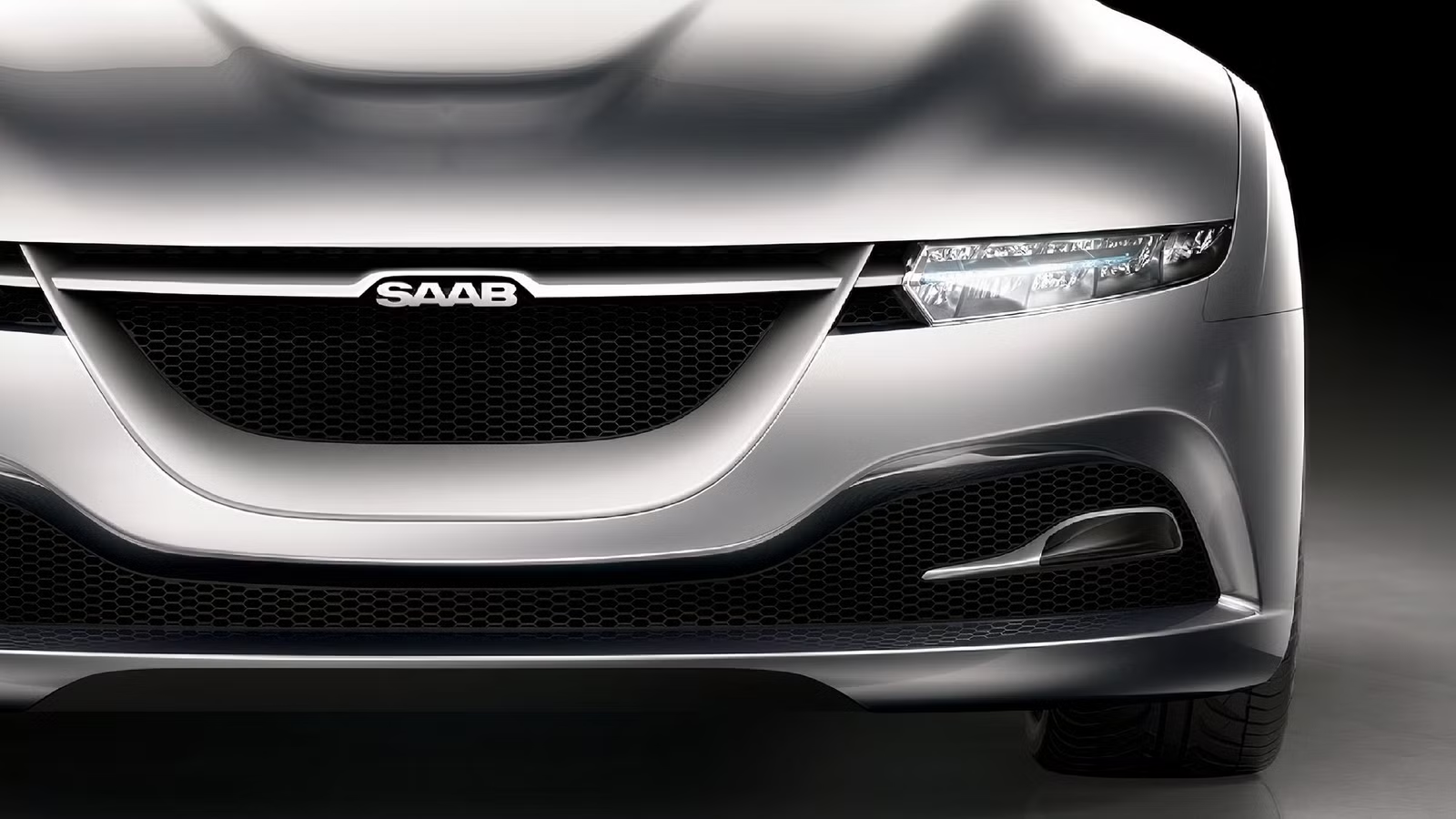
Saab officially closed its doors for good in 2014, but the last Saabs sold in the US were for the 2011 model year, when cars like the Saab 9-3 were struggling to move even a few thousand units. We actually really liked the Saab 9-4X, but one solid SUV clearly wasn’t enough to keep the brand in business.
Saab may be dead, but it’s not quite buried. That is, if you take a look, you can see Saab DNA in brands like Polestar, Volvo, and Lucid. Many of the engineers who made the company what it was, they didn’t simply quit the business when Saab became insolvent, they simply packed up their desks and moved elsewhere, and the spirit of Saab is still very much alive.
Saab’s Commitment To Fuel-Efficient Luxury Made The Brand Special
1978 Saab 99 TurboBring A Trailer
We have Saab to thank for the turbocharging revolution that kicked off in the late 1970s. This was the post-Oil Crisis era, the age of three-wheeled concept cars, a failed push for diesel, and gimmicky scams like magnetic fuel boosters. While drivers were spreading rumors of the 100-MPG carburetor, Saab was developing the first mainstream turbocharged vehicle in the Saab 99 Turbo.
1978 Saab 99 Turbo
Engine
2.0-Liter Turbocharged 4-Cylinder
Power
145 hp
Torque
173 lb-ft
0-60 mph
8.9 Seconds
Fuel Economy
22 MPG (combined)
The performance specs on a 99 Turbo aren’t bad even by today’s standards. It actually outguns the Hyundai Venue by a few dozen horses, thanks to a Garrett T3 turbocharger and Bosch mechanical fuel injection. The 99 Turbo encouraged us to associate the Saab name with overengineering, dependability, and fuel-efficiency at a time when we really needed it. It doesn’t hurt that Saab’s origins in the aircraft market led to some of the most aerodynamic cars ever built, either.
Related
Never Forget Saab’s Fighter Jet-Inspired Hot Hatch
One of the most powerful cars Saab ever made deserves your attention.
Saab would go on to pack the 1998 Saab 9-5 with a B308, the world’s first asymmetrical turbo-six, which provided turbo power to all six cylinders while running on the exhaust gases of only one bank, resulting in low-pressure turbocharging for 200 horsepower. Then there was the technology powering the 2006 9-5 BioPower, running on any mix of gasoline and ethanol you like with no ill effects, at 306 hp.
Combine these engineering innovations with two of Saab’s other biggest innovations, the fully automated heated seat, (1972 Saab 99 and 96) and the active head restraint (1998 Saab 9-5), and you get a reputation for being maybe the most practical, sensible luxury brand on the market.
The 2000 9-5 Aero Was The Brand’s Crown Jewel
Saab 9-5 AeroSaab
2000 Saab 9-5 Aero
Engine
2.3-Liter Turbocharged 4-Cylinder
Power
250 hp
Torque
258 lb-ft
0-60 mph
6.4 Seconds (MT)
Still considered by many to be Saab’s magnum opus, the 1998 9-5 served as the basis for the Saab 9-5 Aero in the 2000 model year, revered for its incredible torque and 0-60 times. The Saab 9-5 Aero is confirmation of what Christian von Koenigsegg praised as “great performance for a family car”.
The End Of Saab Saw The Cancelation Of Some Promising Projects
The 2011 SAAB PhoeniX concept car… with some Spyker genes.SAAB
Saab’s ultimate closure was the result of a failed sale to a Chinese company. General Motors had owned Saab at one point, and didn’t want its technology in the hands of Chinese automakers. Saab was declared officially bankrupt in 2012, and sold to NEVS, which would continue to produce the Saab 9-3 in very limited numbers until 2014.
Saab was still innovating right up until its doors were closed. In 2011, the brand unveiled the Saab PhoeniX, an innovative 2+2 GT coupe with a turbocharged straight-four in front-wheel-drive, paired to an electric rear-axle motor.
2011 Saab PhoeniX Concept
Engine
1.6-liter Turbocharged 4-Cylinder
Power
237 hp
Torque
184 lb-ft
Transmission
6-Speed Manual
Drivetrain
All-Wheel Drive
The PhoeniX was intended in part as a proof-of-concept for the new PhoeniX platform, which would have been the foundation of the fourth-gen 9-3, with Saab hoping to shift away from GM’s Epsilon II platform in order to establish its own next-gen starting-point.
Designed by Jason Castriota, who had a hand in iconic models like the Maserati GranTurismo and the Rolls-Royce Hyperion, the PhoeniX featured butterfly doors, and it won the 2011 Auto Express design award, beating out the Alfa Romeo 4C and the Jaguar C-X75.
With its futuristic design and custom Google Android operating system, this was a hybrid for the EV era, and one of the great “what ifs” of this era of automaking.
Saab Kept Innovating To The Very End
Saab PhoeniX Concept Front 3/4 ViewSaab
Another one of the brand’s could-have-beens was the NEVS Emily GT, a four-motor EV developed in secret over the course of just 10 months in Trollhättan, and which “handles like a go-kart,” according to Saab Planet’s Alex Andersson.
Saab wasn’t nearly finished by the time the brand was forced to call it quits. This is evidenced as much in the scrapped concepts as in the continued work of Saab engineers and designers outside of the Saab brand.
You Can See Saab’s Fingerprints Everywhere
2026 Ford Mustang Mach-E California SpecialFord
If you want to see some Saab DNA in a recent vehicle right now, take a look at the nearest parking lot. The design team for the Ford Mustang Mach-E was led by none other than Jason Castriota, who helped to give the EV its sleek silhouette, elevating it from a compliance car to something more like an entry-level performance model.
Volvo Scooped Up A Lot Of Saab Talent
Polestar 4Polestar
NEVS is as close as you can find to a Saab successor, with many Saab staff continuing their work under new management, on cars like, well, the NEVS 9-3 EV, an electric car based on the Saab sedan of the same name. We don’t get NEVS cars here in the US, though, but we do get our share of Volvos.
A 2011 post on Saab Blog reports Volvo “desperately looking for 900 engineers and 500 more staff” for product development, with “great interest from Saab employees.” By this time, the writing was on the wall, and many Saab employees were no doubt happy to hear they had a place at Volvo.
Saab’s former Head of Development, Mats Fägerhag, would be drafted by Volvo to find a development partner for its smaller cars, resulting in Fägerhag being appointed CEO at Zeekr, a Geely-owned company known for the development of the Compact Modular Architecture (CMA) platform, which would serve as the foundation for the Volvo XC40, and the Polestar 4.
Many former Saab-owners now consider Polestar to be the true successor to the brand.
2026 Polestar 4
Power
272 hp
Torque
253 lb-ft
Range
300 Miles
The Industry’s Been Wanting A Piece Of Saab For A Long Time
Polestar 4. EV. All-electric. e-Crossover. MotionPolestar
Koenigsegg wanted to buy Saab in 2009, with Christian von Koenigsegg hoping to introduce Koenigsegg suspension and turbocharging tech into Saab vehicles, but prolonged negotiations with GM eventually soured the supercar maker on the deal.
Volvo and Saab were in talks to merge decades before Volvo would put Saab’s people to work at Polestar. Back in 1977, the two automakers were this close to joining together like Voltron, but leadership disagreements within Saab (then Saab-Scania) saw the deal falling through, despite Volvo’s enthusiasm for the merger.
Related
The Swedish SUV Built On The Bones Of A Chevy Trailblazer
When a svelte Swede marry a beefy American, the result can be quite intriguing, as can be seen with the curious case of the Saab 9-7X.
Saab was truly a special brand. Not many automakers receive equal praise from both consumer advisory groups like Consumer Reports (one of CR’s last reviews for the 9-5 praised the second-gen 9-5’s handling and crash test ratings), and supercar icons like Christian von Koenigsegg.
The only thing that’s really changed are the name and the corporate hierarchy. Saab may not operate as its own brand anymore, but everything that made Saab special, that is, the people who worked there, and the brand’s lineage of innovation, continue to live on throughout the industry.
Sources: Saab, Volvo, Polestar, Saab Planet, New York Times, Consumer Reports.
