

Front-wheel-drive performance cars have always had something to prove, and few make the case better than the Honda Civic Type R. For decades it has served as many enthusiasts’ gateway into genuine performance motoring — affordable, focused, and relentlessly fun. Yet for all its reputation, the Civic Type R doesn’t actually sit at the top of the FWD power rankings. Two rivals edge it out, and the gap between them is surprisingly small.
One is a stablemate from within the Honda family: the Acura Integra Type S. The other is a landmark special edition of the Volkswagen Golf GTI, the Edition 50. Below, we take a closer look at both challengers, the Civic Type R itself, and the real-world pros and cons of front-wheel drive
The Volkswagen Golf GTI Edition 50
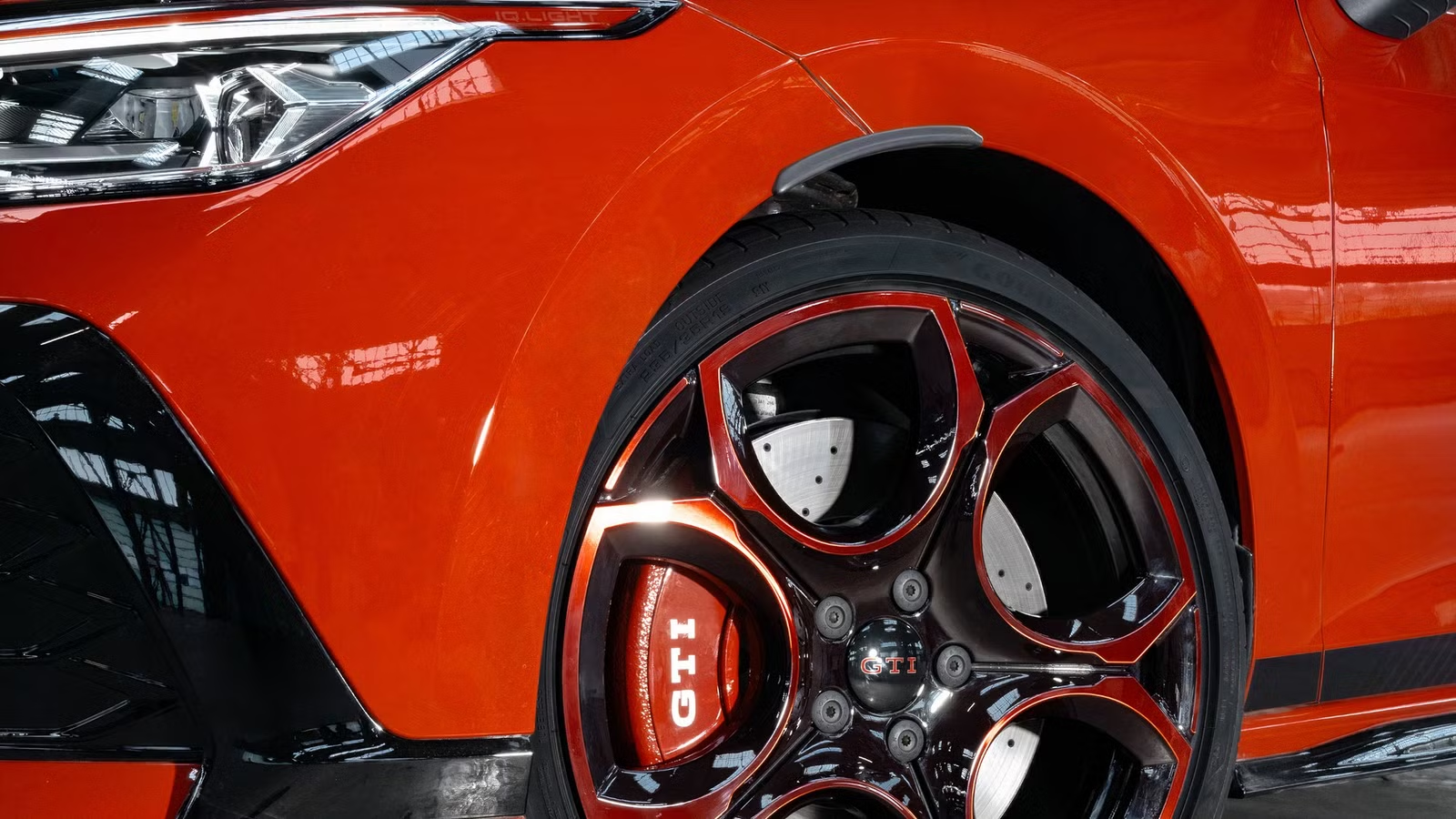
Volkswagen Golf GTI Edition 50 front view.Volkswagen
Volkswagen Golf GTI Edition 50 Specs
Horsepower
320 hp
Torque
310 lb-ft
0-60
5.5 seconds
Top Speed
168 mph
The VW Golf GTI Edition 50 is a milestone model built to celebrate half a century of the iconic hot hatch. Released as an early tribute to the GTI’s 50th anniversary, it is the most powerful production Golf GTI ever made. Its turbocharged 2.0-liter inline-four produces 320 hp — five more than the Civic Type R — while torque is identical between the two at 310 lb-ft.
There is one area where the Edition 50 did not beat the Type R, and that’s around the Nürburgring. On the first try, the Golf did it in 7:46.13, making it the fastest production Volkswagen ever around the famous track — quicker even than the Golf R. However, the Civic Type R is still quicker at the ‘Ring, with a record-setting lap of 7:44.88.
But then Volkswagen returned to the ‘Ring, shaved two seconds off its original time, and claimed that crown from Honda. The Edition 50 is not on sale in the USA, so the Civic Type R remains the fastest hot hatch to go around the Green Hell that you can actually buy in the USA.
The Acura Integra Type S
2024 Acura Integra Type S Exterior Finished In Blue Driving Acura
2026 Acura Integra Civic Type S Specs
Horsepower
320 hp
Torque
310 lb-ft
0-60
~5.2 seconds
Top Speed
~167 mph
The second car that outguns the Civic Type R is also a Honda product. The Acura Integra Type S is one of the few remaining true hot hatches in today’s market. Think of it as the Type R’s more refined, comfort-conscious sibling — it still packs 320 hp and 310 lb-ft of torque, matching the Golf GTI Edition 50 exactly, but it wraps that performance in a more upscale package.
The Integra Type S places greater emphasis on interior quality, offering a slightly more premium cabin than the Civic Type R. Where the Honda leans into a minimalist, race-inspired aesthetic with a bold red finish, the Acura provides a wider palette of color options. The race-inspired crimson carries over, but more understated choices such as white and black are also on the menu.
The exterior design follows the same philosophy — sportier than a standard daily driver, but less aggressive than the Civic. The grille retains sharp, angular lines, though they’re less confrontational than the Type R’s; out back, a modest spoiler and triangular taillights complete the look.
Power comes from a turbocharged 2.0-liter inline-four VTEC engine mated exclusively to a six-speed manual transmission. The suspension is tuned for a more compliant ride than the Civic Type R’s track-focused setup, though the handling remains genuinely nimble. In character, the Type S sits neatly between the everyday Integra and the all-out CTR.
The One To Beat: The Civic Type R
2025 Honda Civic Type R, Rear 3/4 on wet track, WhiteHonda
2025 Honda Civic Type R Specs
Horsepower
315 hp
Torque
310 lb-ft
0-60
4.9 seconds
Top Speed
169 mph
The car both rivals narrowly dethrone for the “most powerful FWD car” title is the Honda Civic Type R. The current Type R produces 315 hp — five fewer than either the Acura or the Volkswagen — yet it remains one of the most celebrated performance hatchbacks on sale, blending genuine daily usability with track-ready ability.
Aesthetically, the current Civic Type R wears an assertive, aerodynamically purposeful body. That said, it’s a touch less visually extreme than the previous generation’s sharper, more angular styling.
The current generation is the sixth iteration of the Civic Type R nameplate, tracing its lineage back to 1997, when it debuted as a spiritual sibling to the equally revered Integra Type R. In the United States, the Civic Type R didn’t arrive until 2017.
The turbocharged 2.0-liter inline-four is paired exclusively with a six-speed manual. Torque steer — a persistent challenge in high-powered front-wheel-drive cars — is kept in check by Honda’s innovative dual-axis strut suspension, which separates the steering and suspension load paths to keep the wheel pulling straight under hard acceleration.
Sources: Volkswagen, Honda
