

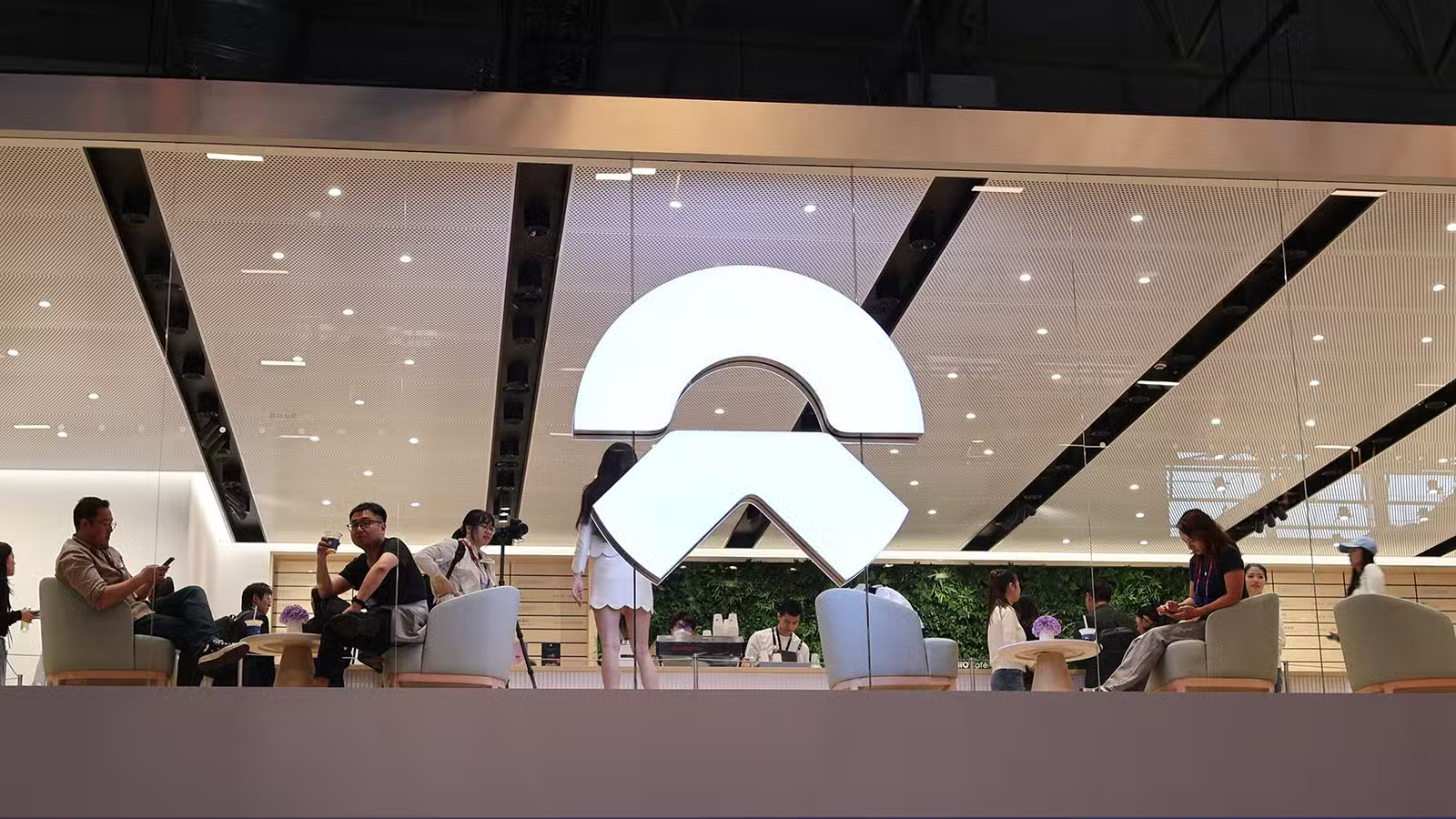
The Nio logo at its booth at the Beijing Auto Show in April 2026. Credit: CnEVPost
- Nio has been in talks with Hong Kong regulators, hoping to convert to a primary listing without changing its user enterprise governance.
- Converting to a primary listing is a prerequisite for inclusion in Stock Connect and access to mainland investor capital.
Nio Inc (NYSE: NIO) is seeking to convert its Hong Kong listing status from a secondary listing to a primary listing, paving the way for easier purchases by Chinese mainland investors.
The company’s management made the remarks at its 2026 shareholders meeting on Wednesday, according to meeting notes shared by several auto bloggers who claimed to be present.
Nio’s management said that, while keeping its user enterprise governance structure unchanged, the company has been in talks with Hong Kong regulators, with the goal of changing its current secondary listing status, which was made by way of introduction.
If successful, the move would clear the obstacles to Nio’s inclusion in Stock Connect. Nio is currently listed in Hong Kong as a secondary listing by way of introduction, a status that prevents it from entering the Stock Connect list.
Under current rules, companies with a secondary listing are not eligible for inclusion in Stock Connect. This means mainland Chinese investors are currently unable to buy Nio’s Hong Kong shares through the channel.
By contrast, Nio’s two domestic peers are in a different position. Both Xpeng (NYSE: XPEV) and Li Auto (NASDAQ: LI) are traded in Hong Kong by way of dual primary listing.
Both companies have already been included in Stock Connect. This allows them to receive southbound capital inflows from mainland investors, thereby expanding their shareholder base.
A secondary listing is simpler than a dual primary listing, but at the moment it doesn’t allow a company to be included in the mainland-Hong Kong stock connect.
Converting to a primary listing has other benefits. It allows a company to escape the impact of changes in its external listing status, no longer being dependent on its US listing status.
There are precedents for this path. Several US-listed Chinese tech companies, such as Alibaba, also previously returned to Hong Kong through secondary listings.
Alibaba changed Hong Kong to a primary listing venue in August 2024, and was subsequently included in Stock Connect. This created convenience for mainland investors to directly invest in the company.
It is worth noting that Stock Connect comes with an investor threshold. Only mainland investors with securities account assets exceeding 500,000 yuan ($73,630) are eligible to participate in the mechanism.
Nio’s management was also asked about market value management during today’s communication. They said that market value has little to do with what the company is able to do.
“When and at what level the market value arrives is something we cannot manage,” Nio’s management said.
They believe that doing their jobs well will create shareholder value and lead to future dividends.
As for subsequent capital plans, Nio’s management said there was nothing to disclose for now.
Nio currently has a market value of about $12.8 billion, roughly in line with Li Auto’s $12.9 billion and slightly above Xpeng’s $12.2 billion.
On the operational front, management explained the company’s R&D investment. In 2025, the company cut 10,000 employees compared with 2024, and the scale of its R&D staff contracted.
However, Nio’s management stressed that investment in basic R&D will be maintained. The cuts in R&D spending were mainly concentrated at the application layer, and the company will strictly rank all projects by return on investment.
In terms of the battery business, the company’s battery procurement this year exceeded 30 billion yuan. Management said this figure will increase further next year, and battery procurement is expected to reach 50 billion yuan within two years.
Nio management believes the competitive advantages of the BaaS (battery as a service) model have yet to be fully released. As long-life batteries are rolled out and battery cells become standardized, a consensus will gradually form within the industry.
In the battery-swap business, the company said the gross margin of its energy business has reached 20% since the first quarter.
Although the free battery-swap benefits previously offered to early users bring annual losses of about 1 billion yuan, this loss is continuously narrowing, the company said.
As for overseas expansion, management said that during the 2025-2028 period, the Chinese market remains the focus. They noted that overseas markets are equally competitive and not a blue ocean.
William Li expects domestic retail sales in China’s auto industry to fall by 15% to 20% this year.
($1 = 6.7905 yuan)
