

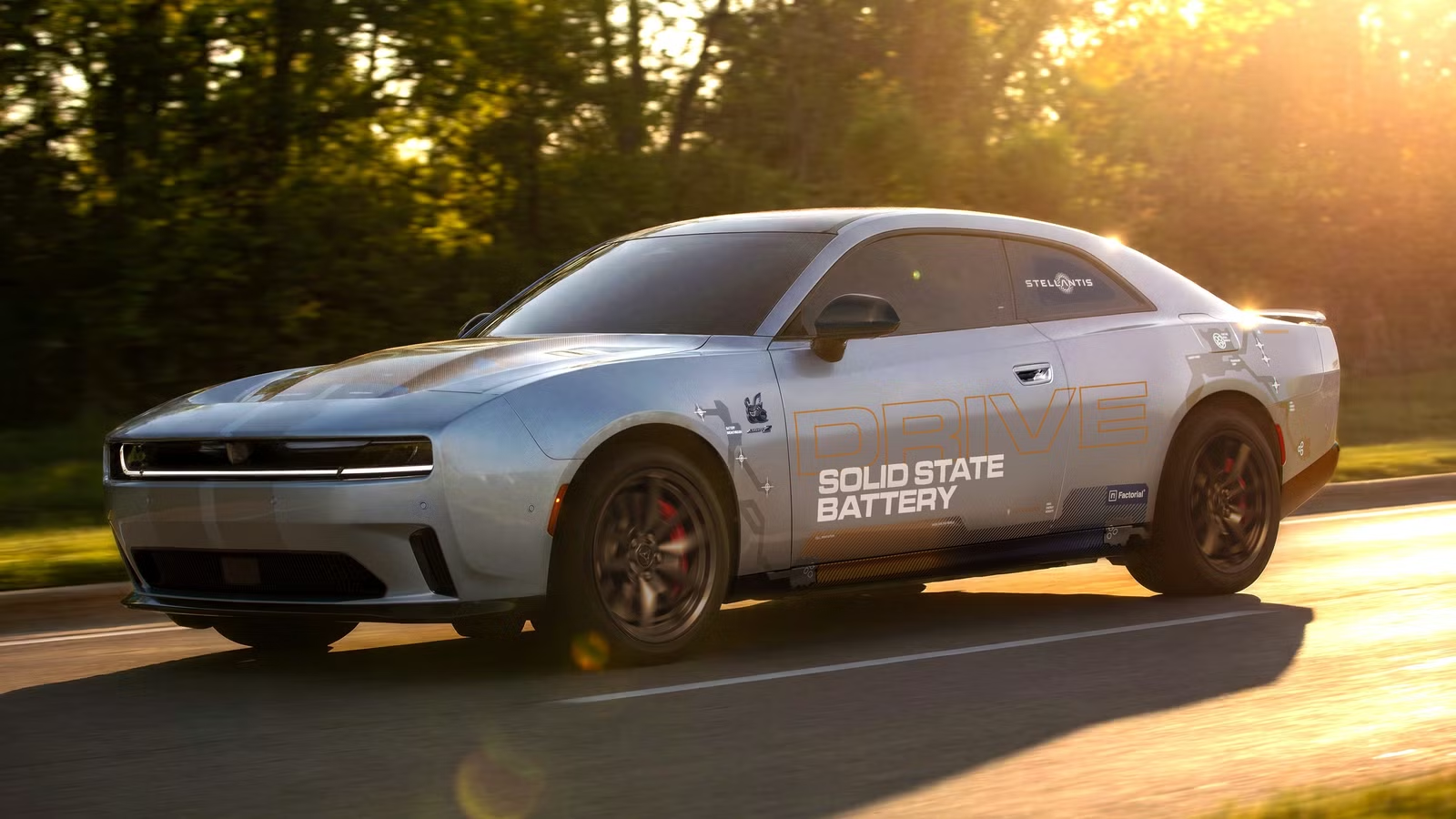
Stellantis has moved its next-generation battery research off the lab bench and onto public roads, inside a Dodge Charger Daytona. The automaker confirmed this week that it has integrated Factorial’s FEST semi-solid-state battery technology into a Charger Daytona development vehicle and launched a real-world road-testing program to verify performance, safety, and reliability. For Charger enthusiasts who’ve been skeptical about the EV nameplate’s performance credentials, this is the most concrete signal yet that Stellantis is engineering the platform for something beyond the current production spec.
The partnership between Stellantis and Massachusetts-based Factorial isn’t new, the two companies have been collaborating on solid-state chemistry for several years, but strapping experimental cells into an actual Charger prototype marks a meaningful step from theory to pavement. Factorial’s cells are the same technology that reportedly carried a Mercedes test vehicle past 748 miles on a single charge. Now they’re riding in a Dodge.
What Semi-Solid-State Actually Means For The Charger
2024 Dodge Charger Daytona Scat Pack rear 3/4 shotChris Chin | TopSpeed
Semi-solid-state batteries occupy a middle ground between today’s conventional lithium-ion cells and the fully solid-state technology the industry has been chasing for over a decade. They replace the liquid electrolyte in standard lithium-ion packs with a semi-solid or gel-like material, which reduces the fire risk associated with flammable liquid electrolytes while enabling higher energy density, more energy packed into the same physical space.
For a performance car like the Charger Daytona, that energy density advantage translates directly to two things drivers care about: range and power delivery. The current production Charger Daytona Scat Pack is rated at up to 267 miles of range. Semi-solid-state chemistry, if it reaches production, could push that figure meaningfully higher without adding weight, a critical consideration for a car that already tips the scales as a large EV. Faster charging is also part of the promise, since the chemistry handles higher charge rates with less thermal stress than conventional cells.
Related
What To Expect From Mercedes’ Ongoing Solid-State Battery Tests
Mercedes-Benz hits a milestone as it’s the first company to put a true solid-state battery on the road. Here’s what to expect from its on-road tests.
Why Road Testing In A Charger Matters More Than Lab Results
Factorial’s solid-state battery cells being tested by StellantisStellantis
Battery chemistry that performs well in a controlled environment doesn’t always survive contact with real-world variables: temperature swings, road vibration, sustained high-load acceleration, and repeated charge cycles. By integrating Factorial’s FEST cells into an actual Charger Daytona development vehicle and running it on public roads, Stellantis is stress-testing the technology against the exact conditions a production performance EV would face.
That distinction matters to anyone who’s watched promising battery announcements stall at the prototype stage. Stellantis is explicitly framing this as a program to verify performance, safety, and reliability, the three checkboxes a technology has to clear before it can move toward a production timeline. The Charger isn’t just a convenient test vehicle; using the actual platform means any data gathered is directly applicable to future Charger engineering decisions.
Where This Sits In The Broader Solid-State Race
Expansion cutaway illustration of the Rimac Technology Solid State Battery introduced at the IAA Mobility 2025 show in MunichRIMAC TECHNOLOGY
Stellantis and Factorial aren’t alone in pushing solid-state and semi-solid-state technology toward real-world validation. Toyota has been among the most vocal about fully solid-state timelines, targeting the late 2020s for production vehicles. Nissan recently joined a consortium aimed at developing solid-state cells at a cost competitive with Chinese manufacturers. In China, semi-solid-state technology has already reached mass-market production, with one model surpassing 100,000 units sold within eight months of launch, offered at price points well under $10,000.
The Western automaker timeline is more conservative, but the Stellantis-Factorial road test suggests the gap between lab chemistry and production hardware is closing faster than the cautious public messaging has implied. For the Charger specifically, no production timeline has been announced; Stellantis is clear that this is a development and validation program, not a product reveal. But the fact that the test mule wears Charger Daytona bodywork rather than a generic engineering mule could signal that the platform is being actively considered as a recipient of the technology when it’s ready.
Related
The Engineering Secrets Of Toyota’s Solid-State Battery Project
Toyota remains highly invested in its next-generation solid-state energy storage solutions.
TopSpeed’s Take
2026 Dodge Charger DaytonaDodge
The Charger nameplate has carried serious performance expectations for more than five decades. Putting experimental next-generation batteries inside the EV version, on actual roads and not just a test track, is Stellantis making a credible argument that those expectations are still part of the brief. Whether the timeline aligns with buyer patience is a separate question, but the engineering intent is no longer just a press release promise. While the noise around EVs has quieted down of late, businesses are still working on the next-generation tech in the background, proving it’s not going anywhere but forward.
Source: Stellantis
