

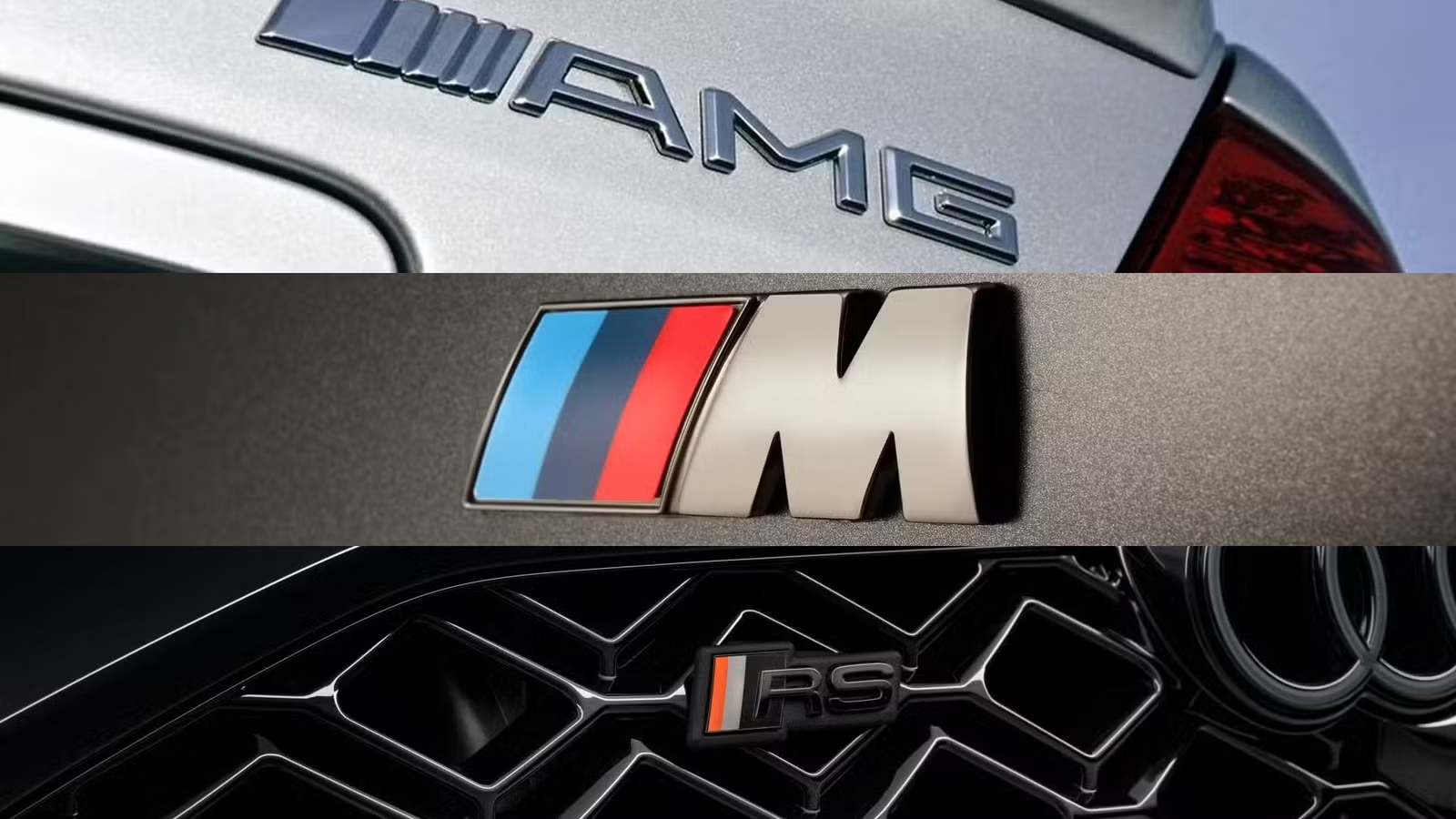
Few debates ignite a car enthusiast’s passion quite like the question of which German performance brand reigns supreme. Audi RS, BMW M, and Mercedes-AMG each represent a distinct vision of what a fast car should be — and understanding those visions makes choosing between them far more interesting than simply comparing horsepower figures. We’ve already explored the broader differences between Audi, BMW, and Mercedes-Benz in their philosophy and approach to building cars. Now it’s time to go deeper into their performance arms: Audi’s RS line via its Audi Sport department, BMW’s M cars, and the Mercedes-AMG brand.
The broad generalizations go something like this: an Audi RS model is what you choose if you want to go fast in any weather or conditions, BMW M is what you choose if you want pinpoint handling on road or track, and Mercedes-AMG is what you choose if you want brute horsepower and theater wrapped in a luxury interior. Dig deeper, though, and the differences become more nuanced — and genuinely entertaining.
General Philosophies Of The German Performance Brands
The iconic Audi Quattro S1, the car that put the five-cylinder engine on a pedestal.Audi
The philosophies behind each brand’s high-performance cars trace directly back to how their performance arms were born. All three have deep roots in motorsport, but the performance divisions as we know them today can be traced to BMW’s M (Motorsport) division.
AMG Mercedes-Benz 300 SEL 6.3. Rote Sau. Red Pig. Spa-Francorchamps. 1971 Spa 24 Hours. Motion. Front, three-quartersMercedes-Benz
BMW M was established in 1972 to develop its first race car project, the BMW 3.0 CSL. The first M car sold to the public was the M1, a road-going race car, but the division’s later success in touring car racing gave rise to the enormously influential BMW M3.
First-Ever BMW M 3.0 CSLDylan Miles
Audi’s RS branding also emerged from motorsport, but its all-wheel-drive passenger car came first. When World Rally Championship (WRC) rules changed to allow four-wheel drive, Audi was ready, exploiting the massive grip advantage of driving all four wheels while deploying serious horsepower. The Audi Quattro became a rallying legend, dominating WRC in the early 1980s with drivers including Stig Blomqvist, Walter Röhrl, and Michèle Mouton. In 1982, Mouton became the first woman to win a round of the WRC drivers’ championship, going on to win three more events and finish second in the overall standings.
Mercedes-AMG is the outlier here. AMG started out as an independent company founded by former Mercedes-Benz engineers, specializing in tuning Mercedes models. AMG began designing and testing racing engines alongside a range of unofficial upgrade and accessory packages for Mercedes cars. The first hint of what was to come was AMG’s makeshift race car from the 1970s — a Mercedes 300 SEL 6.8 nicknamed the Red Sow — which made 422 horsepower, nearly 200 hp more than the stock factory car.
Mercedes and AMG collaborated in motorsport before Mercedes acquired a majority shareholding of AMG in 1999. Before that deal closed, however, AMG created the AMG Hammer — a W124 sedan fitted with a modified 5.6-liter engine producing 335 hp that could hustle the heavy car to 60 mph in 5.0 seconds. In the late 1980s, that was a remarkable achievement, and it served as the unsubtle blueprint for what followed in the 2000s when AMG turned to supercharged V8s.
The Quintessential Modern Cars
Mercedes-Benz
Another useful way to compare and contrast the brands is to examine some of their most representative models — which is not an easy task to do objectively. So, subjectively, we’re going with the Audi RS3, BMW M4, and the Mercedes-AMG GT.
audi tt rsAudi
The Audi RS3 showcases Audi’s most distinctive engine to its fullest, the BMW M4 is its most popular and traditional M car, and the Mercedes-AMG GT is what happened when Mercedes-Benz gave Mercedes-AMG free rein to design a car from scratch.
Silver 2008 BMW Z4 M rear badgeBring a Trailer
Audi RS3
2025 Audi RS3Ian Wright/CarBuzz/Valnet
For Audi, we could have gone with the R8, but the RS3 uses the most quintessentially Audi RS of engines — a charismatic inline five-cylinder generating 401 hp, channeled through its hallmark quattro all-wheel-drive system. It also carries the traditional trait of the engine mounted forward in the bay due to the front differential and transmission bell housing, which historically gave Audi its reputation for understeer.
However, the RS3 also demonstrates Audi’s engineering ingenuity with its seven-speed dual-clutch torque-vectoring rear differential, which uses a pair of multiplate clutch packs to help the car feel like a supremely capable all-weather hatchback on the road. The RS3 is wildly entertaining and ridiculously agile, and the quattro system ensures power can be put down early when exiting a corner.
BMW M4
2024 BMW M4 Coupe Competiton front 3/4 viewBMW
BMW’s M3 and M5 showed the world that a sports sedan can deliver a genuine high-performance experience in a car you can drive to work every day. The decision to split the sedan and coupe body styles — creating the M4 designation for the coupe — is a relatively recent one, but the M4 maintains the traditions of the M3 as a high-performance coupe version of the 3 Series.
Those traditions include an M-tuned version of BMW’s inline-six engine making serious power, and a precision-engineered chassis upgrade applied to a platform already well-balanced and designed for driver enjoyment alongside passenger comfort.
BMW has increasingly embraced all-wheel drive, but the standard configuration for the M4 remains rear-wheel drive with a six-speed manual. On the road, the twin-turbocharged 3.0-liter inline-six is as smooth as it is powerful — 523 hp in standard Competition trim — while the chassis seemingly pivots around the driver through corners, remaining stable and generating an impressive amount of lateral grip.
Mercedes AMG-GT
2016 Mercedes-AMG GT Exterior Finished In Yellow On Salt FlatsMercedes-Benz
When Mercedes-AMG set about developing a car entirely in-house, it chose a front-engine, rear-wheel-drive grand touring sports car in the tradition of the Mercedes-Benz SLS AMG, which itself drew inspiration from the Mercedes-Benz SLR McLaren — a car that paid homage to the iconic Mercedes-Benz 300 SLR of the 1950s.
The AMG GT didn’t carry over the SLS’s gullwing doors. Instead, it arrived as a sleek, seductive car with a traditional long hood and short rear deck. That long hood allowed Mercedes-AMG to fit its hot-V layout twin-turbocharged V8 underneath, producing 456 hp in base form while the S version made 503 hp.
When it was unveiled, there was much nodding of heads — Mercedes-AMG had delivered exactly what the world imagined a purpose-built German muscle car would be. It looks like a car of finesse and sophistication, which it is, right up until the accelerator is buried into the carpet, the rear tires light up, and the exhaust announces to the world that exciting and thoroughly unsophisticated things are happening.
The Homogenization Of Performance
2020 Mercedes-Benz AMG GT-R PRO decals, hinting at the mega-powerful V8 engine living under the hood.Mercedes-Benz
There is an elephant in the room. For the most powerful gasoline-powered performance models across all three badges, there used to be considerable variation in engine configurations — V8s, V10s, and V12s all featured prominently. Mercedes-AMG would seemingly bolt a supercharger onto anything with eight or more cylinders, while BMW and Audi experimented with V10s alongside V8s.
Today, you’ll find all three brands converging on a 4.x-liter twin-turbo V8. That’s largely because it’s the most efficient way to generate substantial power, but also because nearly every model in each main lineup now requires a high-performance variant, and a V8 is easier to package across a broad range of vehicles.
2010 Audi TT RS 2.5L EA855 Turbo I5 EngineAudi
Audi is the clearest example of this trend, with the S8, RS6 Avant, RS7, and RS Q8 all sharing the same turbocharged V8 architecture. And because Audi sits within the Volkswagen Group, that same modular V8 also finds its way into various Bentley, Lamborghini, and Porsche models.
The 2025 BMW X5 M Competition is one of the fastest SUVs in the game.BMW
BMW’s S68 twin-turbo V8 currently powers around 10 models, including the oddball X6 M Competition, and has also been used in certain Land Rover vehicles. BMW currently offers eight M cars, and even its luxury grand-touring flagship, the M8, relies on the 4.4-liter V8. Further blurring the distinctions is the fact that both Mercedes-AMG and BMW M have been steadily embracing all-wheel drive across their lineups.
Related
Audi R8 Coupe Generations: Everything You Need To Know In One Place
Audi’s R8 supercar has always been a usable everyday supercar with stunning looks and superb performance from emotive naturally aspirated engines.
State Of The Union
2026 BMW M5 Touring driving front 3/4BMW
Looking across the full range of each German performance brand, there is still a remarkable amount of variety on offer. We’re in an era where each brand is defining its identity at the close of one chapter while another begins. BMW has embraced hybridization with the BMW M5, yet still offers the brilliantly focused BMW M2 for those who want something more old-school.
2026 Audi RS 3 Sportback competition limited Special EditionAudi
Audi still has the superb RS3 at the accessible end of the spectrum; the heavy hitters are the RS6, RS7, and RS Q8, while the forward-looking RS e-tron GT Performance points toward an all-electric future with over 900 hp on tap.
2025 Mercedes-AMG CLE 53 Coupe front fasciaMercedes
Mercedes-AMG carries the widest range of cars bearing its badge and plays with virtually every form of power delivery across every class of passenger vehicle. Highlights include a four-cylinder turbocharged A-Class hot hatch, an inline-six plug-in hybrid E-Class, and the AMG SL with a twin-turbo V8 hybrid setup. The trajectories suggest BMW M is leaning into hybridization, Audi is pushing toward all-electric power, and Mercedes-AMG is still working out exactly where it wants to land. We’re firmly in a period of transition, and it will take some time before the picture fully comes into focus.
Sources: BMW, Audi, Mercedes-Benz
