

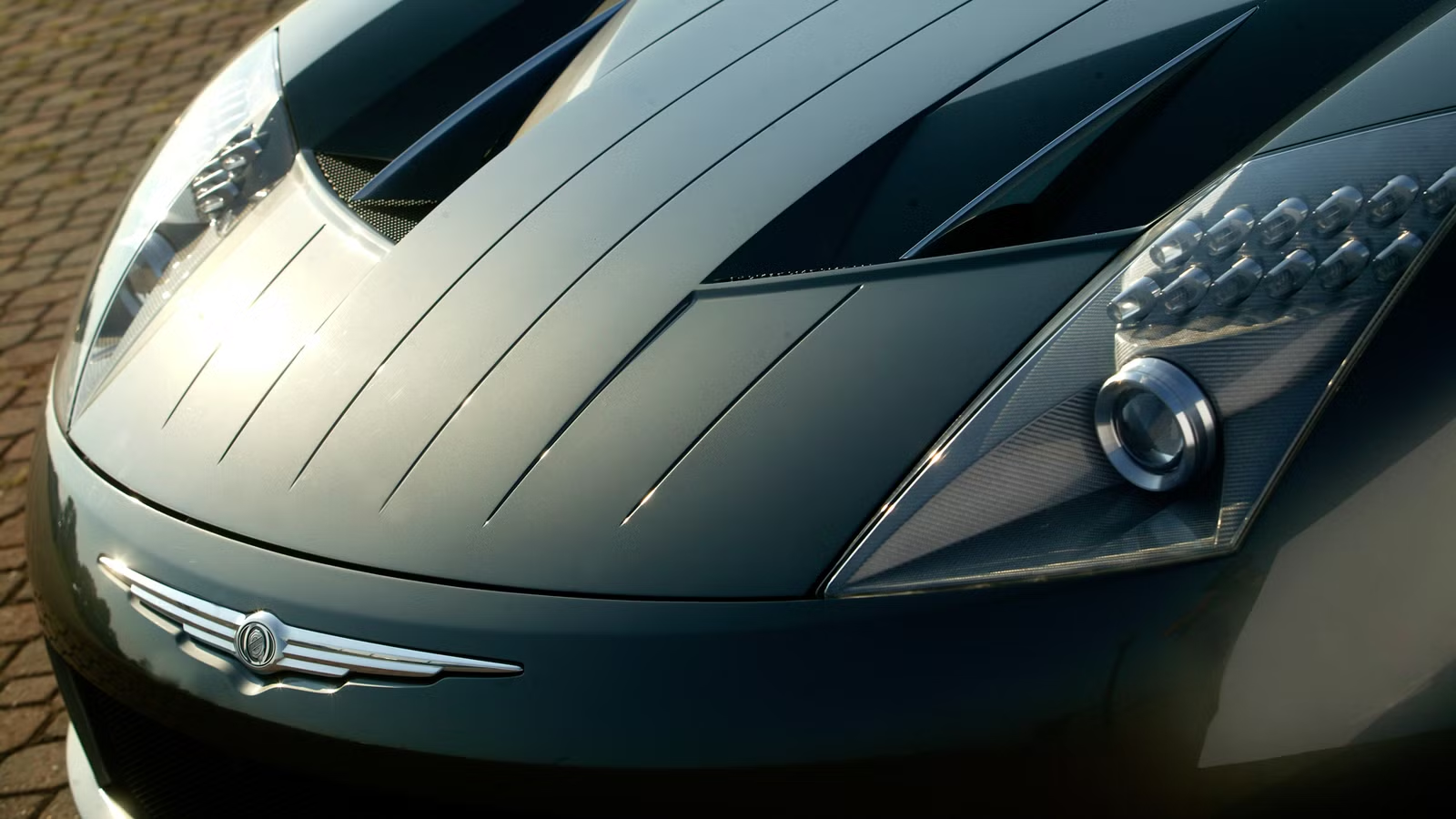
Becoming an established luxury manufacturer takes more than just churning out some posh sedans with sumptuous seats, as a given brand needs to build an overall image that makes people think that they will look the business behind the wheel. That’s why the likes of Hyundai and Toyota developed their own bespoke luxury brands, since the motherships were too closely associated with affordability.
Chrysler had established this reputation in the early to mid-20th century, though things had taken a turn in the latter stages of the century. In the late 1990s though, the marque was looking to make a comeback, and it came out swinging. Ultimately, its most eye-opening project came in 2004, even if it never ended up making production.
Chrysler’s Ferrari Challenger Was Built To Put It Back On The Map
2004 Chrysler ME FourTwelve Concept Silver Front Angled ViewChrysler
One of the best ways to show the public that you mean business, and deserve to be uttered in the same sentence as the automotive elite like Ferrari and Rolls-Royce, is by building some form of insane supercar, or ultra-luxury offering. Chrysler was doing its best to cover both bases, with the latter covered by concepts such as the 1995 Atlantic Concept and the 2000 Chronos Concept. Both featured styling that harked back to the brand’s early 20th-century heyday, and cabins that were penned to ensure onlookers would give anything just to ride around in one. These efforts were assisted by a merger with Daimler, the owners of Mercedes-Benz, in 1998, meaning Chrysler suddenly had access to the information and parts from one of the world’s greatest luxury manufacturers.
When it came to satisfying its performance appetite, Chrysler wasn’t messing about. Rather than just build a car that looked the part, Chrysler tasked its engineers to design something that would embarrass anything in its path, including the upcoming Bugatti Veyron that Daimler’s Volkswagen Group rival was busily working on. The American manufacturer was determined to be seen as one of the big players alongside the likes of Cadillac once more, and it reckoned the so-called ME FourTwelve would be the ticket to achieving it.
The ME FourTwelve Was Built Without Compromise
2004 Chrysler ME Four-Twelve Concept Engine Bay High ShotChrysler
Rather than simply designing a sexy body and shoving a load of Viper bits underneath the surface, Chrysler was open to the ME FourTwelve reaching production, so it wanted it to reflect its sky-high ambitions by being a quality product. From the outset, it leaned on its new Daimler partner to utilize its 6.0-liter M120 V12 engine, which was used in several high-end Mercedes models in the late 1990s and early 2000s. Since it only produced around 400 horsepower though, Chrysler needed to make some alterations so that the ME FourTwelve would be capable of supercar speeds.
A forged crankshaft and pistons were instilled to ensure the engine could deal with the extra firepower, which was made possible by revised intakes and manifolds, as well as a new cylinder head. The cherry on the cake was a squadron of four turbochargers, which boosted the engine’s peak output to 850 hp. To ensure it could row through the gears as efficiently as possible, Chrysler developed its own Formula 1-style seven-speed dual-clutch transmission. With these two components working together in perfect harmony, Chrysler expected the ME FourTwelve to blast past the 60 mph barrier in just 2.9 seconds.
To ensure the rapid machine could get stopped for the next corner, a powerful six-piston braking setup was employed alongside an independent suspension arrangement. The powerplant was also placed in the middle of the car to aid weight distribution, a design choice reflected in its name. The ME FourTwelve was also kept pinned to the road at high speed thanks to an advanced aerodynamic setup, which provided just short of 1,000 pounds of rear downforce at its peak. The body was also developed to be as sleek as possible, and this ended up being a key reason for Chrysler estimating the vehicle could reach 248 mph when granted a long enough stretch of road.
This was good for those behind, as there was less time to be blinded by the ME FourTwelve’s elaborate taillight design, which was crafted from 96 separate LED lights. Using the word ‘busy’ would be an understatement.
Chrysler’s Supercar Was Much Lighter Than A Veyron
2004 Chrysler ME Four-Twelve ConceptChrysler
Rather than just being immensely powerful, Chrysler wanted the ME FourTwelve to be as agile as possible in the hands of its driver. To achieve this, it used a bespoke chassis crafted from aluminum and carbon fiber, while the body was also crafted from the latter. The car also made use of lightweight aluminum wheels, which helped keep the finished article’s weight figure at an impressive 2,880 pounds. For reference, the Veyron would end up tipping the scales at 4,162 pounds. As a result, even though it lacked a bit of outright grunt versus the Bugatti, the ME FourTwelve would likely have fared much better in the bends thanks to its huge weight advantage.
Hell, Chrysler’s weapon would also have shown Ferrari’s Enzo supercar a clean pair of heels, too. The Enzo’s naturally aspirated V12 only pumped out 651 hp, a shade under 200 hp down on the ME FourTwelve, but while only being around 100 pounds lighter. The Chrysler’s weight figure was made all the more impressive by the fact that it wasn’t exactly some stripped-out track beast. Since it was meant to be a high-end Chrysler, the cockpit was lavished with upmarket leather, as well as creature comforts like dual-zone climate control and a premium audio setup.
Rather than the wood trim traditionally found in Chrysler’s luxury creations, the ME FourTwelve used a mix of chrome and carbon fiber to accompany the sumptuous leather.
Internal Politics And High Costs Scuppered Chrysler’s Supercar Dream
2004 Chrysler ME Four-Twelve Concept Interior Side ShotChrysler
Whichever way you looked at it, the ME FourTwelve was shaping up to be a tantalizing prospect. You can never have too many supercars in the world, and it would have been fascinating to see how it stacked up against the creations of the world’s established performance automakers. Sadly, despite a driveable prototype being built and piloted by selected American media in 2004, the car would never enter production.
There were a couple of main reasons for this. Firstly, even though it allowed Chrysler to borrow its M120 engine in the first place, Mercedes-Benz had since embarked on a joint project with McLaren to design its own supercar. Named the SLR, it was developed to combine the luxury elements of a Mercedes with the performance prowess of a McLaren, and the ME FourTwelve would have stepped on its toes somewhat. Especially since the Chrysler would have been much more powerful, as well as lighter. Merc wasn’t too thrilled about having its shiny new performance car being embarrassed by some jumped-up Chrysler, and began protesting the project internally.
That said, it isn’t thought that this was the sole reason behind the ME FourTwelve being canceled. Due to all the bespoke components being costly to develop and produce, Chrysler was finding that its initial sale price target of $150,000 was impossible. There were thoughts that it may have to charge as much as $750,000 per piece, and this was ultimately deemed too extreme. When combined with the fact that its new partners would have had their noses put out of joint had the ME FourTwelve reached production, the decision was made to conclude proceedings.
The ME FourTwelve Helped Bring Some Verve Back To The Chrysler Name
2004 Chrysler ME Four-Twelve Concept Side Angled Shot On BricksChrysler
Happily for Chrysler, even though the ME FourTwelve was never destined to reach production, it left quite the impression. Auto enthusiasts and the world’s media alike were left stunned when the car was unveiled at the 2004 North American Motor Show, since the brand had never produced anything quite like it before. The selected press who drove the prototype mule were left thrilled with how exciting and well put-together the car was, even if there were rough edges to iron out.
The thing is, the whole ME FourTwelve chapter only exists to remind us of the opportunity that Chrysler squandered. The machine showed the level that Chrysler could operate at, which made it all the more disappointing that its subsequent production cars were nothing more than rehashed, previous-generation Mercedes. While the 300C sedan and Crossfire coupe looked the part, underneath they were basically previous-gen Mercedes E-Class and SL models, but with less well-put-together cabins.
They were cheap for what they were, but both models ultimately failed to live up to the image that Chrysler was trying to convince the world of in the 1990s, and with projects like the ME FourTwelve. Any credit was therefore lost quickly, and less than 20 years later the brand existed only as a way for Stellantis to sell minivans to American families. It’s working hard to, once again, rebuild the company into something that America can be proud of, but given what happened last time, only time will tell if this attempt will prove fruitful.
Sources: Chrysler.
