

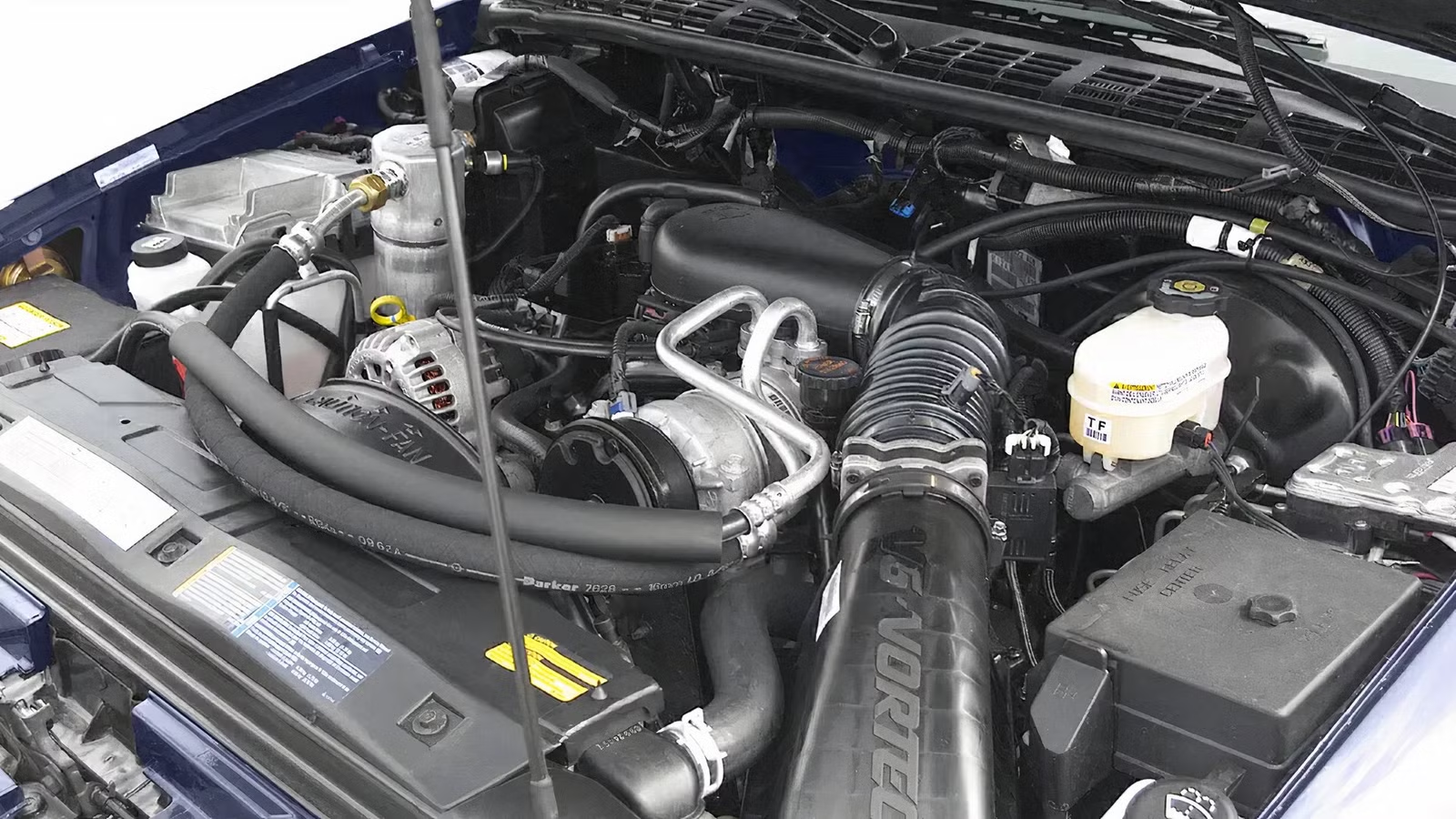
You can’t get much simpler than this: to create the 4.3-liter Vortec 4300 V6, Chevrolet simply removed a pair of cylinders from its small-block V8 engine blueprint. No, two cylinders weren’t literally sawed off, but the simplicity of the decision is virtually the same. It was released in the mid-1980s, and displaced a total of 262 cubic inches. For comparison, the standard small-block Chevy V8 measured in at 350 cubes.
The Vortec 4300 retained much of the same specs as the V8 it was based on, such as bore spacing, cylinder bore, and piston stroke. It also shared many components with its eight-cylinder big brother, making production quite easy for General Motors. While the 90-degree Vortec 4300 wasn’t as naturally balanced as the typical 60-degree V6, it did offer traditional V8 strength in a smaller, more economical package.
The Vortec 4300 Was Far From A Clean-Sheet Design
2003 Chevrolet S-10 XTreme finished in blue with gray interiorCars & Bids
When the 4.3-liter V6 first arrived on GM’s lineup in 1985, it had yet to gain its “Vortec 4300” name. At the time,MotorTrendconsidered the new engine a “3/4 350”, considering its virtually identical nature, apart from its loss of two cylinders. Both the 350 CID V8 and 4.3-liter V6 share a 4.000-inch cylinder bore and a 3.480-inch piston stroke, along with a 4.400-inch bore spacing and a 9.025-inch deck height.
A huge plus-side to GM’s decision to lop two cylinders off its 350 CID engine was parts interchangeability. The 4.3-liter mill utilized the exact same pistons as the V8, along with the same main bearings. Its valvetrain was nearly identical, as well, utilizing many of the same components along with the same timing cover. In the bowels of the engine, you’ll find the exact same oil pump as was found in the 350 CID engine, and the same accessory drive bits, too.
The 4.3-liter’s 90-degree block played a major hand in making things easier for GM production, too. Because the automotive conglomerate already had an immense small-block V8 production ecosystem, the 4.3-liter V6’s identical block shape meant it could be cast by many of the same molds, and existing ones didn’t need to be altered or reshaped all that much.
The parts-sharing extended outside the engine bay, too. Most transmissions made for the 350 CID V8 could bolt directly up to the 4.3-liter V6, making a transmission swap a much easier endeavor. It also made production considerably easier. GM could, effectively, produce the same exact transmission and apply it to multiple applications without having to do virtually anything at all, outside minor alterations here and there for chassis or body fitment.
But all that parts-sharing came with an unwanted side effect – one that Motor Trend would later call a serious flaw.
The Missing Cylinders Created An Odd V6
Flickr
In a four-stroke engine, 720 degrees of crankshaft rotation are required to complete all four stages. So, let’s do the math for a V8 engine. 720 degrees of rotation divided by eight cylinders equals 90 degrees, meaning a combustion stroke must take place every 90 degrees of rotation to equally distribute vibration, as well as create more favorable firing orders. For V6 engines, however, 720 degrees divided by six cylinders equals 120 degrees. Because a 120-degree bank angle would make the engine much too wide, engineers cut that in half, creating the standard 60-degree bank angle found in V6 engines.
Engineers knew this and decided to keep the 350 CID mill’s 90-degree bank angle for the 4.3-liter V6 regardless. This did not bode well for engine smoothness. In order to try and rectify the issue of its unbalanced nature, GM decided to install a split-pin, even-fire crankshaft. Contrarily, older 90-degree V6s built by GM tended to use odd-fire cranks.
1985 GMC Caballero Diablo exteriorBring a Trailer
Complementing the even-fire crankshaft was a set of adjacent connecting rods with offset orientations relative to one another, which differed from the standard rod journal position found in typical V8s. The split-pin crankshaft did manage to solve some of the 4.3-liter’s firing order and balance issues, but not all. Motor Trend ended up referring to the mill as a “shaker.”
However, GM likely was aware of the “shaker” being prone to unsteadiness from the outset, but decided against making any sudden moves to correct it. It wouldn’t be until late 1992 that the engine would finally receive a proper balance shaft. It was thrown into the lifter valley, and designed to counter-rotate with the engine’s camshaft.
But GM’s fix only bought time – the real upgrade wouldn’t come until a decade later, and it changed the engine’s reputation entirely.
Then Came The Vortec 4300
1998-2005 Chevrolet Blazer Front Angle ViewChevrolet
Following its 1985 model-year release, GM kept its basic formula but updated it slightly to move with the times. The earliest versions were equipped with carburetors, as well as throttle-body injection (TBI) offered alongside them. The most basic iteration of the engine produced just 130 horsepower and 205 pound-feet of torque. Come 1995, GM made a significant upgrade to the mill’s fueling by introducing central-port Vortec injection. Hence, the Vortec 4300 was born, and power output was substantially increased.
The Vortec treatment wasn’t only a new name and a new fuel system. Apart from those updates, GM also included revised cylinder heads with better flow, a revised intake system that allowed more air into the engine, and a modernized fuel system. Electronic engine management was introduced, too, which granted much tighter control over fuel and ignition timing.
At the same time, GM’s Vortec engine family expanded rapidly. The 4300 sat as the smallest and only six-cylindered member, with others like the Vortec 5000 V8, 5700 V8, and 7400 V8 making up the rest of the grouping. In 1996, the 4300 V6 produced 195 hp and 250 lb-ft of torque, putting it well ahead of Ford’s equivalent 4.0-liter Cologne V6, which managed only 160 hp and 225 lb-ft of torque.
Like the pre-Vortec 4.3-liter V6, General Motors wasn’t shy about chucking the Vortec 4300 into multiple models. A slew of Chevrolets received it, including the C/K1500-series trucks and later Silverados, the S-10 pickup and Blazer, along with the Express and Astro vans. GMC made widespread use of it, too, in its own C/K1500-series trucks and later Sierras, the Sonoma pickup and Jimmy SUV, along with the Savana and Safari vans.
Models Using The 4.3-Liter V6
Chevrolet C/K-series
Chevrolet S-10
Chevrolet S-10 Blazer
Chevrolet G-series
Chevrolet Astro
Chevrolet Impala
Chevrolet Caprice
Chevrolet El Camino
Chevrolet Monte Carlo
Pontiac Parisienne
Pontiac Grand Prix
GMC S-15 / Sonoma
GMC Caballero
GMC Safari
GMC G-series
GMC C/K-series
GMC S-15 Jimmy
Oldsmobile Bravada
The 4.3 Was One Of GM’s Most Useful Truck Engines
2000 – 2005 GMC Safari – front 3/4 angleGMC
No, it wasn’t refined. It also wasn’t all that fuel efficient. But, the 4.3-liter V6 and later Vortec 4300 were extremely utilitarian, as well as mechanically robust. It also offered a significant advantage for the often cost-conscious GM: it could be deployed wherever a V8 wasn’t strictly necessary, and at lower cost. For example, many folks may need a full-size truck body, but don’t need all the power and towing capacity that a V8 offers.
Its dimensions were entirely small-block V8-derived, which meant GM never had to waste resources designing a new V6 engine family. This also meant small stuff like engine mounts and brackets also worked across both the V6 and multiple V8 engines. The sheer scale of the automotive conglomerate’s V8 engine infrastructure meant the 4.3-liter would never be without ample components or technical expertise on the road, too.
2025 GMC Savana front 3/4 angle in white while parkedGMC
The 4.3-liter also managed to provide a useful middle-ground in terms of capability. It offered considerably more power and usability than a four-cylinder engine, while also achieving better fuel economy than a V8, though only marginally so on average. It was also lighter than the V8, and took up less space in any engine bay it was found in. Those with an affinity for DIY mechanical work can see how that would be a major plus.
1996 chevrolet k1500 front black 3/4 shotBring A Trailer
Most surprising is how long the 4.3-liter V6 has managed to survive. At present, it’s still being produced as the LV1 V6, although its use is limited to only the Chevrolet Express 1500 and GMC Savana 1500 work vans. It can produce up to 297 hp and 330 lb-ft of torque when using E85 fuel.
Again, the 4.3-liter V6 was never all that cool, smooth, or frugal. Instead, it was GM’s ace in the hole for cheap, “good enough” power in light-duty applications that cost much less than a typical clean-sheet engine design to produce.
Sources: General Motors, Motor Trend, Car and Driver, DrivingLine.com.
