

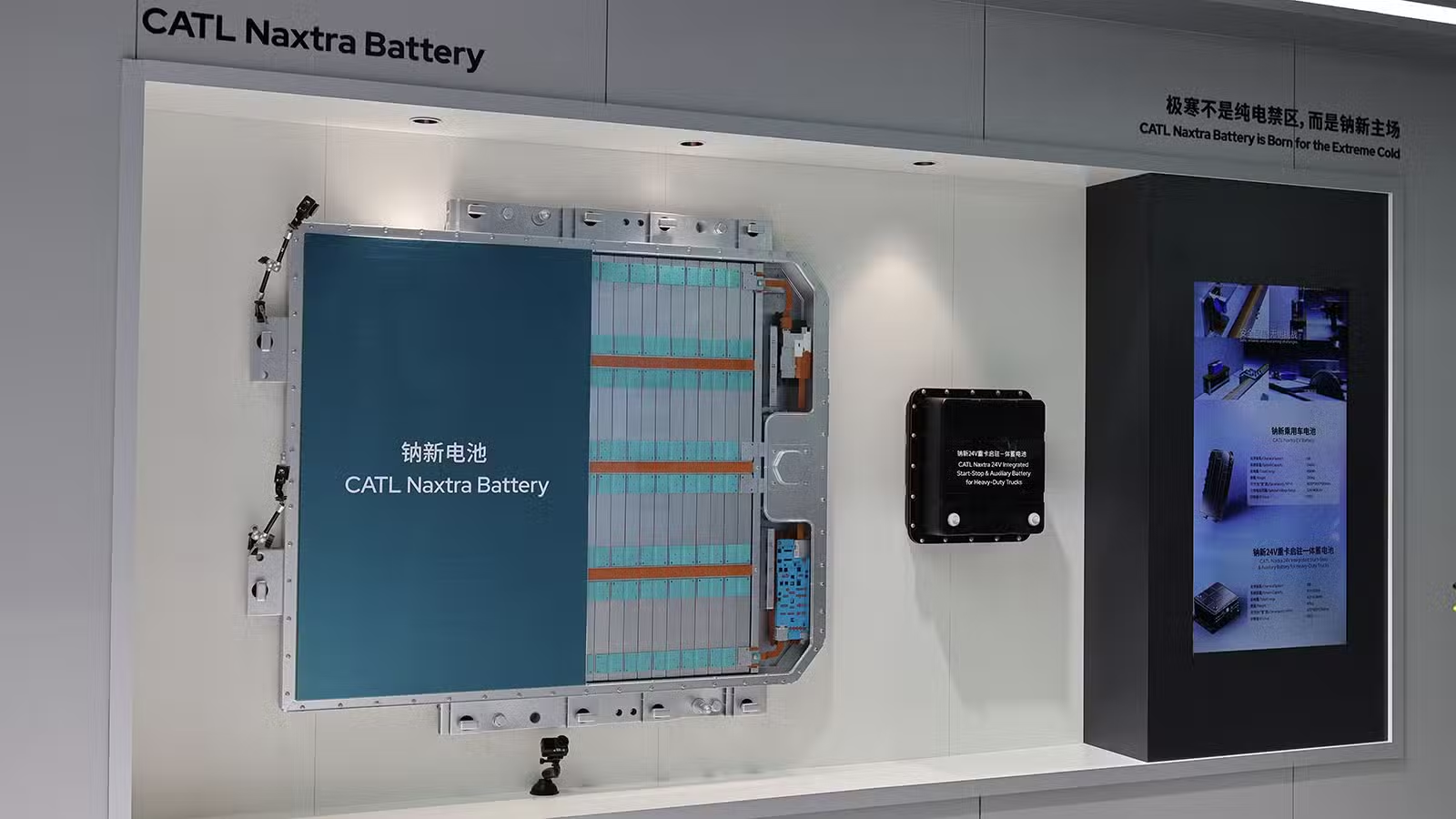
A CATL Naxtra battery pack on display at the Beijing Auto Show in April 2026. Credit: CnEVPost
- A CATL executive said 10,000 to 20,000 EVs are expected to carry the company’s sodium-ion batteries this year.
- The world’s largest battery maker is doubling down on both lithium and sodium technologies.
An executive at CATL (HKEX: 3750) expects 10,000 to 20,000 electric vehicles to carry the company’s sodium-ion batteries this year.
Ni Jun, chief manufacturing officer of the Chinese power battery giant, said in a Bloomberg Television interview on Wednesday that the company’s sodium batteries can operate in temperatures as low as -20C or even -30C.
“We came up with a novel design which can perform at that kind of extreme condition,” he said at the World Economic Forum in the Chinese city of Dalian.
As the world’s largest maker of EV batteries, CATL is ramping up its investment in sodium batteries. The company this week also unveiled a sodium battery energy-storage system.
The system, called Tener Sodium, is slated to begin initial deliveries in China in September, with global deliveries starting in June 2027. It offers improvements in service life and adaptability to extreme temperatures.
These developments underscore CATL’s dual-track strategy of advancing both lithium and sodium battery technologies. A rebound in lithium prices this year has enhanced the competitiveness of sodium-based products, giving the strategic shift greater momentum.
CATL began research and development on sodium batteries in 2016. As of the end of 2025, the company’s cumulative investment in the field had reached nearly 10 billion yuan ($1.47 billion).
The company launched a sodium battery brand called Naxtra in April 2025, beginning to explore alternatives to lithium batteries under the brand. The battery boasts an energy density of up to 175 Wh/kg, on par with mainstream lithium iron phosphate (LFP) batteries.
In February this year, CATL and Changan Automobile jointly unveiled a passenger vehicle equipped with sodium-ion batteries, expected to hit the market in mid-2026. CATL called it the world’s first mass-produced sodium battery passenger car.
EV models fitted with the battery offer a range of up to 400 kilometers. As the supply chain matures, CATL expects the range to rise to between 500 and 600 kilometers.
The main advantages of sodium batteries are better low-temperature performance and lower costs over the long run, as raw materials are more readily available. At -40C, their capacity retention rate still exceeds 90%.
CATL has landed major orders in sodium battery energy storage. In April this year, the company signed a three-year supply agreement with Chinese energy-storage provider HyperStrong for a total capacity of 60 GWh of sodium batteries, setting an industry record.
To support demand, CATL subsequently announced an investment of 5 billion yuan to build 40 GWh of new sodium-ion battery capacity in Fujian.
CATL founder and chairman Robin Zeng has previously told investors that, over the long term, low-cost sodium-ion batteries could replace 30% to 40% of the existing battery market.
FAW Jiefang and Hina Battery completed nearly 7 months of road tests on a sodium-ion battery heavy truck, with cumulative mileage surpassing 15,000 km.
($1 = 6.7905 yuan)
