

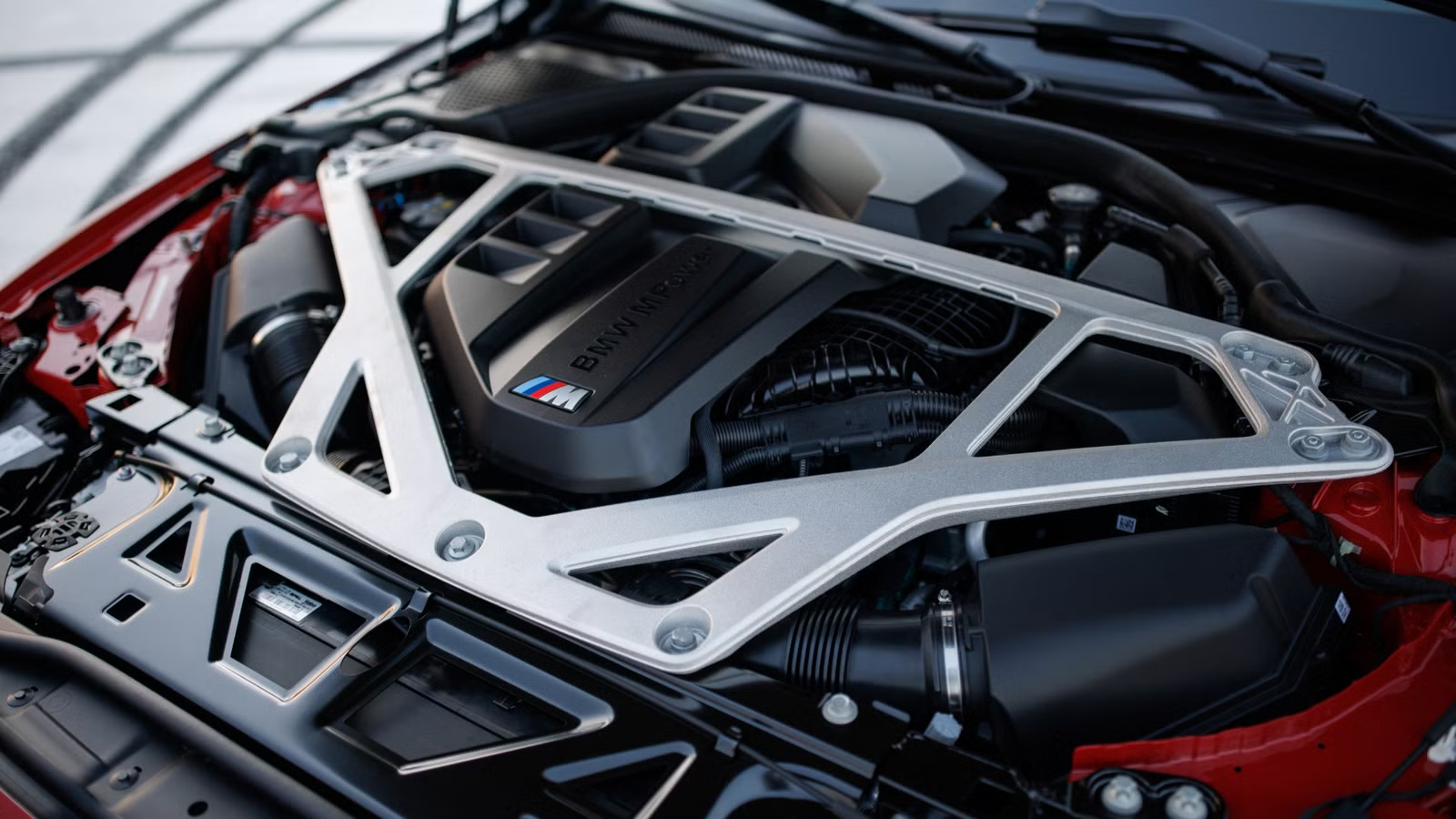
In May of this year, BMW unveiled M Ignite, a new engine technology for the S58 inline-six found in the M3 sedan, and other popular M cars. Production began in July, and cars equipped with the technology are already rolling off the line. Rather than a minor update, M Ignite rewrites how the engine handles combustion, introducing extra spark plugs, extra ignition coils, a higher compression ratio, and more. You’d think all that hardware would liberate at least a few extra horsepower, but you’d be wrong. Despite the extensive changes, output remains exactly the same.
What Exactly Is BMW M Ignite
BMW M Ignite Technology Technical ImageBMW
M Ignite is a form of pre-chamber ignition for gasoline engines, specifically developed for the S58, BMW’s twin-turbocharged 3.0-liter inline-six found in the M2, M3, and M4. Outputs range from 473 horsepower in the M2 and manual-equipped M3 to as high as 543 hp in the limited-edition M3 CS, M4 CS, and M4 CSL.
The technology itself isn’t new, with Honda using a form of pre-chamber ignition in the Civic as early as the mid-1970s. Pre-chamber ignition has also been fine-tuned in racing, including during the current V6 hybrid era of Formula 1. Now, automakers are increasingly using it in production cars as they look for ways to maintain performance amid ever-tightening emissions rules.
Emissions regulations are the main reason BMW has chosen to introduce M Ignite now. According to the automaker, the technology “plays a major role” in meeting the stringent requirements of the Euro 7 standard, which begins to take effect in November. There are fuel savings, too, although they primarily come when driving under high loads, such as during a track day on Germany’s unrestricted autobahns. That’s because M Ignite’s pre-chamber ignition only kicks in at high engine speeds, where it can improve combustion efficiency without sacrificing the performance expected from an M car.
How BMW M Ignite Works
BMW M Ignite Technology Technical ImageBMW
At the heart of M Ignite is a small pre-chamber positioned at the top of each cylinder head. It connects to the main combustion chamber through several small openings and has its own spark plug and ignition coil. In other words, each cylinder effectively gets two ignition systems. At low and medium revs, the conventional spark plug does most of the work. But when the engine is working harder and spinning faster, the pre-chamber system takes over.
Under high loads, some of the air-and-fuel mixture flows into the pre-chamber, where its dedicated spark plug ignites it. The resulting flames shoot through the small openings and into the main combustion chamber at roughly the speed of sound. It means that instead of the air-fuel mix in the cylinder igniting from one point only like in a conventional engine, these jets of flame ignite it in multiple places at once, allowing combustion to happen in a faster, more homogenous manner.
BMW M Ignite Technology Technical ImageBMW
That helps BMW extract more efficiency while also reducing the risk of engine knock, the uncontrolled combustion that can damage an engine. That anti-knock feature is particularly important because BMW has also paired the pre-chamber system with a higher compression ratio, which tends to improve power and efficiency but can also increase the risk of engine knock. But M Ignite isn’t only about improved combustion. It also lowers exhaust-gas temperatures, helping the S58 meet increasingly strict emissions requirements.
On top of all this, BMW has added variable-geometry turbochargers to the updated engine. These feature movable vanes that narrow the passage for the exhaust gases spinning the compressor’s turbine wheel at low revs, accelerating the gases and increasing the turbo’s spool rate, which reduces lag as a result. At higher revs, the vanes widen the passage again, reducing back-pressure on the engine and boosting power at the top end.
Same Power Today, More Potential Tomorrow
2026 BMW M3 Sedan Front ViewBMW
BMW has stated that M Ignite won’t increase the output of the engines it is being applied to. On the surface, that may seem disappointing given the amount of engineering involved, but enthusiasts should still be encouraged. Along with the gains in efficiency, throttle response, and emissions performance, BMW says the technology will help keep its high-performance internal-combustion engines on sale in the years ahead without resorting to more drastic measures like electrification. In other words, M Ignite isn’t about making today’s M3 faster. It’s about ensuring there can still be a gasoline-powered M3 tomorrow.
That’s particularly important because a new-generation M3 is due next year, and for the first time, buyers will be able to choose between internal-combustion and electric power. BMW previewed the design of the electric version earlier this year with the M Concept Neue Klasse.
The automaker could have easily followed the path many rivals are taking and gone all-in on EVs, especially as much of the industry continues to bet on an electric future. Instead, BMW has chosen to keep investing in ICE performance for enthusiasts who still prefer the sound, feel, and character of an inline-six. That’s a positive sign for anyone not ready to give up on combustion power.
Goodwood Festival of SpeedMichal Okonski/CarBuzz/Valnet
There’s also a good chance BMW is simply saving any meaningful power increases for the next-generation gas M3, which will very likely use the latest version of the S58. The updated engine and its M Ignite technology should also bode well for a future M2, which is expected to retain an inline-six engine. The current 2 Series, which underpins the M2, has been around since the 2022 model year and, following BMW tradition, should be due for a redesign around the end of the decade.
The future of the 4 Series and M4 is less certain. An electric 4 Series has already been spotted testing, and rumors suggest the current gas-powered model could receive an extended lifespan before eventually being phased out toward the end of the decade.
Still An Exclusive Club
2026 BMW M3 Sedan Rear ViewBMW
Despite the positives, the updated S58 highlights a worrying trend for internal combustion engines. As emission regulations tighten, automakers are being forced to add ever more complexity just to maintain existing levels of performance. That reality will likely push more brands to reduce their combustion-engine offerings, while the engines that remain could become more expensive, not only to build but also to maintain and repair.
M Ignite itself introduces additional hardware and new potential failure points, including extreme heat inside the pre-chamber and the possibility of carbon buildup in the tiny openings linking it to the combustion chamber. Over time, those conditions could affect performance and place additional stress on components such as pistons, piston rings, and head gaskets. It’s why automakers thus far have been largely reluctant to introduce the technology.
Maserati Nettuno V6 DrawingMaserati
Stellantis recently introduced pre-chamber ignition on its new Hurricane 4 turbocharged 2.0-liter inline-four, which debuted in the 2026 Jeep Grand Cherokee and is considered the first high-volume engine with the technology. Maserati was earlier, albeit with limited use only. The fellow Stellantis brand has used the technology in its Nettuno twin-turbocharged 3.0-liter V6 since the launch of the MC20 supercar for the 2021 model year. That engine now powers the MCPura, the updated version of the MC20 introduced for 2025.
Keeping Combustion Alive, At A Cost
2026 BMW M3 Sedan Rear ViewBMW
All this added complexity, including six extra spark plugs, dual ignition systems, variable-geometry turbos, and a higher compression ratio, buys the S58 exactly zero additional horsepower, at least for now. The real payoff is efficiency under load and Euro 7 compliance, buying BMW time to keep pure combustion M cars alive.
While pre-chamber ignition remains relatively rare, its growing use at BMW and other automakers signals it will likely spread as regulations tighten further. That is both encouraging and concerning, as the technology can extend the life of engaging gasoline engines enthusiasts still want, yet the rising complexity and cost risk pushing more automakers to simply offer fewer combustion models in the future.
Sources: BMW
