

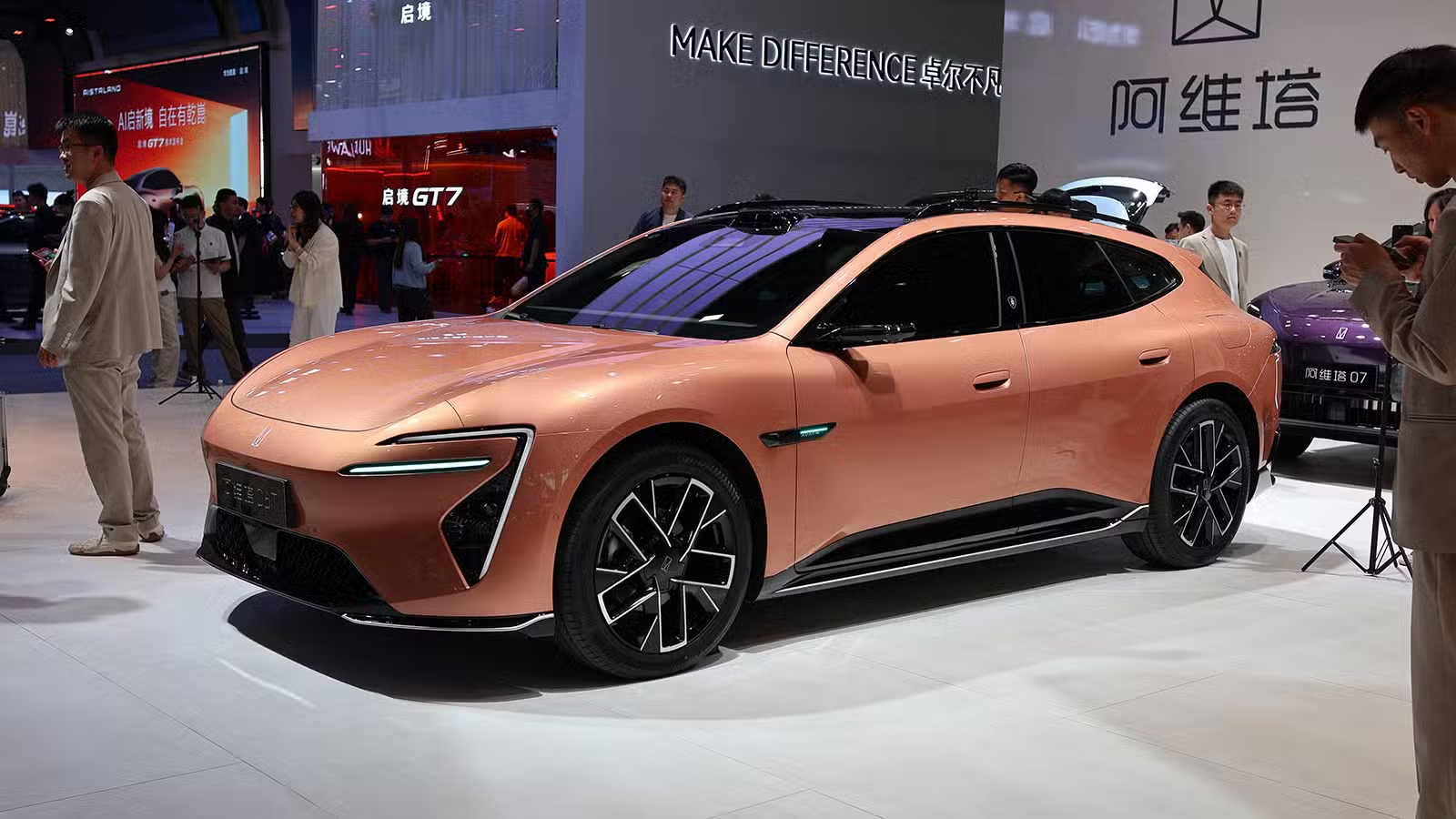
An Avatr 06T on display at the Beijing Auto Show in April 2026. Credit: CnEVPost
- Avatr has updated its prospectus and refiled for a Hong Kong listing, after the earlier version lapsed upon expiry of its six-month validity.
- The company sold about 4,032 vehicles a month on average in the first five months of this year, far below leading EV startups.
Avatr Technology, the electric vehicle (EV) brand jointly built by Changan Automobile (SZSE: 000625), Huawei and CATL (HKEX: 3750), is accelerating its push for a Hong Kong listing.
Avatr has updated its prospectus and refiled its application for a main board listing, according to a disclosure on the Hong Kong Stock Exchange’s website on June 30.
The company’s earlier prospectus, submitted in November 2025, formally lapsed in May upon the expiry of its six-month validity.
The move shows that Avatr is pushing ahead with its listing, and trying to speed up the process toward a flotation. It has also updated its financial data through the end of 2025.
Still, one focus of market attention is its sales scale. The prospectus shows Avatr sold a total of 20,160 vehicles from January to May 2026, including 2,949 units in overseas markets.
That works out to average monthly sales of about 4,030 units. By comparison, leading Chinese EV startups such as Nio Inc (NYSE: NIO) and Xpeng (NYSE: XPEV) saw monthly sales climb to 40,000 units in June.
Avatr has yet to release its June delivery figures, as other EV makers have.
Judging from its financial data, it will be difficult for Avatr to achieve explosive growth in the short term. From 2022 to 2025, the company’s cumulative losses exceeded 13.2 billion yuan ($1.9 billion).
In its prospectus, the company said it may continue to record a net loss for the year ending December 31, 2026.
Behind the losses lies a cost disadvantage stemming from insufficient scale. In 2025, the cost of sales still accounted for as much as 90.6% of revenue.
Avatr acknowledged in its prospectus that its relatively small purchasing volume limits its bargaining power with parts suppliers, weighing on gross margin.
Its gross margin was 9.4% in 2025. While that marked an improvement from 6.3% in 2024, it remains low within the industry.
By comparison, Nio’s gross margin was 19.0% in the first quarter of this year.
On cash flow, Avatr’s cash and cash equivalents fell to 9.69 billion yuan at the end of 2025, from 19.32 billion yuan a year earlier.
As of April 30, 2026, that figure had further dropped to 6.25 billion yuan.
Despite the pressure on sales, the latest prospectus also shows some signs of improvement.
In 2025, the company’s revenue reached 25.63 billion yuan, up about 4.5 times over three years.
Gross profit surged 151.7% to 2.42 billion yuan in 2025, while the net loss narrowed to 3.49 billion yuan.
In addition, in 2025 the company made a strategic investment of 11.5 billion yuan for a 10% stake in Yinwang (or Newcool), Huawei’s intelligent automotive business unit, booking 182 million yuan in profit from the associate in the first year.
Overseas operations are another bright spot. As of the end of 2025, Avatr had set up more than 80 sales outlets across 38 countries and regions.
However, Changan is pushing to integrate another sub-brand, Deepal, with Avatr, adding fresh uncertainty to the company’s premium positioning.
If product boundaries cannot be clearly defined after the integration, it could easily trigger internal homogeneous competition, diluting Avatr’s premium image.
($1 = 6.7855 yuan)
