

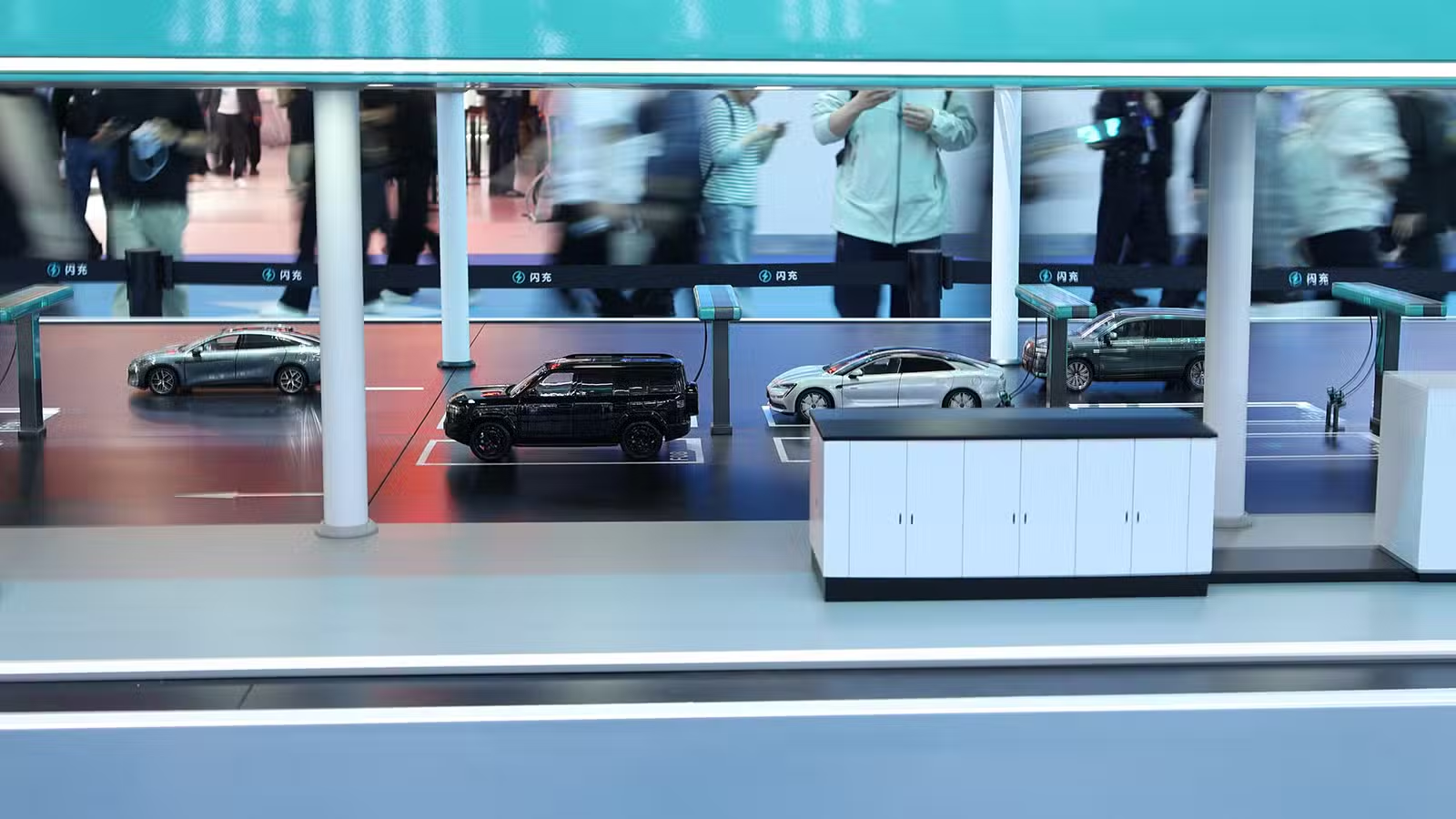
A mock-up of BYD’s flash-charging station displayed at the Beijing Auto Show in April 2026. Credit: CnEVPost
- Guangdong province aims to build over 3 million charging facilities by the end of 2027 to meet the demand of 8 million NEVs.
- The move will benefit automakers headquartered in the province, including BYD, Xpeng, and GAC.
The southern Chinese economic powerhouse of Guangdong has unveiled an ambitious infrastructure plan to further boost the province’s electric vehicle (EV) industry.
Guangdong plans to build a cumulative total of over 3 million EV charging facilities by the end of 2027. This aggressive target is designed to meet the massive charging demand of more than 8 million new energy vehicles (NEVs) in the future.
The action plan, jointly issued on Monday by eight departments including the Guangdong Provincial Development and Reform Commission, marks a major effort by the Chinese local government to eliminate range anxiety.
One of the core objectives of the plan is to achieve full coverage of supercharging stations across all counties in the province. By 2027, the number of supercharging stations in Guangdong will officially surpass that of traditional gas stations.
Guangdong is China’s most populous province, with a population of 129 million as of 2025, official statistics show.
It is also a core hub for the global EV industry, home to automakers such as NEV giant BYD, as well as GAC (HKEX: 2238) and Xpeng (NYSE: XPEV). This latest move by the local government will provide a significant tailwind for these domestic carmakers.
Guangdong is promoting the popularization of high-power charging networks. The province plans to focus on developing facilities with a single-gun charging power of more than 250 kilowatts (kW).
The government encourages the construction of superchargers of 480 kW and above, and even megawatt-level flash charging facilities exceeding 1,000 kW.
By the end of 2027, Guangdong plans to add more than 10,000 high-power charging guns cumulatively.
To achieve this goal, the government will concentrate on deploying them in high-frequency scenarios such as highways, airports, and commercial centers.
This government blueprint is highly aligned with the technological roadmaps of local automakers. Take BYD for example: the NEV giant just released the world’s most powerful mass-produced flash charger in March this year, boasting a single-gun charging power of up to 1,500 kW, representing the industry’s highest technological level.
BYD’s “Flash Charging China” strategy is advancing rapidly nationwide, with plans to build 20,000 flash charging stations by the end of this year.
Beyond urban core areas, Guangdong’s plan also pays special attention to network coverage on highways and in rural areas.
By the end of 2027, more than 10,800 charging facilities will be built in highway service areas across Guangdong. Meanwhile, the government will also push for the extension of charging infrastructure to key rural tourism towns and typical villages.
A massive vehicle fleet provides the fundamental confidence for Guangdong’s plan. As of 2023, the province’s motor vehicle ownership had surpassed 41 million units.
As the NEV penetration rate continues to climb in cities like Guangzhou and Shenzhen, the carrying capacity of the traditional power grid is also facing a test.
In response, Guangdong plans to vigorously promote the large-scale application of vehicle-to-grid (V2G) technology. By the end of 2027, the province will have built over 2,500 V2G facilities cumulatively.
These bi-directional charging and discharging facilities will allow EVs to send power back to the grid during peak hours. The government expects the reverse discharge volume to exceed 3 million kilowatt-hours.
BYD signed an agreement with Sinopec to advance the construction of its flash charging stations by relying on the latter’s massive network.
